 Add to Chrome
 Add to Firefox
 Add to Edge
Clustered Federated Learning with Hierarchical Knowledge Distillation
Dec 11, 2025
Clustered Federated Learning (CFL) has emerged as a powerful approach for addressing data heterogeneity and ensuring privacy in large distributed IoT environments. By clustering clients and training cluster-specific models, CFL enables personalized models tailored to groups of heterogeneous clients. However, conventional CFL approaches suffer from fragmented learning for training independent global models for each cluster and fail to take advantage of collective cluster insights. This paper advocates a shift to hierarchical CFL, allowing bi-level aggregation to train cluster-specific models at the edge and a unified global model at the cloud. This shift improves training efficiency yet might introduce communication challenges. To this end, we propose CFLHKD, a novel personalization scheme for integrating hierarchical cluster knowledge into CFL. Built upon multi-teacher knowledge distillation, CFLHKD enables inter-cluster knowledge sharing while preserving cluster-specific personalization. CFLHKD adopts a bi-level aggregation to bridge the gap between local and global learning. Extensive evaluations of standard benchmark datasets demonstrate that CFLHKD outperforms representative baselines in cluster-specific and global model accuracy and achieves a performance improvement of 3.32-7.57\%.

Autoencoder-based Condition Monitoring and Anomaly Detection Method for Rotating Machines
Jan 27, 2021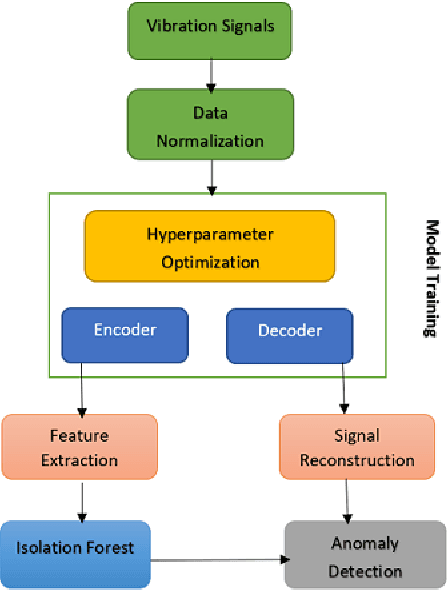
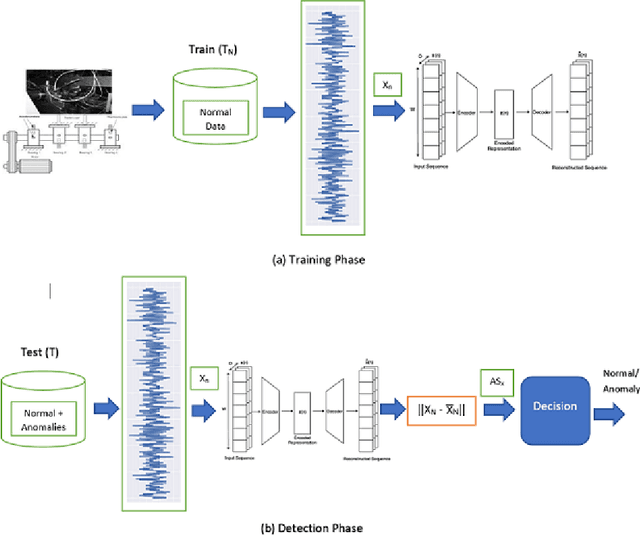
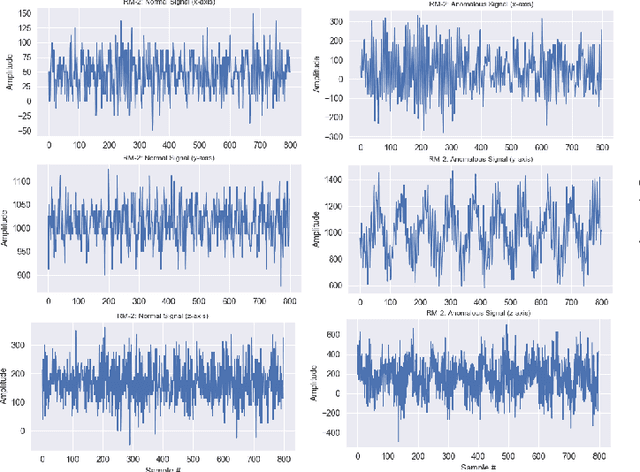
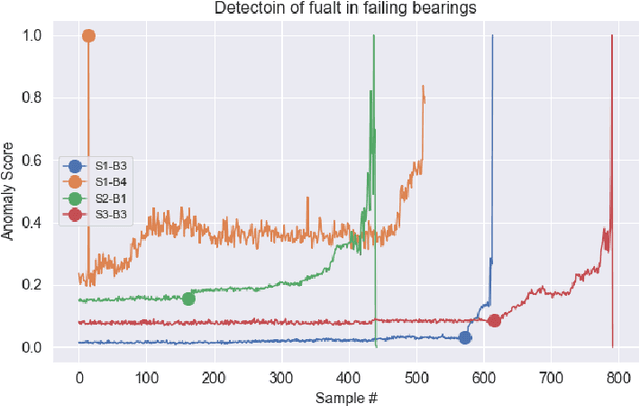
Rotating machines like engines, pumps, or turbines are ubiquitous in modern day societies. Their mechanical parts such as electrical engines, rotors, or bearings are the major components and any failure in them may result in their total shutdown. Anomaly detection in such critical systems is very important to monitor the system's health. As the requirement to obtain a dataset from rotating machines where all possible faults are explicitly labeled is difficult to satisfy, we propose a method that focuses on the normal behavior of the machine instead. We propose an autoencoder model-based method for condition monitoring of rotating machines by using an anomaly detection approach. The method learns the characteristics of a rotating machine using the normal vibration signals to model the healthy state of the machine. A threshold-based approach is then applied to the reconstruction error of unseen data, thus enabling the detection of unseen anomalies. The proposed method can directly extract the salient features from raw vibration signals and eliminate the need for manually engineered features. We demonstrate the effectiveness of the proposed method by employing two rotating machine datasets and the quality of the automatically learned features is compared with a set of handcrafted features by training an Isolation Forest model on either of these two sets. Experimental results on two real-world datasets indicate that our proposed solution gives promising results, achieving an average F1-score of 99.6%.