 Add to Chrome
 Add to Firefox
 Add to Edge
Optimal Derivative Feedback Control for an Active Magnetic Levitation System: An Experimental Study on Data-Driven Approaches
Feb 06, 2026
This paper presents the design and implementation of data-driven optimal derivative feedback controllers for an active magnetic levitation system. A direct, model-free control design method based on the reinforcement learning framework is compared with an indirect optimal control design derived from a numerically identified mathematical model of the system. For the direct model-free approach, a policy iteration procedure is proposed, which adds an iteration layer called the epoch loop to gather multiple sets of process data, providing a more diverse dataset and helping reduce learning biases. This direct control design method is evaluated against a comparable optimal control solution designed from a plant model obtained through the combined Dynamic Mode Decomposition with Control (DMDc) and Prediction Error Minimization (PEM) system identification. Results show that while both controllers can stabilize and improve the performance of the magnetic levitation system when compared to controllers designed from a nominal model, the direct model-free approach consistently outperforms the indirect solution when multiple epochs are allowed. The iterative refinement of the optimal control law over the epoch loop provides the direct approach a clear advantage over the indirect method, which relies on a single set of system data to determine the identified model and control.

Probabilistic Safety Guarantee for Stochastic Control Systems Using Average Reward MDPs
Nov 11, 2025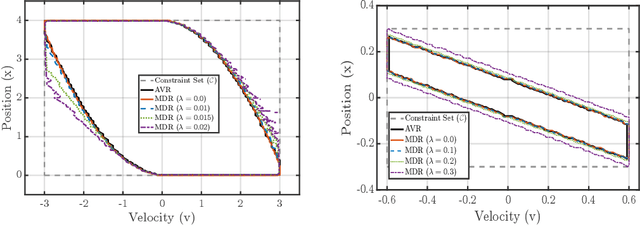
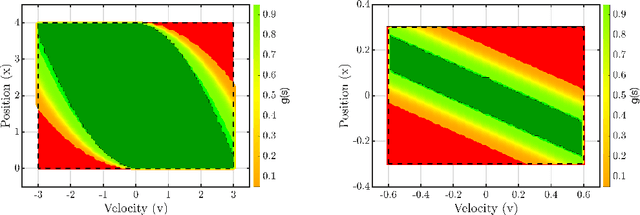
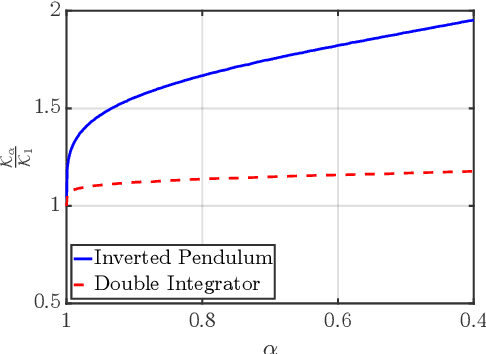
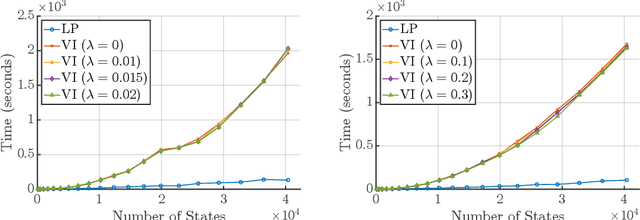
Safety in stochastic control systems, which are subject to random noise with a known probability distribution, aims to compute policies that satisfy predefined operational constraints with high confidence throughout the uncertain evolution of the state variables. The unpredictable evolution of state variables poses a significant challenge for meeting predefined constraints using various control methods. To address this, we present a new algorithm that computes safe policies to determine the safety level across a finite state set. This algorithm reduces the safety objective to the standard average reward Markov Decision Process (MDP) objective. This reduction enables us to use standard techniques, such as linear programs, to compute and analyze safe policies. We validate the proposed method numerically on the Double Integrator and the Inverted Pendulum systems. Results indicate that the average-reward MDPs solution is more comprehensive, converges faster, and offers higher quality compared to the minimum discounted-reward solution.