 Add to Chrome
 Add to Firefox
 Add to Edge
The Role of Natural Language Understanding in Multimodal Video-Based Dengue Diagnosis
Aug 13, 2026
Detecting infection-related behavioral changes in mosquitoes from video data is challenging because mosquitoes are small, move rapidly and irregularly, and are affected by environmental factors such as background, lighting, and shadows, which can make reliable feature extraction difficult. In this study, a YOLO- and Contrastive Language-Image Pre-training (CLIP)-based vision-language framework is proposed to classify mosquito flight frames of uninfected and Dengue virus serotype 2 (DENV2)-infected mosquitoes. First, YOLO is used to isolate mosquito regions from the background. Then, visual features extracted from video frames are aligned with biologically meaningful textual prompts in a shared embedding space. The multimodal model was fine-tuned using supervised bidirectional contrastive learning and evaluated through frame-level image-text similarity-based classification. The results show that the proposed method achieved 98.54% accuracy and 99.91% sensitivity at the frame level. After temporal aggregation of frame-level information, the model achieved complete video-level performance. The ablation results showed that fine-tuning and CLIP-based representations were essential for this domain, while the textual branch provided semantic image-text alignment rather than an accuracy advantage over the vision-only model. These findings suggest that vision-language models can provide a useful framework for analyzing infection-related biological behaviors from video data.

A Hybrid Framework of Vision Transformer and Gated Recurrent Unit for Detection of Mosquito Diseases
Aug 12, 2026Identifying dengue virus-infected mosquitoes from control mosquitoes is a major challenge in analyzing mosquito locomotion behavior due to the small size and complexity of the video background. Conventional AI methods are often unable to extract accurate features from video frames and produce erroneous features. In this study, a three-step framework is introduced: first, mosquitoes are identified and the background is removed using the YOLO 11M model, then visual features are extracted using the Vision Transformer (ViT), and finally the videos are classified with a convolutional GRU (ConvGRU) classifier. A comparative analysis of different models, including Recurrent Neural Network (RNN), Long Short-Term Memory (LSTM), Gated Recurrent Unit (GRU), and their convolutional versions showed that the ConvGRU model achieved the best performance; it achieved 88.88% accuracy, 84.45% precision, 82.82% recall, and 82.81% F1 score. These results demonstrate that combining convolutional models with sequence-based networks, especially in the ConvGRU model, allows the simultaneous extraction of precise spatial features and long-term temporal dependencies from mosquito movements. Finally, the proposed framework provides a reliable solution for analyzing mosquito behavior in complex environments.
Brain Ageing Prediction using Isolation Forest Technique and Residual Neural Network (ResNet)
Dec 26, 2024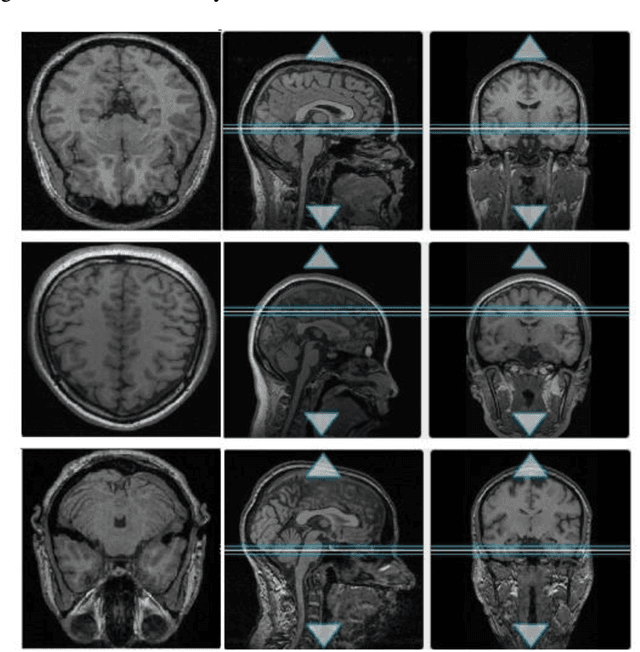
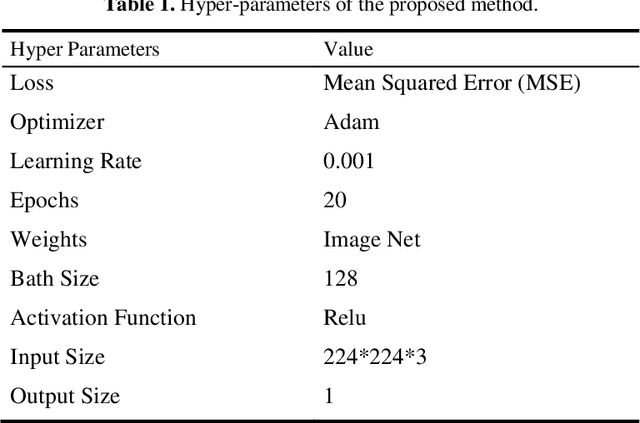
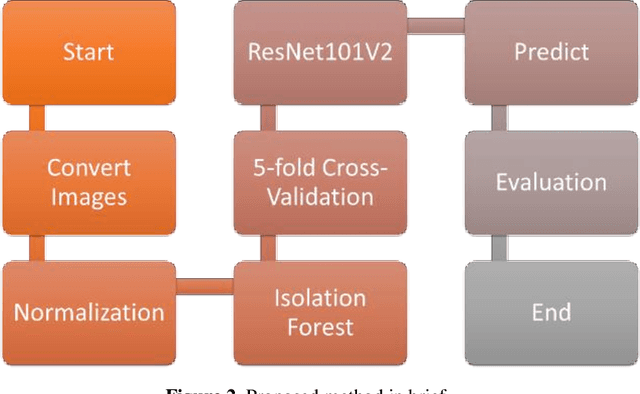
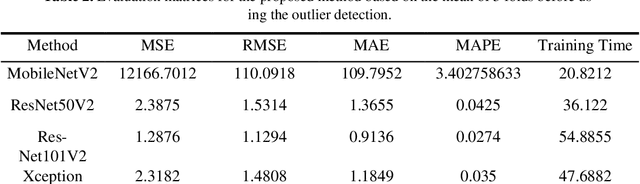
Brain aging is a complex and dynamic process, leading to functional and structural changes in the brain. These changes could lead to the increased risk of neurodegenerative diseases and cognitive decline. Accurate brain-age estimation utilizing neuroimaging data has become necessary for detecting initial signs of neurodegeneration. Here, we propose a novel deep learning approach using the Residual Neural Network 101 Version 2 (ResNet101V2) model to predict brain age from MRI scans. To train, validate and test our proposed model, we used a large dataset of 2102 images which were selected randomly from the International Consortium for Brain Mapping (ICBM). Next, we applied data preprocessing techniques, including normalizing the images and using outlier detection via Isolation Forest method. Then, we evaluated various pre-trained approaches (namely: MobileNetV2, ResNet50V2, ResNet101V2, Xception). The results demonstrated that the ResNet101V2 model has higher performance compared with the other models, attaining MAEs of 0.9136 and 0.8242 years for before and after using Isolation Forest process. Our method achieved a high accuracy in brain age estimation in ICBM dataset and it provides a reliable brain age prediction.