 Add to Chrome
 Add to Firefox
 Add to Edge
The Role of Natural Language Understanding in Multimodal Video-Based Dengue Diagnosis
Aug 13, 2026
Detecting infection-related behavioral changes in mosquitoes from video data is challenging because mosquitoes are small, move rapidly and irregularly, and are affected by environmental factors such as background, lighting, and shadows, which can make reliable feature extraction difficult. In this study, a YOLO- and Contrastive Language-Image Pre-training (CLIP)-based vision-language framework is proposed to classify mosquito flight frames of uninfected and Dengue virus serotype 2 (DENV2)-infected mosquitoes. First, YOLO is used to isolate mosquito regions from the background. Then, visual features extracted from video frames are aligned with biologically meaningful textual prompts in a shared embedding space. The multimodal model was fine-tuned using supervised bidirectional contrastive learning and evaluated through frame-level image-text similarity-based classification. The results show that the proposed method achieved 98.54% accuracy and 99.91% sensitivity at the frame level. After temporal aggregation of frame-level information, the model achieved complete video-level performance. The ablation results showed that fine-tuning and CLIP-based representations were essential for this domain, while the textual branch provided semantic image-text alignment rather than an accuracy advantage over the vision-only model. These findings suggest that vision-language models can provide a useful framework for analyzing infection-related biological behaviors from video data.

SSI-GAN: Semi-Supervised Swin-Inspired Generative Adversarial Networks for Neuronal Spike Classification
Jan 01, 2026Mosquitos are the main transmissive agents of arboviral diseases. Manual classification of their neuronal spike patterns is very labor-intensive and expensive. Most available deep learning solutions require fully labeled spike datasets and highly preprocessed neuronal signals. This reduces the feasibility of mass adoption in actual field scenarios. To address the scarcity of labeled data problems, we propose a new Generative Adversarial Network (GAN) architecture that we call the Semi-supervised Swin-Inspired GAN (SSI-GAN). The Swin-inspired, shifted-window discriminator, together with a transformer-based generator, is used to classify neuronal spike trains and, consequently, detect viral neurotropism. We use a multi-head self-attention model in a flat, window-based transformer discriminator that learns to capture sparser high-frequency spike features. Using just 1 to 3% labeled data, SSI-GAN was trained with more than 15 million spike samples collected at five-time post-infection and recording classification into Zika-infected, dengue-infected, or uninfected categories. Hyperparameters were optimized using the Bayesian Optuna framework, and performance for robustness was validated under fivefold Monte Carlo cross-validation. SSI-GAN reached 99.93% classification accuracy on the third day post-infection with only 3% labeled data. It maintained high accuracy across all stages of infection with just 1% supervision. This shows a 97-99% reduction in manual labeling effort relative to standard supervised approaches at the same performance level. The shifted-window transformer design proposed here beat all baselines by a wide margin and set new best marks in spike-based neuronal infection classification.
A Cyber-Physical Architecture for Microgrids based on Deep learning and LORA Technology
Dec 16, 2023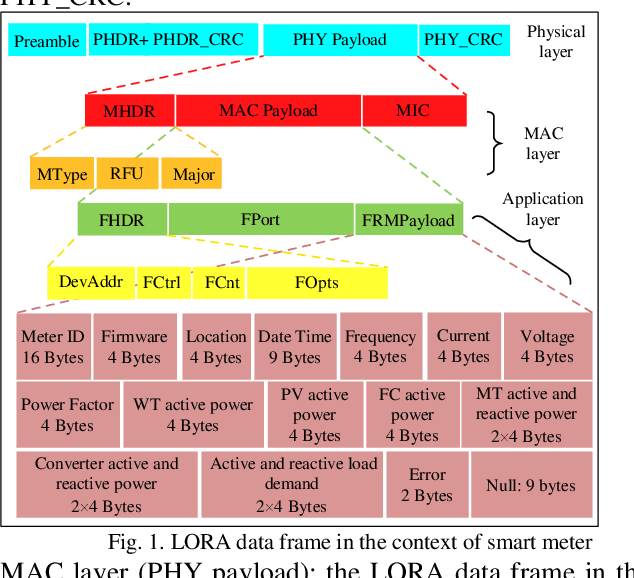
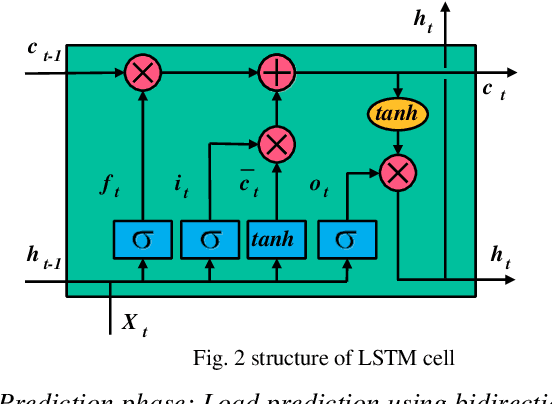
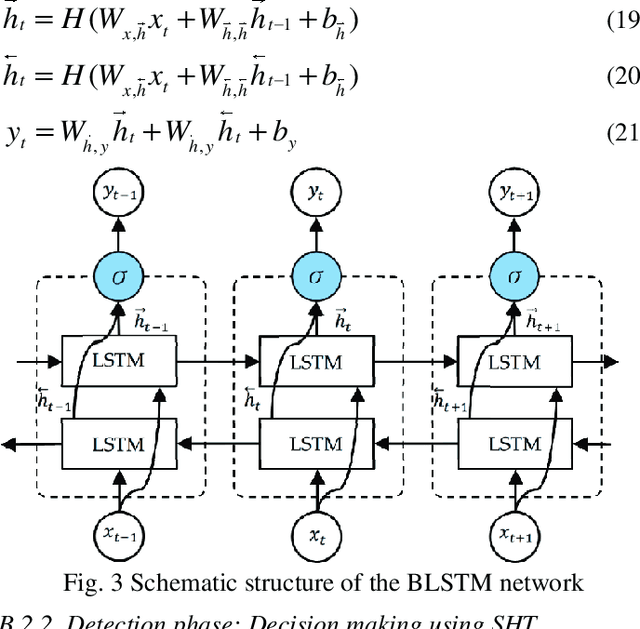
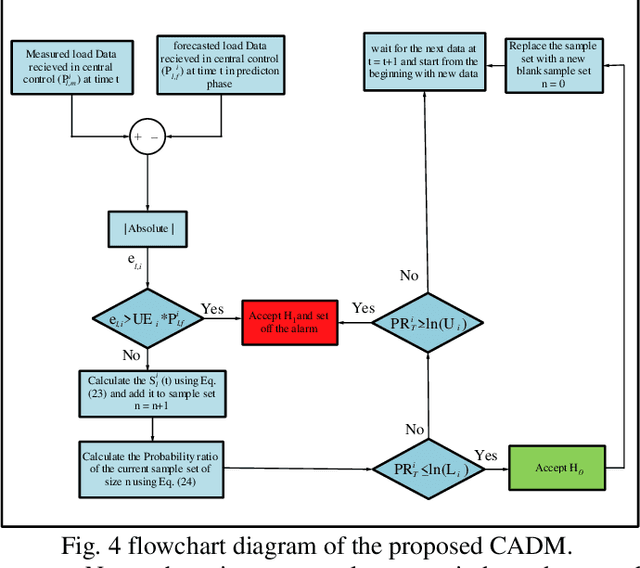
This paper proposes a cyber-physical architecture for the secured social operation of isolated hybrid microgrids (HMGs). On the physical side of the proposed architecture, an optimal scheduling scheme considering various renewable energy sources (RESs) and fossil fuel-based distributed generation units (DGs) is proposed. Regarding the cyber layer of MGs, a wireless architecture based on low range wide area (LORA) technology is introduced for advanced metering infrastructure (AMI) in smart electricity grids. In the proposed architecture, the LORA data frame is described in detail and designed for the application of smart meters considering DGs and ac-dc converters. Additionally, since the cyber layer of smart grids is highly vulnerable to cyber-attacks, t1his paper proposes a deep-learning-based cyber-attack detection model (CADM) based on bidirectional long short-term memory (BLSTM) and sequential hypothesis testing (SHT) to detect false data injection attacks (FDIA) on the smart meters within AMI. The performance of the proposed energy management architecture is evaluated using the IEEE 33-bus test system. In order to investigate the effect of FDIA on the isolated HMGs and highlight the interactions between the cyber layer and physical layer, an FDIA is launched against the test system. The results showed that a successful attack can highly damage the system and cause widespread load shedding. Also, the performance of the proposed CADM is examined using a real-world dataset. Results prove the effectiveness of the proposed CADM in detecting the attacks using only two samples.
Deep Learning-Based Cyber-Attack Detection Model for Smart Grids
Dec 14, 2023In this paper, a novel artificial intelligence-based cyber-attack detection model for smart grids is developed to stop data integrity cyber-attacks (DIAs) on the received load data by supervisory control and data acquisition (SCADA). In the proposed model, first the load data is forecasted using a regression model and after processing stage, the processed data is clustered using the unsupervised learning method. In this work, in order to achieve the best performance, three load forecasting methods (i.e. extra tree regression (ETR), long short-term memory (LSTM) and bidirectional long short-term memory (BiLSTM)) are utilized as regression models and their performance is compared. For clustering and outlying detection, the covariance elliptic envelope (EE) is employed as an unsupervised learning method. To examine the proposed model, the hourly load data of the power company of the city of Johor in Malaysia is employed and Two common DIAs, which are DIAs targeting economic loss and DIAs targeting blackouts, are used to evaluate the accuracy of detection methods in several scenarios. The simulation results show that the proposed EE-BiLSTM method can perform more robust and accurate compared to the other two methods.