 Add to Chrome
 Add to Firefox
 Add to Edge
Toward Deployable Bangla Sign Language Recognition with Expert-Validated Data and a Lightweight Attention-Based Model
Aug 06, 2026
Deaf and hard-of-hearing people in Bangladesh communicate mainly through Bangla Sign Language (BdSL). Automatic BdSL recognition on personal devices could widen access to education and services. Existing systems use controlled-setting datasets without expert verification and heavyweight pretrained backbones unsuited to on-device use. We introduce RSBdSL38, 10,874 expert-validated images spanning all 38 BdSL hand signs, representing the 51 letters of the Bangla alphabet, recorded from real signers at three special-needs schools across Bangladesh. We propose a lightweight attention based convolutional network of 298,470 parameters, built from grouped bottleneck residual blocks, channel and spatial attention, a multi-scale depthwise hand-feature block, dual pooling, and Swish activations. Trained from scratch, it attains 96.37% accuracy (95.72% +- 0.54% over five seeds), within 1.08 percentage points of the best of nine ImageNet-pretrained efficient architectures under an identical protocol, using 8.5 to 68x fewer parameters and 1.3 to 21.7x fewer MACs. Retrained, it reaches 92.95 to 98.33% on six public BdSL benchmarks, 97.04% on a merged corpus, and 76.25% zero-shot on BdSL-38. Removing any architectural stage costs 7.61 to 89.30 points, against at most 3.17 for the training recipe. Grad-CAM with deletion-insertion and weight-randomization checks confirms that predictions follow the signing hand. A signer-independent split holding out 6 of 36 signers yields 85.18%. Quantized to 0.48 MB, it runs at 3.98 ms per image within a 15.5 MB footprint on a commodity smartphone. Together, RSBdSL38 and our from-scratch model turn benchmark accuracy into deployable accessibility at a fraction of pretrained-backbone cost; dataset, code, and models are released.

MS-SSE-Net: A Multi-Scale Spatial Squeeze-and-Excitation Network for Structural Damage Detection in Civil and Geotechnical Engineering
Apr 16, 2026Structural damage detection is essential for maintaining the safety and reliability of civil infrastructure. However, accurately identifying different types of structural damage from images remains challenging due to variations in damage patterns and environmental conditions. To address these challenges, this paper proposes MS-SSE-Net, a novel deep learning (DL) framework for structural damage classification. The proposed model is built upon the DenseNet201 backbone and integrates novel multi-scale feature extraction with channel and spatial attention mechanisms (MS-SSE-Net). Specifically, parallel depthwise convolutions capture both local and contextual features, while squeeze-and-excitation style channel attention and spatial attention emphasize informative regions and suppress irrelevant noise. The refined features are then processed through global average pooling and a fully connected classification layer to generate the final predictions. Experiments are conducted on the StructDamage dataset containing multiple structural damage categories. The proposed MS-SSE-Net demonstrates superior performance compared with the baseline DenseNet201 and other comparative approaches. Specifically, the proposed method achieves 99.31% precision, 99.25% recall, 99.27% F1-score, and 99.26% accuracy, outperforming the baseline model which achieved 98.62% precision, 98.53% recall, 98.58% F1-score, and 98.53% accuracy.
Memory-efficient Energy-adaptive Inference of Pre-Trained Models on Batteryless Embedded Systems
May 16, 2024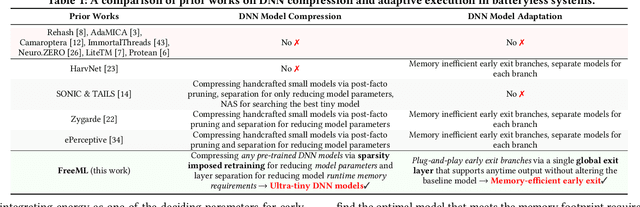
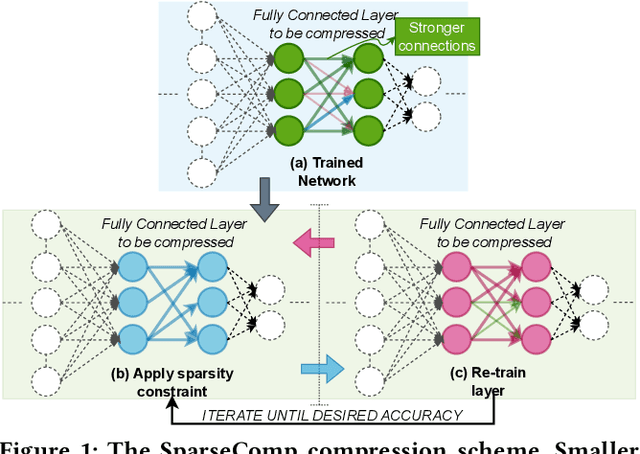
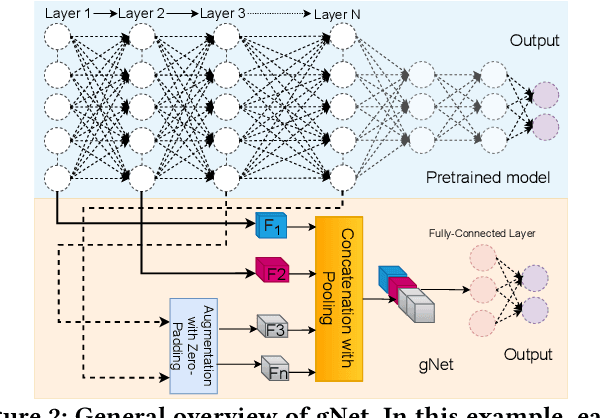
Batteryless systems frequently face power failures, requiring extra runtime buffers to maintain inference progress and leaving only a memory space for storing ultra-tiny deep neural networks (DNNs). Besides, making these models responsive to stochastic energy harvesting dynamics during inference requires a balance between inference accuracy, latency, and energy overhead. Recent works on compression mostly focus on time and memory, but often ignore energy dynamics or significantly reduce the accuracy of pre-trained DNNs. Existing energy-adaptive inference works modify the architecture of pre-trained models and have significant memory overhead. Thus, energy-adaptive and accurate inference of pre-trained DNNs on batteryless devices with extreme memory constraints is more challenging than traditional microcontrollers. We combat these issues by proposing FreeML, a framework to optimize pre-trained DNN models for memory-efficient and energy-adaptive inference on batteryless systems. FreeML comprises (1) a novel compression technique to reduce the model footprint and runtime memory requirements simultaneously, making them executable on extremely memory-constrained batteryless platforms; and (2) the first early exit mechanism that uses a single exit branch for all exit points to terminate inference at any time, making models energy-adaptive with minimal memory overhead. Our experiments showed that FreeML reduces the model sizes by up to $95 \times$, supports adaptive inference with a $2.03-19.65 \times$ less memory overhead, and provides significant time and energy benefits with only a negligible accuracy drop compared to the state-of-the-art.