 Add to Chrome
 Add to Firefox
 Add to Edge
Doubly Adaptive Channel and Spatial Attention for Semantic Image Communication by IoT Devices
Feb 26, 2026
Internet of Things (IoT) networks face significant challenges such as limited communication bandwidth, constrained computational and energy resources, and highly dynamic wireless channel conditions. Utilization of deep neural networks (DNNs) combined with semantic communication has emerged as a promising paradigm to address these limitations. Deep joint source-channel coding (DJSCC) has recently been proposed to enable semantic communication of images. Building upon the original DJSCC formulation, low-complexity attention-style architectures has been added to the DNNs for further performance enhancement. As a main hurdle, training these DNNs separately for various signal-to-noise ratios (SNRs) will amount to excessive storage or communication overhead, which can not be maintained by small IoT devices. SNR Adaptive DJSCC (ADJSCC), has been proposed to train the DNNs once but feed the current SNR as part of the data to the channel-wise attention mechanism. We improve upon ADJSCC by a simultaneous utilization of doubly adaptive channel-wise and spatial attention modules at both transmitter and receiver. These modules dynamically adjust to varying channel conditions and spatial feature importance, enabling robust and efficient feature extraction and semantic information recovery. Simulation results corroborate that our proposed doubly adaptive DJSCC (DA-DJSCC) significantly improves upon ADJSCC in several performance criteria, while incurring a mild increase in complexity. These facts render DA-DJSCC a desirable choice for semantic communication in performance demanding but low-complexity IoT networks.

DRL-Based Secure Spectrum-Reuse D2D Communications with RIS Assistance
Feb 26, 2025This study examines the secrecy performance of an uplink device-to-device (D2D) communication system enhanced by reconfigurable intelligent surfaces (RIS) while considering the presence of multiple eavesdroppers. RIS technology is employed to improve wireless communication environment by intelligently reflecting signals, thereby improving both capacity and security. We employ deep reinforcement learning (DRL) to optimize resource allocation dynamically, addressing challenges in D2D pairs and optimizing RIS positioning and phase shifts in a changing wireless environment. Our simulations demonstrate that the developed DRL-based framework significantly maximizes the sum secrecy capacity of both D2D and cellular communications, achieving higher transmission secrecy rates compared to existing benchmarks. The results highlight the effectiveness of integrating RIS with D2D communications for improved security performance.
Integrated Access and Backhaul (IAB) in Low Altitude Platforms
Jul 28, 2024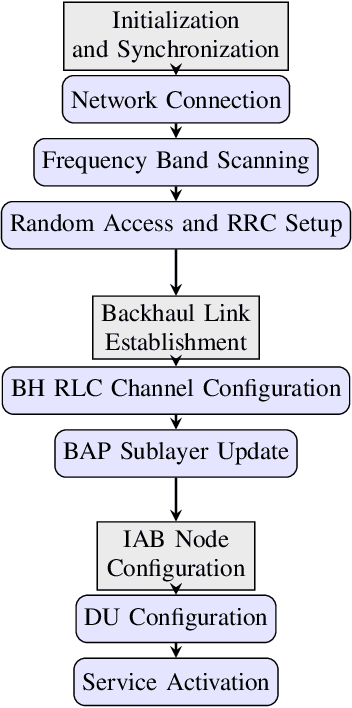
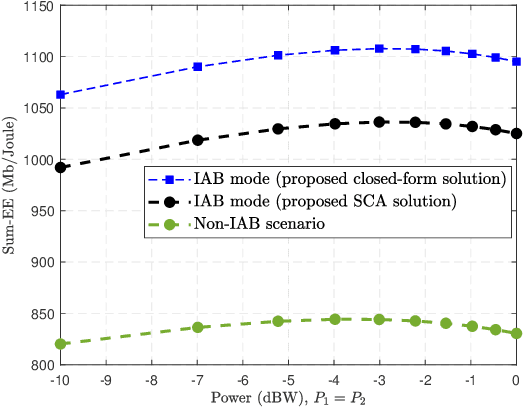
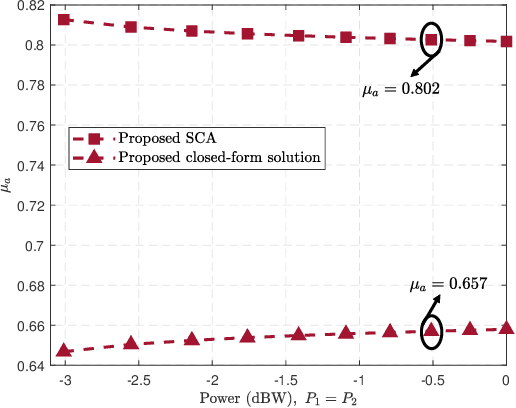
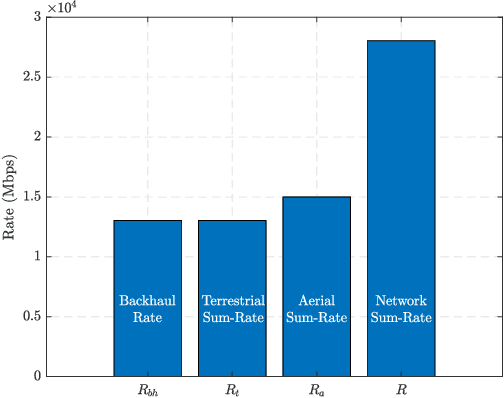
In this paper, we explore the problem of utilizing Integrated Access and Backhaul (IAB) technology in Non-Terrestrial Networks (NTN), with a particular focus on aerial access networks. We consider an Uncrewed Aerial Vehicle (UAV)-based wireless network comprised of two layers of UAVs: (a) a lower layer consisting a number of flying users and a UAV Base Station (BS) that provides coverage for terrestrial users and, (b) an upper layer designated to provide both wireless access for flying users and backhaul connectivity for UAV BS. By adopting IAB technology, the backhaul and access links collaboratively share their resources, enabling aerial backhauling and the utilization of the same infrastructure and frequency resources for access links. A sum-rate maximization problem is formulated by considering aerial backhaul constraints to optimally allocate the frequency spectrum between aerial and terrestrial networks. We decompose the resulting non-convex optimization problem into two sub-problems of beamforming and spectrum allocation and then propose efficient solutions for each. Numerical results in different scenarios yield insightful findings about the effectiveness of using the IAB technique in aerial networks.
Integrated Access and Backhaul in Cell-free Massive MIMO Systems
Oct 23, 2022One of the major challenges with cell-free (CF) massive multiple-input multiple-output (MIMO) networks is providing backhaul links for a large number of distributed access points (APs). In general, providing fiber optics backhaul for these APs is not cost-effective and also reduces network scalability. Wireless backhauling can be a promising solution that can be integrated with wireless access links to increase spectrum efficiency. In this paper, the application of integrated access and backhaul (IAB) technique in millimeter-wave (mmWave) CF massive MIMO systems is investigated. The access and backhaul links share a frequency spectrum in the mmWave bands, and in both, hybrid beamforming techniques are adopted for signal transmission. The bandwidth allocation (division) parameter between the two link types as well as the beamforming matrices are optimized to maximize the end-to-end data-rate. This leads to a non-convex optimization problem for which an efficient solution method is proposed. The simulation results show the effectiveness of the IAB technique and our proposed scheme in CF massive MIMO systems. These simulations also compare the proposed hybrid beamforming method with a fully digital solution in terms of the number of radio frequency (RF) chains and the volume of backhaul traffic. Finally, the effect of increasing the number of APs on the users data rates in terms of wireless access and backhaul links constraints is also examined.
Vertical Beamforming in Reconfigurable Intelligent Surface-aided Cognitive Radio Networks
Mar 16, 2021


In this letter, we investigate joint application of reconfigurable intelligent surface (RIS) and vertical beamforming in cognitive radio networks (CRN). After properly modeling the network, an optimization problem is formed to jointly design the beamforming vector and tilt angle at the secondary base station (BS) as well as the phase shifts at the RIS with the objective of maximizing spectral efficiency of the secondary network. The optimization problem is non-convex; thus, we propose an efficient solution method for it. Numerical results show that adding a RIS and optimizing the radiation orientation, can significantly improve performance of the CRNs.