 Add to Chrome
 Add to Firefox
 Add to Edge
Towards autonomous quantum physics research using LLM agents with access to intelligent tools
Nov 13, 2025
Artificial intelligence (AI) is used in numerous fields of science, yet the initial research questions and targets are still almost always provided by human researchers. AI-generated creative ideas in science are rare and often vague, so that it remains a human task to execute them. Automating idea generation and implementation in one coherent system would significantly shift the role of humans in the scientific process. Here we present AI-Mandel, an LLM agent that can generate and implement ideas in quantum physics. AI-Mandel formulates ideas from the literature and uses a domain-specific AI tool to turn them into concrete experiment designs that can readily be implemented in laboratories. The generated ideas by AI-Mandel are often scientifically interesting - for two of them we have already written independent scientific follow-up papers. The ideas include new variations of quantum teleportation, primitives of quantum networks in indefinite causal orders, and new concepts of geometric phases based on closed loops of quantum information transfer. AI-Mandel is a prototypical demonstration of an AI physicist that can generate and implement concrete, actionable ideas. Building such a system is not only useful to accelerate science, but it also reveals concrete open challenges on the path to human-level artificial scientists.

Meta-Designing Quantum Experiments with Language Models
Jun 04, 2024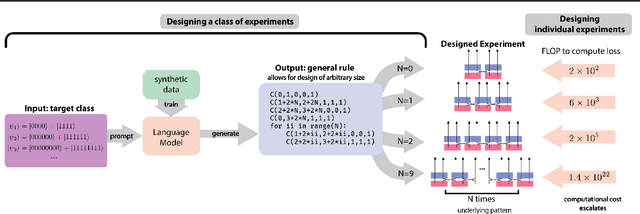
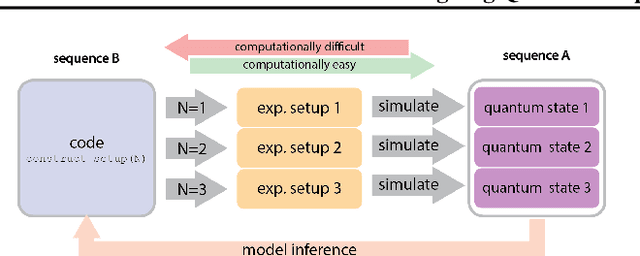
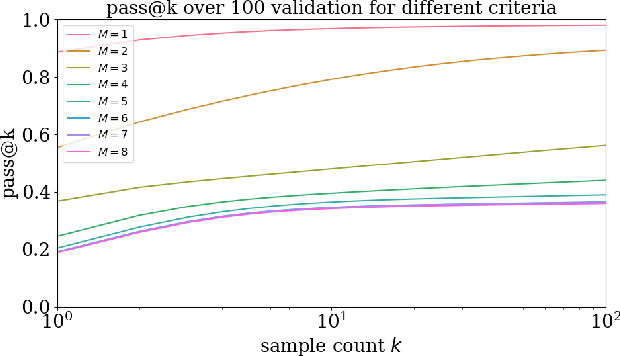
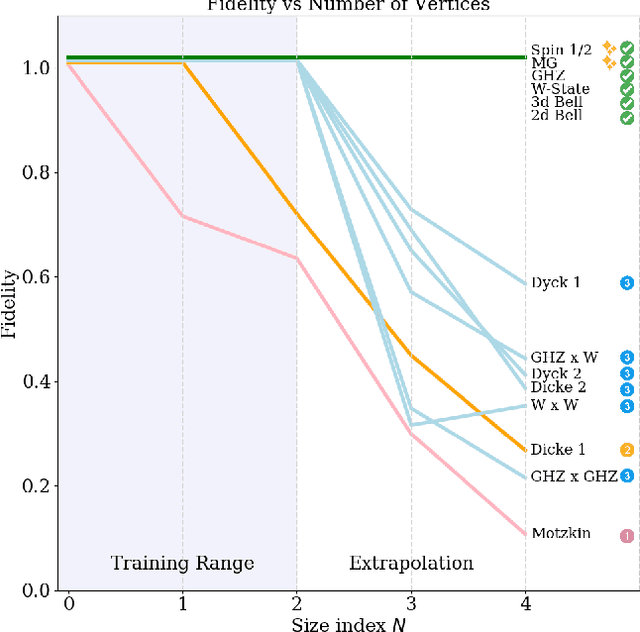
Artificial Intelligence (AI) has the potential to significantly advance scientific discovery by finding solutions beyond human capabilities. However, these super-human solutions are often unintuitive and require considerable effort to uncover underlying principles, if possible at all. Here, we show how a code-generating language model trained on synthetic data can not only find solutions to specific problems but can create meta-solutions, which solve an entire class of problems in one shot and simultaneously offer insight into the underlying design principles. Specifically, for the design of new quantum physics experiments, our sequence-to-sequence transformer architecture generates interpretable Python code that describes experimental blueprints for a whole class of quantum systems. We discover general and previously unknown design rules for infinitely large classes of quantum states. The ability to automatically generate generalized patterns in readable computer code is a crucial step toward machines that help discover new scientific understanding -- one of the central aims of physics.
Deep Quantum Graph Dreaming: Deciphering Neural Network Insights into Quantum Experiments
Sep 13, 2023Despite their promise to facilitate new scientific discoveries, the opaqueness of neural networks presents a challenge in interpreting the logic behind their findings. Here, we use a eXplainable-AI (XAI) technique called $inception$ or $deep$ $dreaming$, which has been invented in machine learning for computer vision. We use this techniques to explore what neural networks learn about quantum optics experiments. Our story begins by training a deep neural networks on the properties of quantum systems. Once trained, we "invert" the neural network -- effectively asking how it imagines a quantum system with a specific property, and how it would continuously modify the quantum system to change a property. We find that the network can shift the initial distribution of properties of the quantum system, and we can conceptualize the learned strategies of the neural network. Interestingly, we find that, in the first layers, the neural network identifies simple properties, while in the deeper ones, it can identify complex quantum structures and even quantum entanglement. This is in reminiscence of long-understood properties known in computer vision, which we now identify in a complex natural science task. Our approach could be useful in a more interpretable way to develop new advanced AI-based scientific discovery techniques in quantum physics.