 Add to Chrome
 Add to Firefox
 Add to Edge
Ultra-low-light computer vision using trained photon correlations
Apr 13, 2026
Illumination using correlated photon sources has been established as an approach to allowing high-fidelity images to be reconstructed from noisy camera frames by taking advantage of the knowledge that signal photons are spatially correlated whereas detector clicks due to noise are uncorrelated. However, in computer-vision tasks, the goal is often not ultimately to reconstruct an image, but to make inferences about a scene -- such as what object is present. Here we show how correlated-photon illumination can be used to gain an advantage in a hybrid optical-electronic computer-vision pipeline for object recognition. We demonstrate correlation-aware training (CAT): end-to-end optimization of a trainable correlated-photon illumination source and a Transformer backend in a way that the Transformer can learn to benefit from the correlations, using a small number (<= 100) of shots. We show a classification accuracy enhancement of up to 15 percentage points over conventional, uncorrelated-illumination-based computer vision in ultra-low-light and noisy imaging conditions, as well as an improvement over using untrained correlated-photon illumination. Our work illustrates how specializing to a computer-vision task -- object recognition -- and training the pattern of photon correlations in conjunction with a digital backend allows us to push the limits of accuracy in highly photon-budget-constrained scenarios beyond existing methods focused on image reconstruction.

Scaling on-chip photonic neural processors using arbitrarily programmable wave propagation
Feb 27, 2024

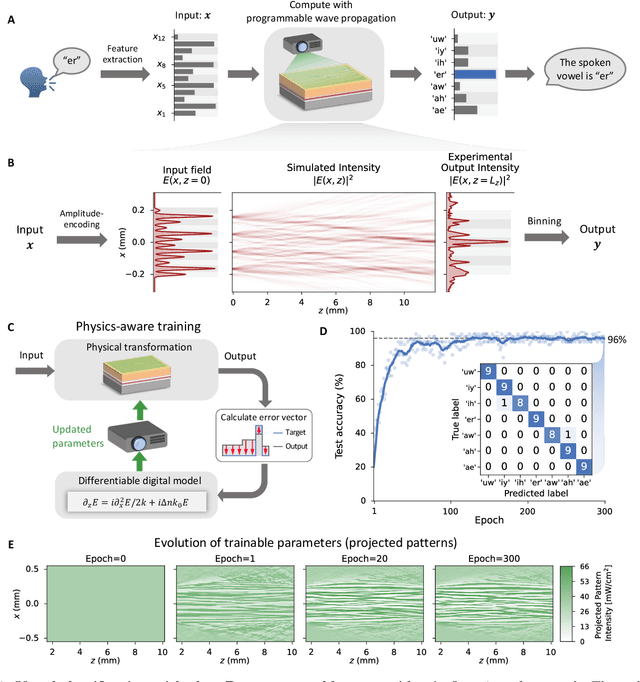

On-chip photonic processors for neural networks have potential benefits in both speed and energy efficiency but have not yet reached the scale at which they can outperform electronic processors. The dominant paradigm for designing on-chip photonics is to make networks of relatively bulky discrete components connected by one-dimensional waveguides. A far more compact alternative is to avoid explicitly defining any components and instead sculpt the continuous substrate of the photonic processor to directly perform the computation using waves freely propagating in two dimensions. We propose and demonstrate a device whose refractive index as a function of space, $n(x,z)$, can be rapidly reprogrammed, allowing arbitrary control over the wave propagation in the device. Our device, a 2D-programmable waveguide, combines photoconductive gain with the electro-optic effect to achieve massively parallel modulation of the refractive index of a slab waveguide, with an index modulation depth of $10^{-3}$ and approximately $10^4$ programmable degrees of freedom. We used a prototype device with a functional area of $12\,\text{mm}^2$ to perform neural-network inference with up to 49-dimensional input vectors in a single pass, achieving 96% accuracy on vowel classification and 86% accuracy on $7 \times 7$-pixel MNIST handwritten-digit classification. This is a scale beyond that of previous photonic chips relying on discrete components, illustrating the benefit of the continuous-waves paradigm. In principle, with large enough chip area, the reprogrammability of the device's refractive index distribution enables the reconfigurable realization of any passive, linear photonic circuit or device. This promises the development of more compact and versatile photonic systems for a wide range of applications, including optical processing, smart sensing, spectroscopy, and optical communications.