 Add to Chrome
 Add to Firefox
 Add to Edge
Exponential quantum advantage for learning signals with a single qubit
Aug 13, 2026
Quantum technology has the potential to transform scientific discovery, but quantum advantages often require processing capabilities well beyond the reach of experimental platforms. We show that coupling a single controllable qubit to an otherwise conventional sensor can exponentially reduce the number of measurements required to learn classical signals. These rigorous quantum advantages apply to fundamental sensing tasks, including learning Fourier coefficients, extracting temporal correlations from time-varying signals, and estimating transformations of physical observables. Using a superconducting cavity--qubit architecture, we experimentally demonstrate $10^7$-fold reductions in the number of measurements required for Fourier-amplitude and time-varying signal learning. Our $\textit{quantum feature sensing}$ algorithms further enable orders-of-magnitude improvements in simulations of weak-signal dark matter detection and wireless communication applications. These quantum advantages are derived from Quantum Phase-Space Inference (Q$Ψ$), a unifying theory of quantum-enhanced experiments that simultaneously converts a set of experimental objectives and constraints into tight lower bounds and optimal quantum-enhanced learning algorithms while producing a certificate of quantum advantage. Q$Ψ$ extends beyond the regimes captured by quantum Fisher information and provides a framework for systematically identifying rigorous quantum advantages in practical experimental tasks. Together, our results establish that near-term quantum technology can exponentially enhance our ability to learn from classical signals.

Measurement-Adapted Eigentask Representations for Photon-Limited Optical Readout
May 11, 2026Optical readout in low-light imaging is fundamentally limited by measurement noise, including photon shot noise, detector noise, and quantization error. In this regime, downstream inference depends not only on the optical front end, but also on how noisy high-dimensional sensor measurements are represented before classification or decision-making. Here we show that eigentasks provide a measurement-adapted representation for optical sensor outputs by ordering readout features according to their resolvability under noise. Using experimental data from a lens-based optical imaging system and a reanalysis of published data from a single-photon-detection neural network, we find that eigentask representations frequently outperform standard baselines including principal component analysis and filtering-based compression. The advantage is most pronounced in photon-limited, few-shot, and higher-difficulty classification regimes. In few-shot MPEG-7 classification, for example, the advantage over other methods reaches about 10 percentage points as the number of classes increases. In these settings, eigentasks yield more informative low-dimensional features and improve sample-efficient downstream learning. These results identify measurement-adapted representation as a promising strategy for optical inference when photon budget, acquisition time, and task complexity are constrained.
Ultra-low-light computer vision using trained photon correlations
Apr 13, 2026Illumination using correlated photon sources has been established as an approach to allowing high-fidelity images to be reconstructed from noisy camera frames by taking advantage of the knowledge that signal photons are spatially correlated whereas detector clicks due to noise are uncorrelated. However, in computer-vision tasks, the goal is often not ultimately to reconstruct an image, but to make inferences about a scene -- such as what object is present. Here we show how correlated-photon illumination can be used to gain an advantage in a hybrid optical-electronic computer-vision pipeline for object recognition. We demonstrate correlation-aware training (CAT): end-to-end optimization of a trainable correlated-photon illumination source and a Transformer backend in a way that the Transformer can learn to benefit from the correlations, using a small number (<= 100) of shots. We show a classification accuracy enhancement of up to 15 percentage points over conventional, uncorrelated-illumination-based computer vision in ultra-low-light and noisy imaging conditions, as well as an improvement over using untrained correlated-photon illumination. Our work illustrates how specializing to a computer-vision task -- object recognition -- and training the pattern of photon correlations in conjunction with a digital backend allows us to push the limits of accuracy in highly photon-budget-constrained scenarios beyond existing methods focused on image reconstruction.
Machine vision with small numbers of detected photons per inference
Mar 25, 2026Machine vision, including object recognition and image reconstruction, is a central technology in many consumer devices and scientific instruments. The design of machine-vision systems has been revolutionized by the adoption of end-to-end optimization, in which the optical front end and the post-processing back end are jointly optimized. However, while machine vision currently works extremely well in moderate-light or bright-light situations -- where a camera may detect thousands of photons per pixel and billions of photons per frame -- it is far more challenging in very low-light situations. We introduce photon-aware neuromorphic sensing (PANS), an approach for end-to-end optimization in highly photon-starved scenarios. The training incorporates knowledge of the low photon budget and the stochastic nature of light detection when the average number of photons per pixel is near or less than 1. We report a proof-of-principle experimental demonstration in which we performed low-light image classification using PANS, achieving 73% (82%) accuracy on FashionMNIST with an average of only 4.9 (17) detected photons in total per inference, and 86% (97%) on MNIST with 8.6 (29) detected photons -- orders of magnitude more photon-efficient than conventional approaches. We also report simulation studies showing how PANS could be applied to other classification, event-detection, and image-reconstruction tasks. By taking into account the statistics of measurement results for non-classical states or alternative sensing hardware, PANS could in principle be adapted to enable high-accuracy results in quantum and other photon-starved setups.
Scaling on-chip photonic neural processors using arbitrarily programmable wave propagation
Feb 27, 2024

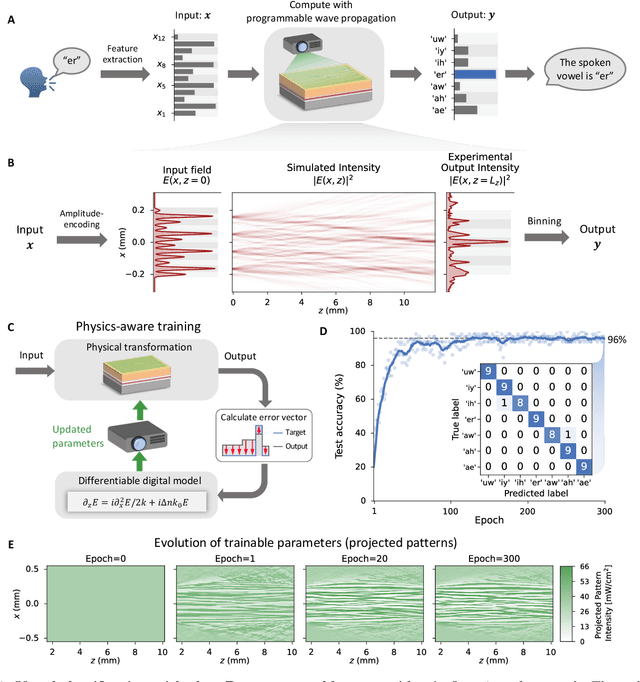

On-chip photonic processors for neural networks have potential benefits in both speed and energy efficiency but have not yet reached the scale at which they can outperform electronic processors. The dominant paradigm for designing on-chip photonics is to make networks of relatively bulky discrete components connected by one-dimensional waveguides. A far more compact alternative is to avoid explicitly defining any components and instead sculpt the continuous substrate of the photonic processor to directly perform the computation using waves freely propagating in two dimensions. We propose and demonstrate a device whose refractive index as a function of space, $n(x,z)$, can be rapidly reprogrammed, allowing arbitrary control over the wave propagation in the device. Our device, a 2D-programmable waveguide, combines photoconductive gain with the electro-optic effect to achieve massively parallel modulation of the refractive index of a slab waveguide, with an index modulation depth of $10^{-3}$ and approximately $10^4$ programmable degrees of freedom. We used a prototype device with a functional area of $12\,\text{mm}^2$ to perform neural-network inference with up to 49-dimensional input vectors in a single pass, achieving 96% accuracy on vowel classification and 86% accuracy on $7 \times 7$-pixel MNIST handwritten-digit classification. This is a scale beyond that of previous photonic chips relying on discrete components, illustrating the benefit of the continuous-waves paradigm. In principle, with large enough chip area, the reprogrammability of the device's refractive index distribution enables the reconfigurable realization of any passive, linear photonic circuit or device. This promises the development of more compact and versatile photonic systems for a wide range of applications, including optical processing, smart sensing, spectroscopy, and optical communications.
Image sensing with multilayer, nonlinear optical neural networks
Jul 27, 2022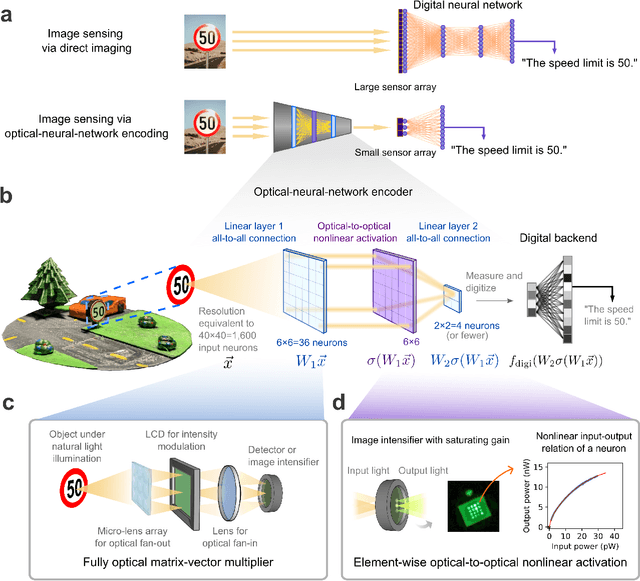
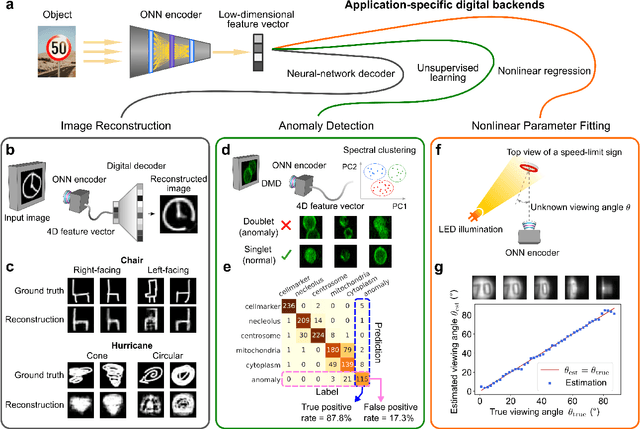
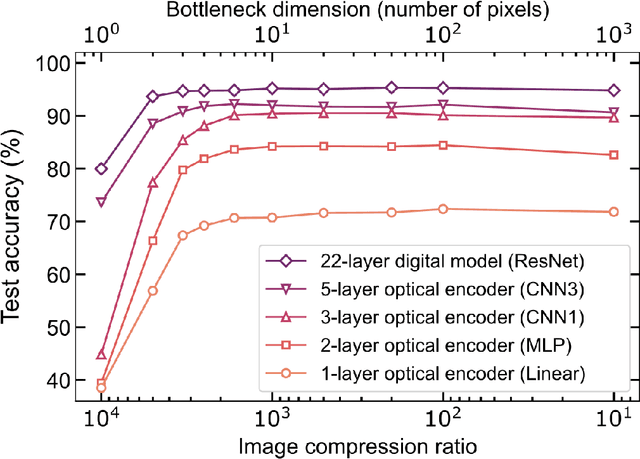
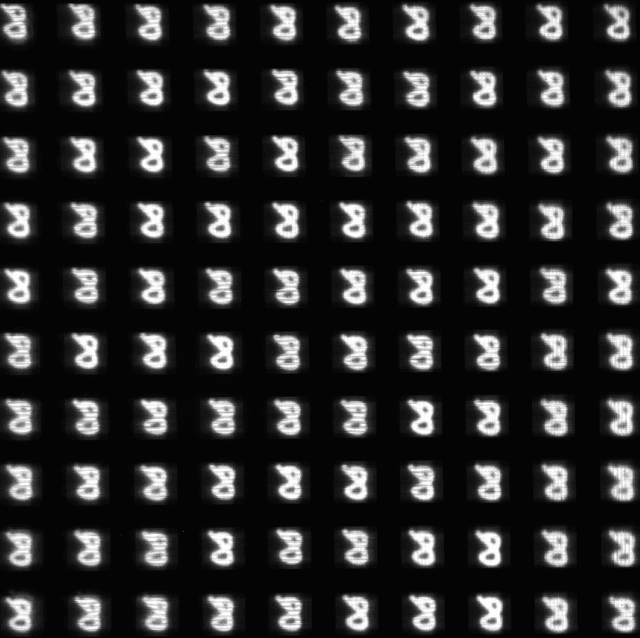
Optical imaging is commonly used for both scientific and technological applications across industry and academia. In image sensing, a measurement, such as of an object's position, is performed by computational analysis of a digitized image. An emerging image-sensing paradigm breaks this delineation between data collection and analysis by designing optical components to perform not imaging, but encoding. By optically encoding images into a compressed, low-dimensional latent space suitable for efficient post-analysis, these image sensors can operate with fewer pixels and fewer photons, allowing higher-throughput, lower-latency operation. Optical neural networks (ONNs) offer a platform for processing data in the analog, optical domain. ONN-based sensors have however been limited to linear processing, but nonlinearity is a prerequisite for depth, and multilayer NNs significantly outperform shallow NNs on many tasks. Here, we realize a multilayer ONN pre-processor for image sensing, using a commercial image intensifier as a parallel optoelectronic, optical-to-optical nonlinear activation function. We demonstrate that the nonlinear ONN pre-processor can achieve compression ratios of up to 800:1 while still enabling high accuracy across several representative computer-vision tasks, including machine-vision benchmarks, flow-cytometry image classification, and identification of objects in real scenes. In all cases we find that the ONN's nonlinearity and depth allowed it to outperform a purely linear ONN encoder. Although our experiments are specialized to ONN sensors for incoherent-light images, alternative ONN platforms should facilitate a range of ONN sensors. These ONN sensors may surpass conventional sensors by pre-processing optical information in spatial, temporal, and/or spectral dimensions, potentially with coherent and quantum qualities, all natively in the optical domain.