 Add to Chrome
 Add to Firefox
 Add to Edge
Beyond IGO-Flow: Toward Convergence Analysis of IGO in Continuous Spaces
Jun 16, 2026
Information-Geometric Optimization (IGO) provides a unified framework for black-box optimization by interpreting the adaptation of a search distribution as a natural gradient update. Despite its conceptual importance, the convergence theory of IGO remains limited: most existing results concern continuous-time idealizations such as the IGO flow, rather than discrete-time updates with non-infinitesimal learning rates. In this paper, we study discrete-time IGO in continuous spaces, formulated as natural gradient updates in the expectation-parameter coordinates of an exponential family. In particular, we analyze IGO over the multivariate Gaussian family on strongly convex quadratic objective functions. Our analysis covers a setting that simultaneously incorporates full covariance adaptation, a fixed positive learning rate, and quantile-based weights. In this setting, we prove that the covariance matrix converges to the zero matrix. We further show that the mean vector converges to the global optimum, provided that the condition number of the appropriately scaled covariance matrix is bounded at sufficiently frequent iterations. These results advance the convergence theory of IGO and help bridge the gap between the mathematical theory of IGO and practical covariance-adaptive search methods such as CMA-ES.

Representing a Partially Observed Non-Rigid 3D Human Using Eigen-Texture and Eigen-Deformation
Jul 07, 2018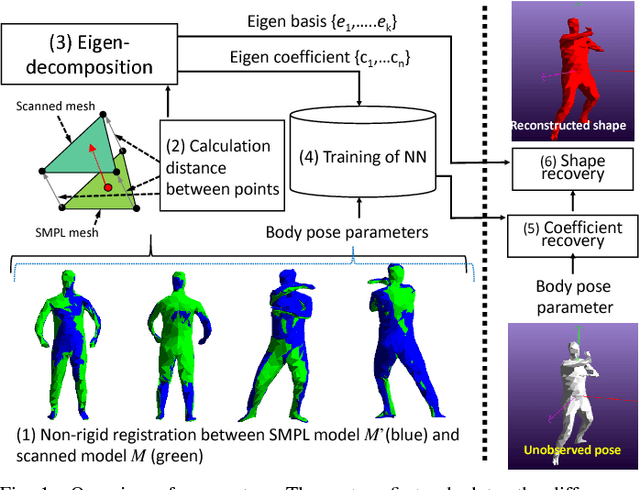
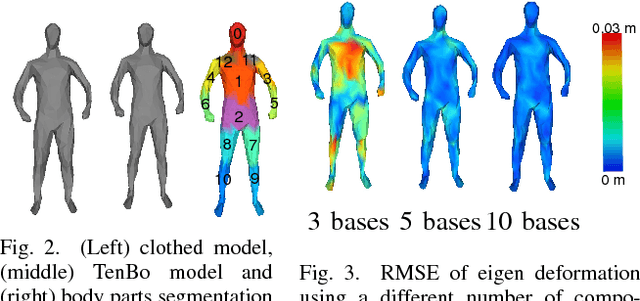
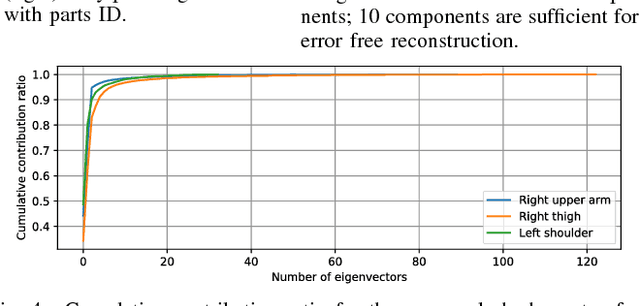
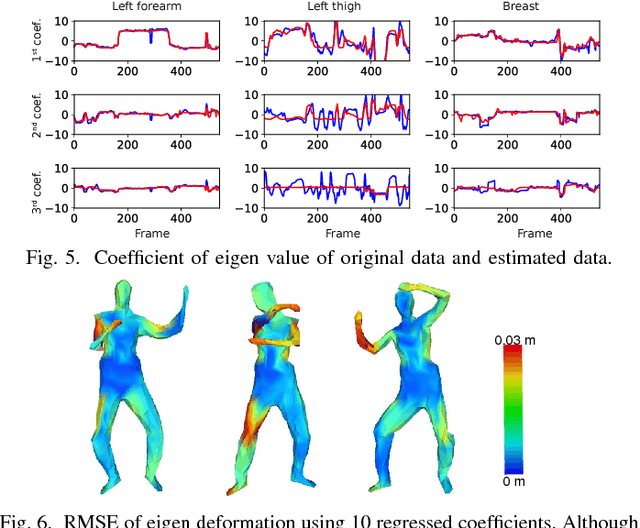
Reconstruction of the shape and motion of humans from RGB-D is a challenging problem, receiving much attention in recent years. Recent approaches for full-body reconstruction use a statistic shape model, which is built upon accurate full-body scans of people in skin-tight clothes, to complete invisible parts due to occlusion. Such a statistic model may still be fit to an RGB-D measurement with loose clothes but cannot describe its deformations, such as clothing wrinkles. Observed surfaces may be reconstructed precisely from actual measurements, while we have no cues for unobserved surfaces. For full-body reconstruction with loose clothes, we propose to use lower dimensional embeddings of texture and deformation referred to as eigen-texturing and eigen-deformation, to reproduce views of even unobserved surfaces. Provided a full-body reconstruction from a sequence of partial measurements as 3D meshes, the texture and deformation of each triangle are then embedded using eigen-decomposition. Combined with neural-network-based coefficient regression, our method synthesizes the texture and deformation from arbitrary viewpoints. We evaluate our method using simulated data and visually demonstrate how our method works on real data.