 Add to Chrome
 Add to Firefox
 Add to Edge
Visual Semantic Decoding of Electrocorticography from Video Stimuli using End-to-End Deep Learning
Jul 21, 2026
ECoG-based visual semantic decoding enables inference of semantic interpretation of visual perception from complex, noisy brain activity. This study examines the feasibility of visual semantic decoding using an end-to-end deep learning framework using electrocorticography (ECoG). Specifically, the decoding task is to predict visual categories from video stimuli using time-series neural inputs. A previously collected ECoG dataset from participants ($n=17$) with drug-resistant epilepsy is used for analysis. With fewer than 50 training samples per visual category, this study evaluates multiple deep learning approaches, artificial neural network architectures, and frequency-band filtered inputs. The best-performing approach is analyzed to shed light on the discriminative information it relies on across spectral, temporal, and cortical dimensions. The selected decoding system uses mixup augmentation, a Transformer-based encoder, and high-gamma (80-150 Hz) inputs with a 900 ms post-stimulus window. Further analysis shows that early visual cortex (V2-V4), ventral stream visual cortex, MT+ complex with neighbouring visual areas, and lateral temporal cortex contributed substantially to decoding performance. This study demonstrates that an end-to-end deep learning framework can yield promising decoding performance from dynamic visual stimuli without handcrafted features, while the model behavior remains interpretable through spectral, temporal, and cortical dimensions, which are broadly consistent with established neuroscience knowledge.

Brain-grounding of semantic vectors improves neural decoding of visual stimuli
Mar 22, 2024
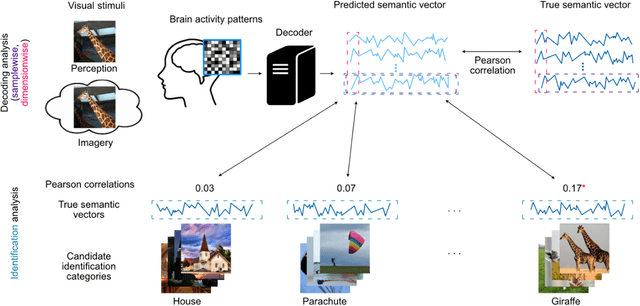


Developing algorithms for accurate and comprehensive neural decoding of mental contents is one of the long-cherished goals in the field of neuroscience and brain-machine interfaces. Previous studies have demonstrated the feasibility of neural decoding by training machine learning models to map brain activity patterns into a semantic vector representation of stimuli. These vectors, hereafter referred as pretrained feature vectors, are usually derived from semantic spaces based solely on image and/or text features and therefore they might have a totally different characteristics than how visual stimuli is represented in the human brain, resulting in limiting the capability of brain decoders to learn this mapping. To address this issue, we propose a representation learning framework, termed brain-grounding of semantic vectors, which fine-tunes pretrained feature vectors to better align with the neural representation of visual stimuli in the human brain. We trained this model this model with functional magnetic resonance imaging (fMRI) of 150 different visual stimuli categories, and then performed zero-shot brain decoding and identification analyses on 1) fMRI and 2) magnetoencephalography (MEG). Interestingly, we observed that by using the brain-grounded vectors, the brain decoding and identification accuracy on brain data from different neuroimaging modalities increases. These findings underscore the potential of incorporating a richer array of brain-derived features to enhance performance of brain decoding algorithms.
Fast, accurate, and interpretable decoding of electrocorticographic signals using dynamic mode decomposition
Oct 31, 2023Dynamic mode (DM) decomposition decomposes spatiotemporal signals into basic oscillatory components (DMs). DMs can improve the accuracy of neural decoding when used with the nonlinear Grassmann kernel, compared to conventional power features. However, such kernel-based machine learning algorithms have three limitations: large computational time preventing real-time application, incompatibility with non-kernel algorithms, and low interpretability. Here, we propose a mapping function corresponding to the Grassmann kernel that explicitly transforms DMs into spatial DM (sDM) features, which can be used in any machine learning algorithm. Using electrocorticographic signals recorded during various movement and visual perception tasks, the sDM features were shown to improve the decoding accuracy and computational time compared to conventional methods. Furthermore, the components of the sDM features informative for decoding showed similar characteristics to the high-$\gamma$ power of the signals, but with higher trial-to-trial reproducibility. The proposed sDM features enable fast, accurate, and interpretable neural decoding.