 Add to Chrome
 Add to Firefox
 Add to Edge
Teaching Diffusion to Speculate Left-to-Right
Jun 10, 2026
Large language models (LLMs) achieve remarkable performance across a wide range of tasks, but their autoregressive decoding process incurs substantial inference costs due to inherently sequential token generation. Speculative decoding addresses this bottleneck by employing a lightweight draft model to propose multiple future tokens that are subsequently verified in parallel by a larger target model. Recent work has demonstrated that diffusion language models are well suited for this setting, as they can generate entire blocks of draft tokens in parallel and thereby alleviate the sequential constraints of autoregressive drafting. A subtlety of this regime is that block-diffusion drafters generate tokens bidirectionally within a block, whereas verification is performed by an autoregressive target model that evaluates tokens in a strictly left-to-right manner, leaving a gap between the symmetric training-time objective and the asymmetric verification-time reward. In this work, we offer an empirical analysis of three training-time interventions that narrow this gap: token positional weighting, a first-error focal loss that targets the position that breaks the accepted prefix within each block, and a chain loss term that substitutes a differentiable surrogate for the expected accepted length. The three interventions act along orthogonal axes (position, block-conditional first error, joint prefix) and compose additively; they are likewise orthogonal to test-time alignment mechanisms such as multi-draft self-selection, with which they can in principle be combined. Across four target models and six reasoning, code, and dialogue benchmarks, the three interventions raise accepted draft length by 21-76% per benchmark over a position-uniform baseline, without adding additional forward passes and without changing the inference pipeline or the rejection-sampling exactness contract.

Boosting Radiology Report Generation by Infusing Comparison Prior
May 08, 2023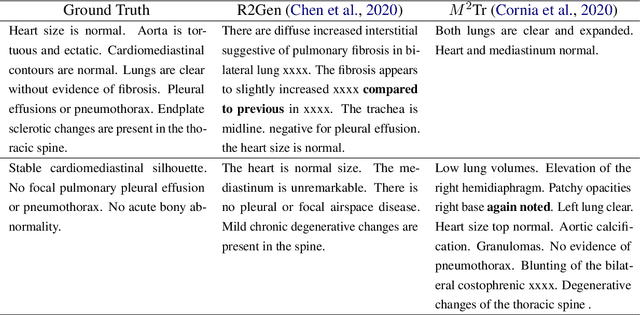
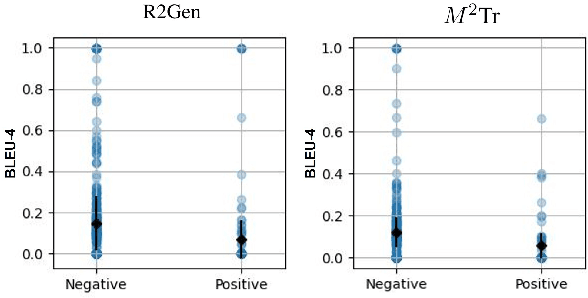

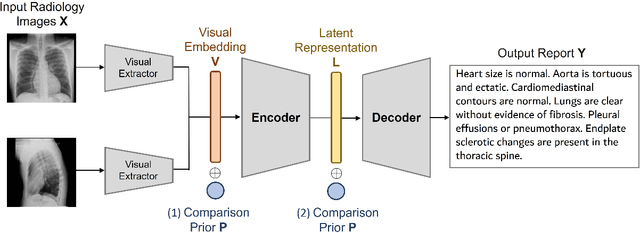
Current transformer-based models achieved great success in generating radiology reports from chest X-ray images. Nonetheless, one of the major issues is the model's lack of prior knowledge, which frequently leads to false references to non-existent prior exams in synthetic reports. This is mainly due to the knowledge gap between radiologists and the generation models: radiologists are aware of the prior information of patients to write a medical report, while models only receive X-ray images at a specific time. To address this issue, we propose a novel approach that employs a labeler to extract comparison prior information from radiology reports in the IU X-ray and MIMIC-CXR datasets. This comparison prior is then incorporated into state-of-the-art transformer-based models, allowing them to generate more realistic and comprehensive reports. We test our method on the IU X-ray and MIMIC-CXR datasets and find that it outperforms previous state-of-the-art models in terms of both automatic and human evaluation metrics. In addition, unlike previous models, our model generates reports that do not contain false references to non-existent prior exams. Our approach provides a promising direction for bridging the gap between radiologists and generation models in medical report generation.