 Add to Chrome
 Add to Firefox
 Add to Edge
A Score Filter Enhanced Data Assimilation Framework for Data-Driven Dynamical Systems
Mar 16, 2026
We introduce a score-filter-enhanced data assimilation framework designed to reduce predictive uncertainty in machine learning (ML) models for data-driven dynamical system forecasting. Machine learning serves as an efficient numerical model for predicting dynamical systems. However, even with sufficient data, model uncertainty remains and accumulates over time, causing the long-term performance of ML models to deteriorate. To overcome this difficulty, we integrate data assimilation techniques into the training process to iteratively refine the model predictions by incorporating observational information. Specifically, we apply the Ensemble Score Filter (EnSF), a generative AI-based training-free diffusion model approach, for solving the data assimilation problem in high-dimensional nonlinear complex systems. This leads to a hybrid data assimilation-training framework that combines ML with EnSF to improve long-term predictive performance. We shall demonstrate that EnSF-enhanced ML can effectively reduce predictive uncertainty in ML-based Lorenz-96 system prediction and the Korteweg-De Vries (KdV) equation prediction.

Federated Learning on Stochastic Neural Networks
Jun 09, 2025Federated learning is a machine learning paradigm that leverages edge computing on client devices to optimize models while maintaining user privacy by ensuring that local data remains on the device. However, since all data is collected by clients, federated learning is susceptible to latent noise in local datasets. Factors such as limited measurement capabilities or human errors may introduce inaccuracies in client data. To address this challenge, we propose the use of a stochastic neural network as the local model within the federated learning framework. Stochastic neural networks not only facilitate the estimation of the true underlying states of the data but also enable the quantification of latent noise. We refer to our federated learning approach, which incorporates stochastic neural networks as local models, as Federated stochastic neural networks. We will present numerical experiments demonstrating the performance and effectiveness of our method, particularly in handling non-independent and identically distributed data.
Improved Stock Price Movement Classification Using News Articles Based on Embeddings and Label Smoothing
Jan 25, 2023
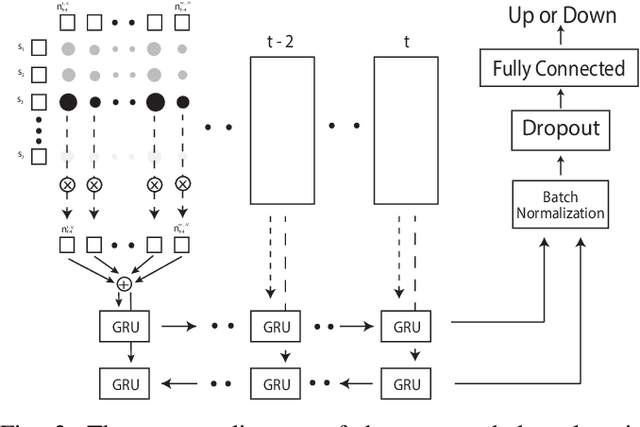


Stock price movement prediction is a challenging and essential problem in finance. While it is well established in modern behavioral finance that the share prices of related stocks often move after the release of news via reactions and overreactions of investors, how to capture the relationships between price movements and news articles via quantitative models is an active area research; existing models have achieved success with variable degrees. In this paper, we propose to improve stock price movement classification using news articles by incorporating regularization and optimization techniques from deep learning. More specifically, we capture the dependencies between news articles and stocks through embeddings and bidirectional recurrent neural networks as in recent models. We further incorporate weight decay, batch normalization, dropout, and label smoothing to improve the generalization of the trained models. To handle high fluctuations of validation accuracy of batch normalization, we propose dual-phase training to realize the improvements reliably. Our experimental results on a commonly used dataset show significant improvements, achieving average accuracy of 80.7% on the test set, which is more than 10.0% absolute improvement over existing models. Our ablation studies show batch normalization and label smoothing are most effective, leading to 6.0% and 3.4% absolute improvement, respectively on average.