 Add to Chrome
 Add to Firefox
 Add to Edge
Phoenix-VL 1.5 Medium Technical Report
May 11, 2026
We introduce Phoenix-VL 1.5 Medium, a 123B-parameter natively multimodal and multilingual foundation model, adapted to regional languages and the Singapore context. Developed as a sovereign AI asset, it demonstrates that deep domain adaptation can be achieved with minimal degradation to broad-spectrum intelligence and alignment. Continued pretraining was performed on Mistral Medium 3.1 using a localized 1-trillion tokens multimodal corpus, followed by a 250-billion tokens long-context extension phase. Subsequent post-training incorporated a novel human-annotated Singapore multimodal dataset and curated textual corpus on Singapore culture, knowledge, and legislation, totaling 22-billion tokens. An additional 5 billion tokens of model alignment was performed through Online Direct Preference Optimization. Phoenix-VL 1.5 Medium achieves state-of-the-art performance for its size on Singapore multimodal, legal, and government policy benchmarks while remaining globally competitive on general multimodal intelligence, multilingual, and STEM benchmarks. We also introduce a novel evaluation suite encompassing localized knowledge benchmarks and an institutionally aligned model behavior and safety framework. We report the data curation principles, training methodology, and highlight benchmark and inference performance.

Voxtral TTS
Mar 26, 2026We introduce Voxtral TTS, an expressive multilingual text-to-speech model that generates natural speech from as little as 3 seconds of reference audio. Voxtral TTS adopts a hybrid architecture that combines auto-regressive generation of semantic speech tokens with flow-matching for acoustic tokens. These tokens are encoded and decoded with Voxtral Codec, a speech tokenizer trained from scratch with a hybrid VQ-FSQ quantization scheme. In human evaluations conducted by native speakers, Voxtral TTS is preferred for multilingual voice cloning due to its naturalness and expressivity, achieving a 68.4\% win rate over ElevenLabs Flash v2.5. We release the model weights under a CC BY-NC license.
Ministral 3
Jan 13, 2026We introduce the Ministral 3 series, a family of parameter-efficient dense language models designed for compute and memory constrained applications, available in three model sizes: 3B, 8B, and 14B parameters. For each model size, we release three variants: a pretrained base model for general-purpose use, an instruction finetuned, and a reasoning model for complex problem-solving. In addition, we present our recipe to derive the Ministral 3 models through Cascade Distillation, an iterative pruning and continued training with distillation technique. Each model comes with image understanding capabilities, all under the Apache 2.0 license.
Heterogeneous Image GNN: Graph-Conditioned Diffusion for Image Synthesis
Feb 03, 2025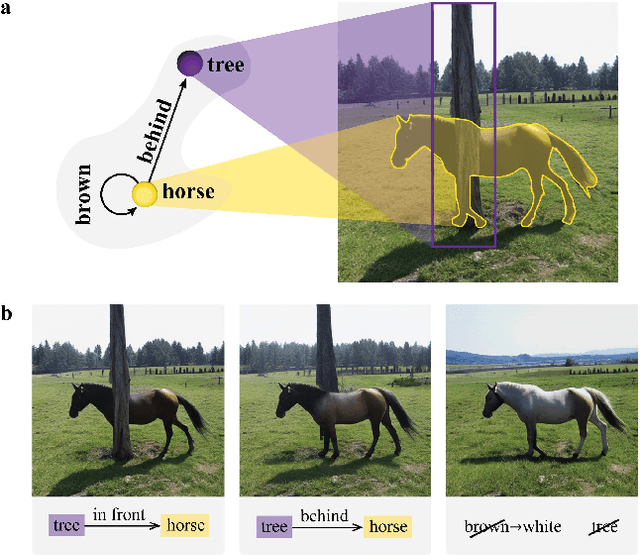
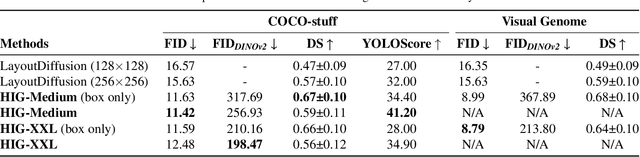
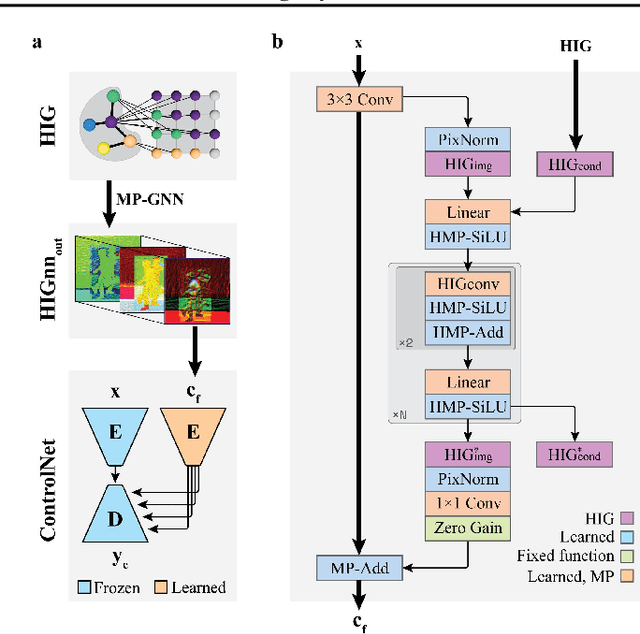
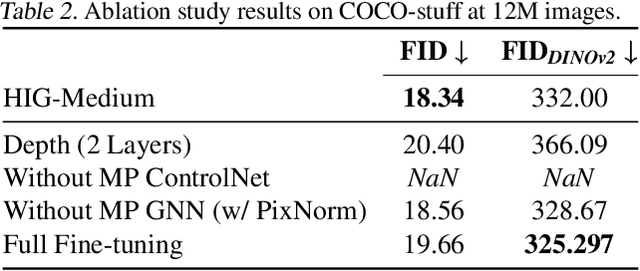
We introduce a novel method for conditioning diffusion-based image synthesis models with heterogeneous graph data. Existing approaches typically incorporate conditioning variables directly into model architectures, either through cross-attention layers that attend to text latents or image concatenation that spatially restrict generation. However, these methods struggle to handle complex scenarios involving diverse, relational conditioning variables, which are more naturally represented as unstructured graphs. This paper presents Heterogeneous Image Graphs (HIG), a novel representation that models conditioning variables and target images as two interconnected graphs, enabling efficient handling of variable-length conditioning inputs and their relationships. We also propose a magnitude-preserving GNN that integrates the HIG into the existing EDM2 diffusion model using a ControlNet approach. Our approach improves upon the SOTA on a variety of conditioning inputs for the COCO-stuff and Visual Genome datasets, and showcases the ability to condition on graph attributes and relationships represented by edges in the HIG.