 Add to Chrome
 Add to Firefox
 Add to Edge
Generating Developable 3D Molecules via Pocket-Conditioned Diffusion and Property-Aware Optimization
Jul 14, 2026
Drug discovery and development is time-consuming and resource-intensive, motivating computational approaches such as diffusion models for de novo drug design. Many such models follow the structure-based drug design (SBDD) paradigm, generating molecules to fit a target binding pocket. However, existing diffusion-based SBDD methods typically couple pocket and ligand representation learning, model interactions only at the atom level, and prioritize binding affinity over other developability properties. Here, we introduce conDitar-dev, a conditional diffusion-based SBDD framework for generating ligands with strong binding affinities and favorable ADMET properties. It consists of three modules: msPRL, a pretrained multi-scale pocket representation learning module; conDitar, a pocket-conditioned diffusion model guided by msPRL representations; and paOPT, a generation-time method for optimizing ligand developability. On a newly curated benchmark of human disease targets, conDitar outperforms state-of-the-art SBDD baselines, achieving an average binding score of -8.85 kcal/mol. Across five ADMET properties, conDitar-dev improves performance by up to 73% over conDitar. To further validate the abilities of conDitar-dev to generate developable molecules, we have applied it to two validated druggable targets: programmed death-ligand 1 (PD-L1) and colony-stimulating factor 1 receptor (CSF1R) proteins. Top-ranked generatively designed molecules and their analogs have been experimentally synthesized and biologically tested. Two molecules generated directly by conDitar-dev for PD-L1 exhibited SPR-derived $K_D$ values of 3.49 and 3.75 $μ$M, respectively. Hit expansion based on conDitar-dev-designed molecules identified selective CSF1R inhibitors with IC$_{50}$ values as low as 200 nM, while also uncovering opportunities for drug repositioning.

GRU-TV: Time- and velocity-aware GRU for patient representation on multivariate clinical time-series data
May 04, 2022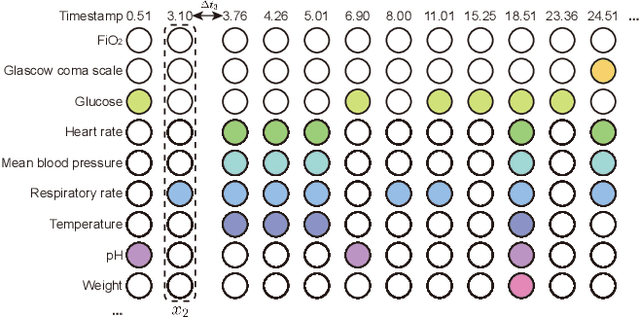
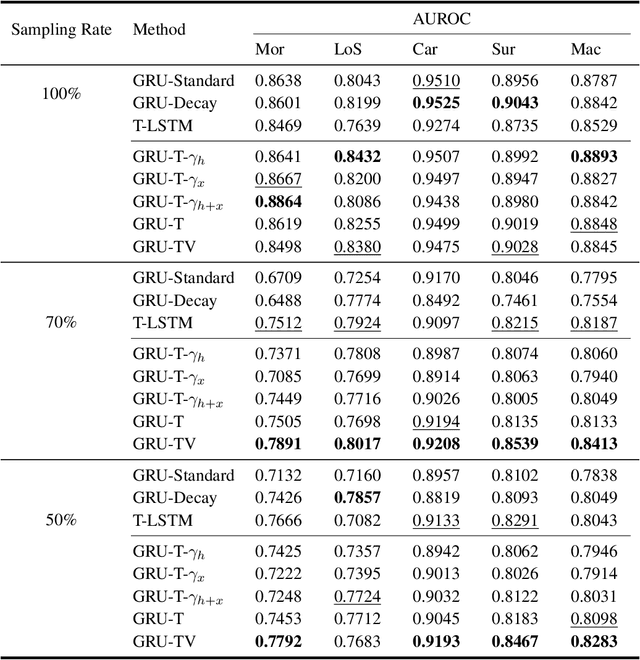
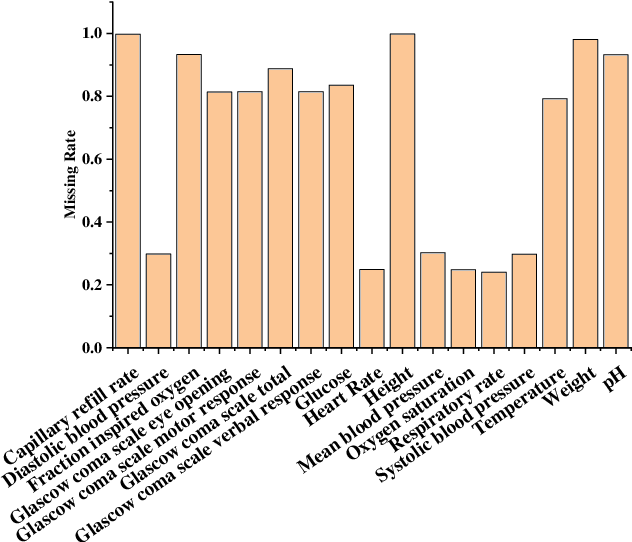
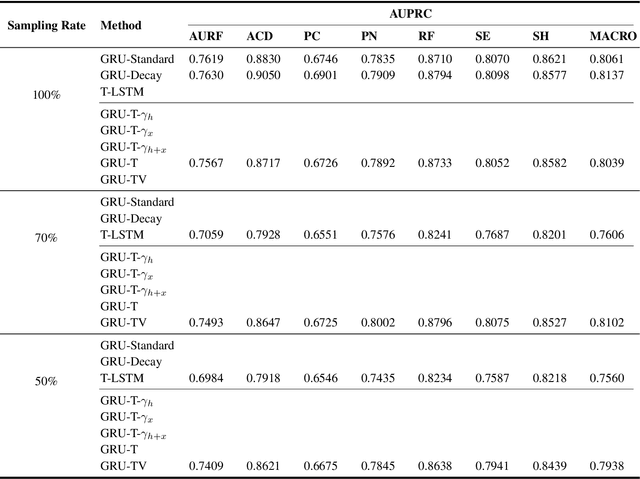
Electronic health records (EHRs) provide a rich repository to track a patient's health status. EHRs seek to fully document the patient's physiological status, and include data that is is high dimensional, heterogeneous, and multimodal. The significant differences in the sampling frequency of clinical variables can result in high missing rates and uneven time intervals between adjacent records in the multivariate clinical time-series data extracted from EHRs. Current studies using clinical time-series data for patient characterization view the patient's physiological status as a discrete process described by sporadically collected values, while the dynamics in patient's physiological status are time-continuous. In addition, recurrent neural networks (RNNs) models widely used for patient representation learning lack the perception of time intervals and velocity, which limits the ability of the model to represent the physiological status of the patient. In this paper, we propose an improved gated recurrent unit (GRU), namely time- and velocity-aware GRU (GRU-TV), for patient representation learning of clinical multivariate time-series data in a time-continuous manner. In proposed GRU-TV, the neural ordinary differential equations (ODEs) and velocity perception mechanism are used to perceive the time interval between records in the time-series data and changing rate of the patient's physiological status, respectively. Experimental results on two real-world clinical EHR datasets(PhysioNet2012, MIMIC-III) show that GRU-TV achieve state-of-the-art performance in computer aided diagnosis (CAD) tasks, and is more advantageous in processing sampled data.