 Add to Chrome
 Add to Firefox
 Add to Edge
Generating Roadside LiDAR Datasets from Vehicle-Side Datasets via Novel View Synthesis
May 07, 2026
Intelligent Transportation Systems (ITS) require reliable environmental perception to support safe and efficient transportation. With the rapid development of Vehicle-to-everything (V2X), roadside perception has become an effective means to extend sensing coverage and improve traffic safety. However, the scarcity of large-scale annotated roadside LiDAR datasets poses a major challenge for training high-performance roadside perception models. In this paper, we introduce Vehicle-to-Roadside LiDAR Synthesis (VRS), a data synthesis framework that generates labeled roadside LiDAR datasets from vehicle-side datasets via LiDAR novel view synthesis. To mitigate the vehicle-to-roadside domain gap, VRS employs vehicle point cloud completion to compensate for missing geometry in vehicle-side observations, and introduces an occupancy-based visibility constraint to handle large viewpoint changes during cross-view rendering. The proposed framework enables flexible multi-view rendering for scalable roadside data generation. Extensive experiments on roadside 3D object detection demonstrate that the synthesized data effectively complements real roadside data, mitigates the limitations of limited real-world roadside data, and improves generalization to unseen roadside viewpoints.

Bench-RNR: Dataset for Benchmarking Repetitive and Non-repetitive Scanning LiDAR for Infrastructure-based Vehicle Localization
Sep 19, 2025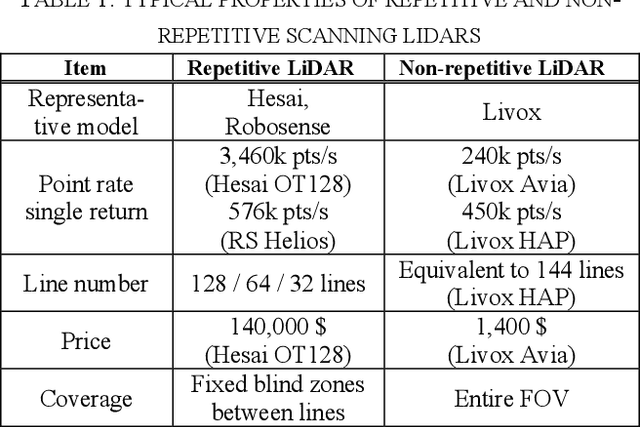
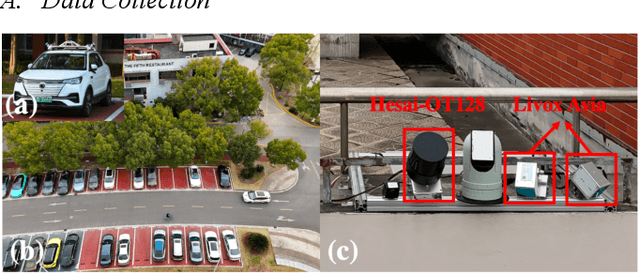
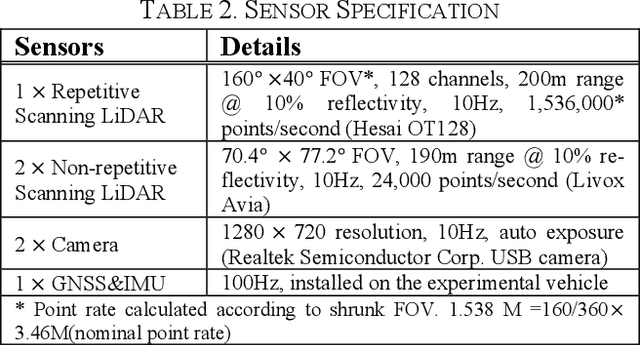
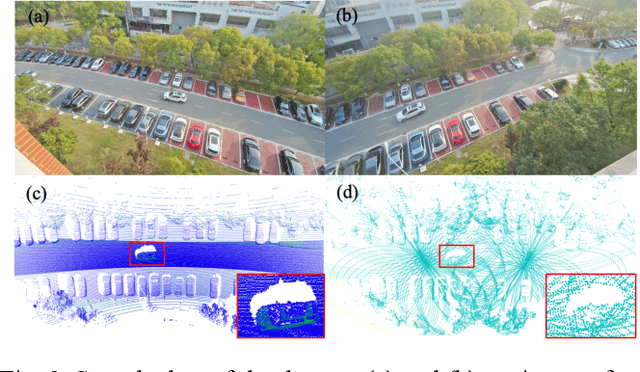
Vehicle localization using roadside LiDARs can provide centimeter-level accuracy for cloud-controlled vehicles while simultaneously serving multiple vehicles, enhanc-ing safety and efficiency. While most existing studies rely on repetitive scanning LiDARs, non-repetitive scanning LiDAR offers advantages such as eliminating blind zones and being more cost-effective. However, its application in roadside perception and localization remains limited. To address this, we present a dataset for infrastructure-based vehicle localization, with data collected from both repetitive and non-repetitive scanning LiDARs, in order to benchmark the performance of different LiDAR scanning patterns. The dataset contains 5,445 frames of point clouds across eight vehicle trajectory sequences, with diverse trajectory types. Our experiments establish base-lines for infrastructure-based vehicle localization and compare the performance of these methods using both non-repetitive and repetitive scanning LiDARs. This work offers valuable insights for selecting the most suitable LiDAR scanning pattern for infrastruc-ture-based vehicle localization. Our dataset is a signifi-cant contribution to the scientific community, supporting advancements in infrastructure-based perception and vehicle localization. The dataset and source code are publicly available at: https://github.com/sjtu-cyberc3/BenchRNR.