 Add to Chrome
 Add to Firefox
 Add to Edge
NeuroPath: Brain-Inspired Dual-Pathway Graph Convolutional Networks for Skeleton-Based Action Recognition
Aug 18, 2026
Skeleton-based action recognition aims to recognize human actions from sequences of human joint coordinates. Most existing Spatial-Temporal Graph Convolutional Networks (STGCNs) have achieved promising results by modeling skeletal structures with implicit spatial-temporal representations. However, our empirical study reveals a clear performance imbalance across different skeletal modalities, indicating that implicitly coupling spatial and temporal information limits the full exploitation of complementary structural and motion cues. Inspired by the ventral and dorsal pathways in human perception, we propose Dual-Pathway Graph Convolutional Networks (NeuroPath), which adopt a dual-pathway architecture for separate yet collaborative modeling of spatial and temporal information. Specifically, transformation units first convert the input into pathway-specific skeletal representations, allowing each pathway to focus on complementary aspects of human motion. To further capture coordinated joint behaviors and their interrelationships, we introduce a group graph convolution block that dynamically identifies key body parts and models their spatial-temporal dependencies. In addition, inter-pathway dynamic fusion modules integrate complementary inter-modal information across pathways, facilitating higher-level semantic interpretation of actions. Extensive experiments on Kinetics Skeleton 400, NTU RGB+D 60, and NTU RGB+D 120 demonstrate consistent performance improvements, validating the effectiveness of dual-pathway spatial-temporal modeling for skeleton-based action recognition.

Two-Stage Multi-Modal Fusion with Adaptive Alignment for Action Quality Assessment
Jul 08, 2026Action Quality Assessment (AQA) aims to evaluate how well a person performs a movement, which is essential in applications such as sports scoring, skill assessment, and healthcare. However, unimodal approaches often struggle to capture subtle cues of movement quality in real-world settings. Although multi-modal inputs provide complementary information, existing methods still face two major challenges: heterogeneous modalities often lead to cross-modal misalignment and unstable fusion, and reliable multi-modal annotation is costly, resulting in limited dataset diversity. To address these challenges, we propose DualAlign, a two-stage multi-modal fusion framework with adaptive alignment. The framework first constructs a coherent visual representation by maximizing shared structural information across RGB video, optical flow, and skeleton modalities. Textual semantics are then incorporated after visual stabilization, allowing high-level descriptions to complement rather than distort the underlying visual manifold. To evaluate the framework under realistic multi-modal conditions, we introduce MM--JDM, a movement-quality assessment dataset integrating RGB videos, optical flow, skeleton sequences, and structured text. MM--JDM naturally exhibits modality noise, class imbalance, and label scarcity, making it a challenging benchmark for studying multi-modal fusion and alignment. Extensive experiments show that DualAlign improves average correlation on MM--JDM by 21.16% over the state-of-the-art methods and achieves gains of 3.53% and 5.95% on the RG and Fis-V benchmarks, respectively. DualAlign also remains robust under missing-modality and label-scarce conditions.
A Comprehensive Survey of Action Quality Assessment: Method and Benchmark
Dec 15, 2024Action Quality Assessment (AQA) quantitatively evaluates the quality of human actions, providing automated assessments that reduce biases in human judgment. Its applications span domains such as sports analysis, skill assessment, and medical care. Recent advances in AQA have introduced innovative methodologies, but similar methods often intertwine across different domains, highlighting the fragmented nature that hinders systematic reviews. In addition, the lack of a unified benchmark and limited computational comparisons hinder consistent evaluation and fair assessment of AQA approaches. In this work, we address these gaps by systematically analyzing over 150 AQA-related papers to develop a hierarchical taxonomy, construct a unified benchmark, and provide an in-depth analysis of current trends, challenges, and future directions. Our hierarchical taxonomy categorizes AQA methods based on input modalities (video, skeleton, multi-modal) and their specific characteristics, highlighting the evolution and interrelations across various approaches. To promote standardization, we present a unified benchmark, integrating diverse datasets to evaluate the assessment precision and computational efficiency. Finally, we review emerging task-specific applications and identify under-explored challenges in AQA, providing actionable insights into future research directions. This survey aims to deepen understanding of AQA progress, facilitate method comparison, and guide future innovations. The project web page can be found at https://ZhouKanglei.github.io/AQA-Survey.
CoFInAl: Enhancing Action Quality Assessment with Coarse-to-Fine Instruction Alignment
Apr 22, 2024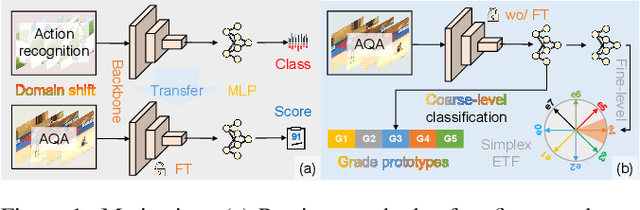
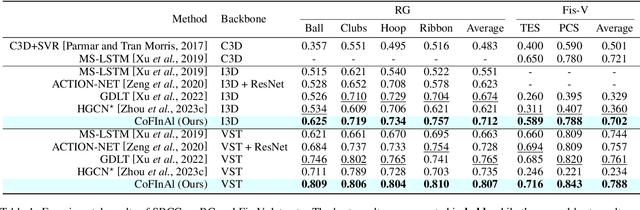
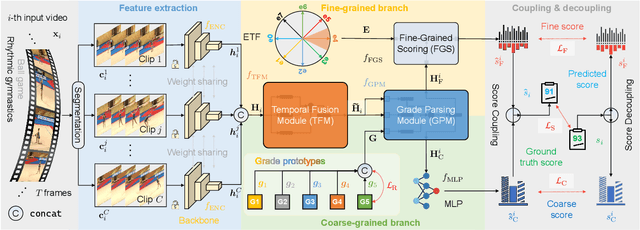
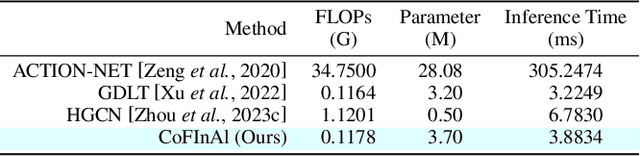
Action Quality Assessment (AQA) is pivotal for quantifying actions across domains like sports and medical care. Existing methods often rely on pre-trained backbones from large-scale action recognition datasets to boost performance on smaller AQA datasets. However, this common strategy yields suboptimal results due to the inherent struggle of these backbones to capture the subtle cues essential for AQA. Moreover, fine-tuning on smaller datasets risks overfitting. To address these issues, we propose Coarse-to-Fine Instruction Alignment (CoFInAl). Inspired by recent advances in large language model tuning, CoFInAl aligns AQA with broader pre-trained tasks by reformulating it as a coarse-to-fine classification task. Initially, it learns grade prototypes for coarse assessment and then utilizes fixed sub-grade prototypes for fine-grained assessment. This hierarchical approach mirrors the judging process, enhancing interpretability within the AQA framework. Experimental results on two long-term AQA datasets demonstrate CoFInAl achieves state-of-the-art performance with significant correlation gains of 5.49% and 3.55% on Rhythmic Gymnastics and Fis-V, respectively. Our code is available at https://github.com/ZhouKanglei/CoFInAl_AQA.