 Add to Chrome
 Add to Firefox
 Add to Edge
SilLang: Improving Gait Recognition with Silhouette Language Encoding
Mar 25, 2026
Gait silhouettes, which can be encoded into binary gait codes, are widely adopted to representing motion patterns of pedestrian. Recent approaches commonly leverage visual backbones to encode gait silhouettes, achieving successful performance. However, they primarily focus on continuous visual features, overlooking the discrete nature of binary silhouettes that inherently share a discrete encoding space with natural language. Large Language Models (LLMs) have demonstrated exceptional capability in extracting discriminative features from discrete sequences and modeling long-range dependencies, highlighting their potential to capture temporal motion patterns by identifying subtle variations. Motivated by these observations, we explore bridging binary gait silhouettes and natural language within a binary encoding space. However, the encoding spaces of text tokens and binary gait silhouettes remain misaligned, primarily due to differences in token frequency and density. To address this issue, we propose the Contour-Velocity Tokenizer, which encodes binary gait silhouettes while reshaping their distribution to better align with the text token space. We then establish a dual-branch framework termed Silhouette Language Model, which enhances visual silhouettes by integrating discrete linguistic embeddings derived from LLMs. Implemented on mainstream gait backbones, SilLang consistently improves state-of-the-art methods across SUSTech1K, GREW, and Gait3D.

TCAQ-DM: Timestep-Channel Adaptive Quantization for Diffusion Models
Dec 21, 2024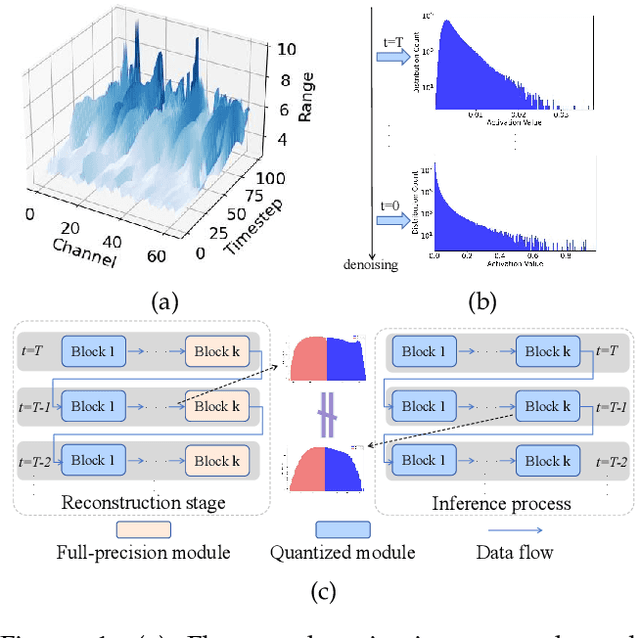


Diffusion models have achieved remarkable success in the image and video generation tasks. Nevertheless, they often require a large amount of memory and time overhead during inference, due to the complex network architecture and considerable number of timesteps for iterative diffusion. Recently, the post-training quantization (PTQ) technique has proved a promising way to reduce the inference cost by quantizing the float-point operations to low-bit ones. However, most of them fail to tackle with the large variations in the distribution of activations across distinct channels and timesteps, as well as the inconsistent of input between quantization and inference on diffusion models, thus leaving much room for improvement. To address the above issues, we propose a novel method dubbed Timestep-Channel Adaptive Quantization for Diffusion Models (TCAQ-DM). Specifically, we develop a timestep-channel joint reparameterization (TCR) module to balance the activation range along both the timesteps and channels, facilitating the successive reconstruction procedure. Subsequently, we employ a dynamically adaptive quantization (DAQ) module that mitigate the quantization error by selecting an optimal quantizer for each post-Softmax layers according to their specific types of distributions. Moreover, we present a progressively aligned reconstruction (PAR) strategy to mitigate the bias caused by the input mismatch. Extensive experiments on various benchmarks and distinct diffusion models demonstrate that the proposed method substantially outperforms the state-of-the-art approaches in most cases, especially yielding comparable FID metrics to the full precision model on CIFAR-10 in the W6A6 setting, while enabling generating available images in the W4A4 settings.