 Add to Chrome
 Add to Firefox
 Add to Edge
NanoMorph-3D: An End-to-End Physics-Driven Unrolling Framework for Nanomaterial Reconstruction
Aug 04, 2026
Precise 3D characterization of nanomaterials is essential for unlocking structure-property relationships. However, standard electron tomography is fundamentally limited by the missing wedge problem. Consequently, conventional algorithms suffer from severe geometric distortions, a challenge further complicated by pervasive noise interference. Current learning-based methods either rely on physics-blind post-processing or employ end-to-end architectures constrained by local receptive fields, failing to capture complex 3D topologies. We propose NanoMorph-3D, a unified end-to-end framework grounded in a comprehensive Nanomorphological Taxonomy. Powered by a large-scale synthetic dataset explicitly modeling non-linear electron attenuation, we design a Physics-Driven Unrolled Network mapping proximal gradient descent into a learnable architecture. To capture complex internal topologies, we formulate a hierarchical attention mechanism with Physics-Normalization for long-range 3D dependencies and scale invariance. Crucially, our Dual-Domain strategy leverages Sinusoidal Attention to explicitly model physical projection trajectories, enforcing strict sinogram consistency to mitigate missing wedge artifacts. Finally, an unsupervised dual-stream mechanism bridges the simulation-to-reality gap. Experiments demonstrate NanoMorph-3D reconstructs diverse topologies with superior fidelity and speed.

3D Gaussian Splatting for Annular Dark Field Scanning Transmission Electron Microscopy Tomography Reconstruction
Apr 06, 2026Analytical Dark Field Scanning Transmission Electron Microscopy (ADF-STEM) tomography reconstructs nanoscale materials in 3D by integrating multi-view tilt-series images, enabling precise analysis of their structural and compositional features. Although integrating more tilt views improves 3D reconstruction, it requires extended electron exposure that risks damaging dose-sensitive materials and introduces drift and misalignment, making it difficult to balance reconstruction fidelity with sample preservation. In practice, sparse-view acquisition is frequently required, yet conventional ADF-STEM methods degrade under limited views, exhibiting artifacts and reduced structural fidelity. To resolve these issues, in this paper, we adapt 3D GS to this domain with three key components. We first model the local scattering strength as a learnable scalar field, denza, to address the mismatch between 3DGS and ADF-STEM imaging physics. Then we introduce a coefficient $γ$ to stabilize scattering across tilt angles, ensuring consistent denza via scattering view normalization. Finally, We incorporate a loss function that includes a 2D Fourier amplitude term to suppress missing wedge artifacts in sparse-view reconstruction. Experiments on 45-view and 15-view tilt series show that DenZa-Gaussian produces high-fidelity reconstructions and 2D projections that align more closely with original tilts, demonstrating superior robustness under sparse-view conditions.
Statistical Characteristic-Guided Denoising for Rapid High-Resolution Transmission Electron Microscopy Imaging
Mar 19, 2026High-Resolution Transmission Electron Microscopy (HRTEM) enables atomic-scale observation of nucleation dynamics, which boosts the studies of advanced solid materials. Nonetheless, due to the millisecond-scale rapid change of nucleation, it requires short-exposure rapid imaging, leading to severe noise that obscures atomic positions. In this work, we propose a statistical characteristic-guided denoising network, which utilizes statistical characteristics to guide the denoising process in both spatial and frequency domains. In the spatial domain, we present spatial deviation-guided weighting to select appropriate convolution operations for each spatial position based on deviation characteristic. In the frequency domain, we present frequency band-guided weighting to enhance signals and suppress noise based on band characteristics. We also develop an HRTEM-specific noise calibration method and generate a dataset with disordered structures and realistic HRTEM image noises. It can ensure the denoising performance of models on real images for nucleation observation. Experiments on synthetic and real data show our method outperforms the state-of-the-art methods in HRTEM image denoising, with effectiveness in the localization downstream task. Code will be available at https://github.com/HeasonLee/SCGN.
Noise Calibration and Spatial-Frequency Interactive Network for STEM Image Enhancement
Apr 03, 2025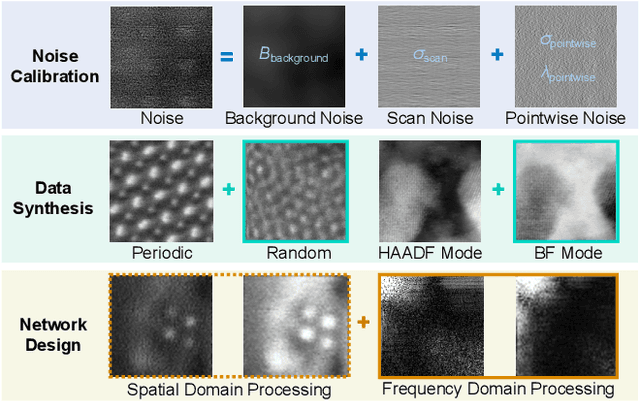
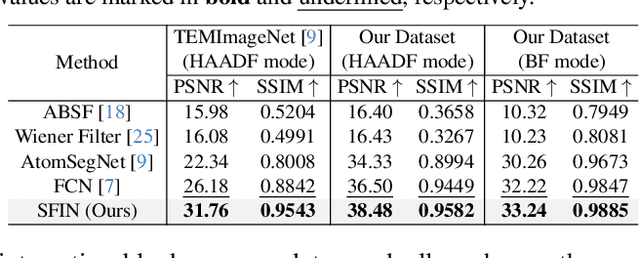
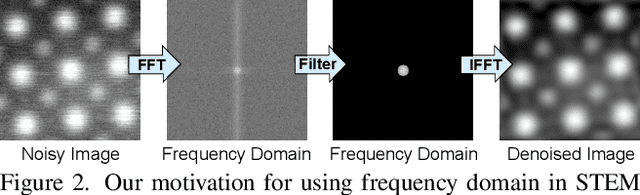
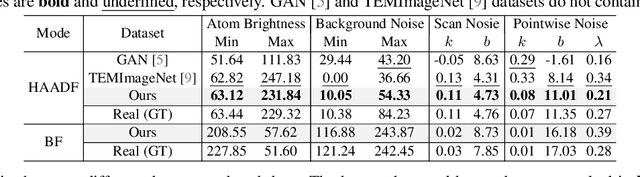
Scanning Transmission Electron Microscopy (STEM) enables the observation of atomic arrangements at sub-angstrom resolution, allowing for atomically resolved analysis of the physical and chemical properties of materials. However, due to the effects of noise, electron beam damage, sample thickness, etc, obtaining satisfactory atomic-level images is often challenging. Enhancing STEM images can reveal clearer structural details of materials. Nonetheless, existing STEM image enhancement methods usually overlook unique features in the frequency domain, and existing datasets lack realism and generality. To resolve these issues, in this paper, we develop noise calibration, data synthesis, and enhancement methods for STEM images. We first present a STEM noise calibration method, which is used to synthesize more realistic STEM images. The parameters of background noise, scan noise, and pointwise noise are obtained by statistical analysis and fitting of real STEM images containing atoms. Then we use these parameters to develop a more general dataset that considers both regular and random atomic arrangements and includes both HAADF and BF mode images. Finally, we design a spatial-frequency interactive network for STEM image enhancement, which can explore the information in the frequency domain formed by the periodicity of atomic arrangement. Experimental results show that our data is closer to real STEM images and achieves better enhancement performances together with our network. Code will be available at https://github.com/HeasonLee/SFIN}{https://github.com/HeasonLee/SFIN.