 Add to Chrome
 Add to Firefox
 Add to Edge
General sample size analysis for probabilities of causation: a delta method approach
Feb 19, 2026
Probabilities of causation (PoCs), such as the probability of necessity and sufficiency (PNS), are important tools for decision making but are generally not point identifiable. Existing work has derived bounds for these quantities using combinations of experimental and observational data. However, there is very limited research on sample size analysis, namely, how many experimental and observational samples are required to achieve a desired margin of error. In this paper, we propose a general sample size framework based on the delta method. Our approach applies to settings in which the target bounds of PoCs can be expressed as finite minima or maxima of linear combinations of experimental and observational probabilities. Through simulation studies, we demonstrate that the proposed sample size calculations lead to stable estimation of these bounds.

Probabilities of Causation: Adequate Size of Experimental and Observational Samples
Oct 10, 2022
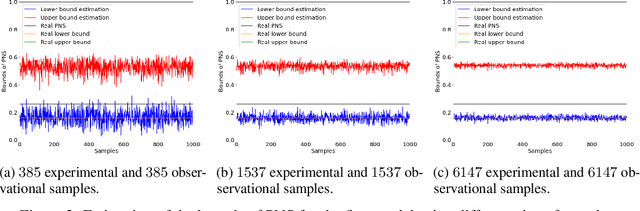
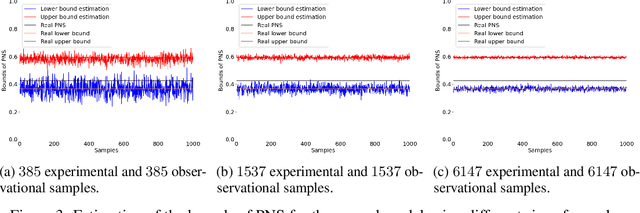
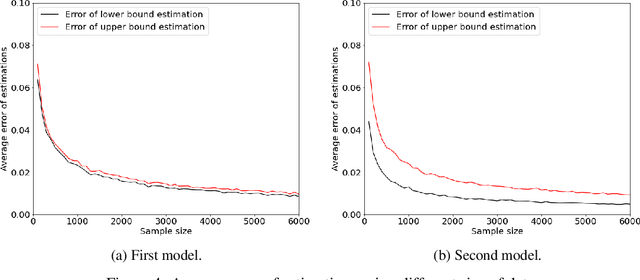
The probabilities of causation are commonly used to solve decision-making problems. Tian and Pearl derived sharp bounds for the probability of necessity and sufficiency (PNS), the probability of sufficiency (PS), and the probability of necessity (PN) using experimental and observational data. The assumption is that one is in possession of a large enough sample to permit an accurate estimation of the experimental and observational distributions. In this study, we present a method for determining the sample size needed for such estimation, when a given confidence interval (CI) is specified. We further show by simulation that the proposed sample size delivered stable estimations of the bounds of PNS.