 Add to Chrome
 Add to Firefox
 Add to Edge
Multiscale aperture synthesis imager
Nov 08, 2025
Synthetic aperture imaging has enabled breakthrough observations from radar to astronomy. However, optical implementation remains challenging due to stringent wavefield synchronization requirements among multiple receivers. Here we present the multiscale aperture synthesis imager (MASI), which utilizes parallelism to break complex optical challenges into tractable sub-problems. MASI employs a distributed array of coded sensors that operate independently yet coherently to surpass the diffraction limit of single receiver. It combines the propagated wavefields from individual sensors through a computational phase synchronization scheme, eliminating the need for overlapping measurement regions to establish phase coherence. Light diffraction in MASI naturally expands the imaging field, generating phase-contrast visualizations that are substantially larger than sensor dimensions. Without using lenses, MASI resolves sub-micron features at ultralong working distances and reconstructs 3D shapes over centimeter-scale fields. MASI transforms the intractable optical synchronization problem into a computational one, enabling practical deployment of scalable synthetic aperture systems at optical wavelengths.

Video-rate gigapixel ptychography via space-time neural field representations
Nov 08, 2025Achieving gigapixel space-bandwidth products (SBP) at video rates represents a fundamental challenge in imaging science. Here we demonstrate video-rate ptychography that overcomes this barrier by exploiting spatiotemporal correlations through neural field representations. Our approach factorizes the space-time volume into low-rank spatial and temporal features, transforming SBP scaling from sequential measurements to efficient correlation extraction. The architecture employs dual networks for decoding real and imaginary field components, avoiding phase-wrapping discontinuities plagued in amplitude-phase representations. A gradient-domain loss on spatial derivatives ensures robust convergence. We demonstrate video-rate gigapixel imaging with centimeter-scale coverage while resolving 308-nm linewidths. Validations span from monitoring sample dynamics of crystals, bacteria, stem cells, microneedle to characterizing time-varying probes in extreme ultraviolet experiments, demonstrating versatility across wavelengths. By transforming temporal variations from a constraint into exploitable correlations, we establish that gigapixel video is tractable with single-sensor measurements, making ptychography a high-throughput sensing tool for monitoring mesoscale dynamics without lenses.
Deep-ultraviolet ptychographic pocket-scope (DART): mesoscale lensless molecular imaging with label-free spectroscopic contrast
Nov 08, 2025The mesoscale characterization of biological specimens has traditionally required compromises between resolution, field-of-view, depth-of-field, and molecular specificity, with most approaches relying on external labels. Here we present the Deep-ultrAviolet ptychogRaphic pockeT-scope (DART), a handheld platform that transforms label-free molecular imaging through intrinsic deep-ultraviolet spectroscopic contrast. By leveraging biomolecules' natural absorption fingerprints and combining them with lensless ptychographic microscopy, DART resolves down to 308-nm linewidths across centimeter-scale areas while maintaining millimeter-scale depth-of-field. The system's virtual error-bin methodology effectively eliminates artifacts from limited temporal coherence and other optical imperfections, enabling high-fidelity molecular imaging without lenses. Through differential spectroscopic imaging at deep-ultraviolet wavelengths, DART quantitatively maps nucleic acid and protein distributions with femtogram sensitivity, providing an intrinsic basis for explainable virtual staining. We demonstrate DART's capabilities through molecular imaging of tissue sections, cytopathology specimens, blood cells, and neural populations, revealing detailed molecular contrast without external labels. The combination of high-resolution molecular mapping and broad mesoscale imaging in a portable platform opens new possibilities from rapid clinical diagnostics, tissue analysis, to biological characterization in space exploration.
Ptychographic non-line-of-sight imaging for depth-resolved visualization of hidden objects
May 17, 2024
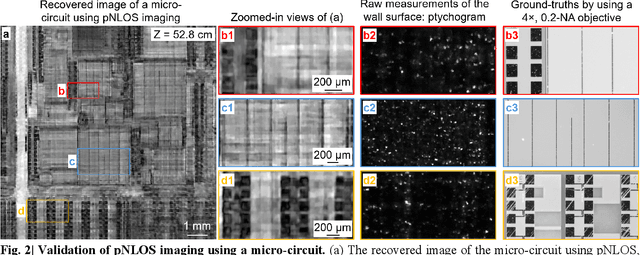


Non-line-of-sight (NLOS) imaging enables the visualization of objects hidden from direct view, with applications in surveillance, remote sensing, and light detection and ranging. Here, we introduce a NLOS imaging technique termed ptychographic NLOS (pNLOS), which leverages coded ptychography for depth-resolved imaging of obscured objects. Our approach involves scanning a laser spot on a wall to illuminate the hidden objects in an obscured region. The reflected wavefields from these objects then travel back to the wall, get modulated by the wall's complex-valued profile, and the resulting diffraction patterns are captured by a camera. By modulating the object wavefields, the wall surface serves the role of the coded layer as in coded ptychography. As we scan the laser spot to different positions, the reflected object wavefields on the wall translate accordingly, with the shifts varying for objects at different depths. This translational diversity enables the acquisition of a set of modulated diffraction patterns referred to as a ptychogram. By processing the ptychogram, we recover both the objects at different depths and the modulation profile of the wall surface. Experimental results demonstrate high-resolution, high-fidelity imaging of hidden objects, showcasing the potential of pNLOS for depth-aware vision beyond the direct line of sight.
Ptychographic sensor for large-scale lensless microbial monitoring with high spatiotemporal resolution
Dec 15, 2021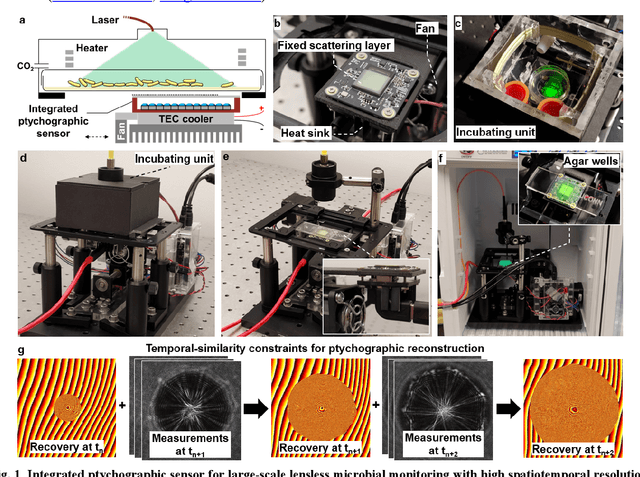
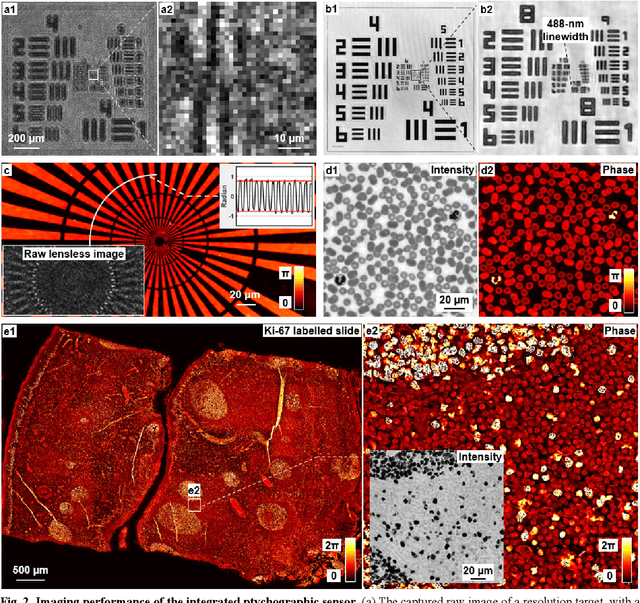
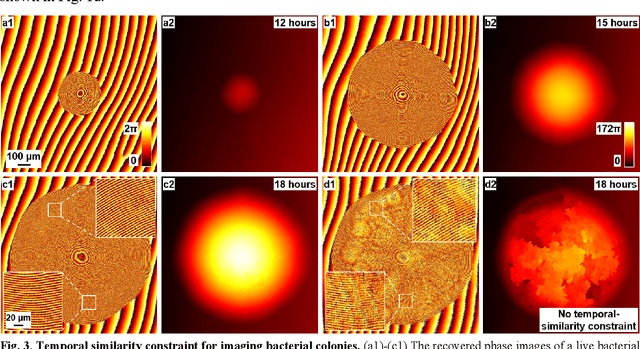
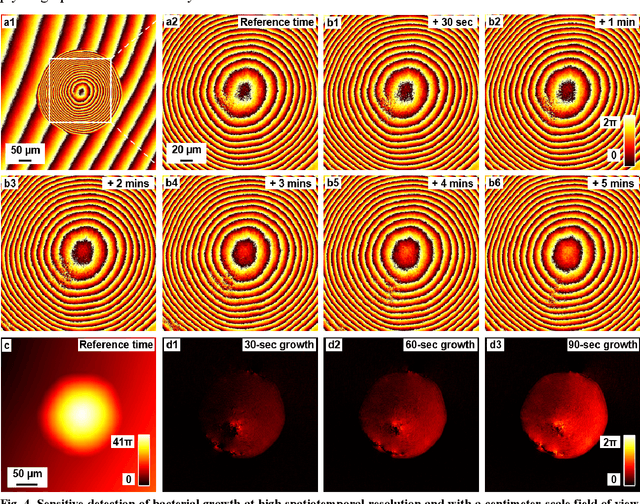
Traditional microbial detection methods often rely on the overall property of microbial cultures and cannot resolve individual growth event at high spatiotemporal resolution. As a result, they require bacteria to grow to confluence and then interpret the results. Here, we demonstrate the application of an integrated ptychographic sensor for lensless cytometric analysis of microbial cultures over a large scale and with high spatiotemporal resolution. The reported device can be placed within a regular incubator or used as a standalone incubating unit for long-term microbial monitoring. For longitudinal study where massive data are acquired at sequential time points, we report a new temporal-similarity constraint to increase the temporal resolution of ptychographic reconstruction by 7-fold. With this strategy, the reported device achieves a centimeter-scale field of view, a half-pitch spatial resolution of 488 nm, and a temporal resolution of 15-second intervals. For the first time, we report the direct observation of bacterial growth in a 15-second interval by tracking the phase wraps of the recovered images, with high phase sensitivity like that in interferometric measurements. We also characterize cell growth via longitudinal dry mass measurement and perform rapid bacterial detection at low concentrations. For drug-screening application, we demonstrate proof-of-concept antibiotic susceptibility testing and perform single-cell analysis of antibiotic-induced filamentation. The combination of high phase sensitivity, high spatiotemporal resolution, and large field of view is unique among existing microscopy techniques. As a quantitative and miniaturized platform, it can improve studies with microorganisms and other biospecimens at resource-limited settings.