 Add to Chrome
 Add to Firefox
 Add to Edge
MoE-TransMov: A Transformer-based Model for Next POI Prediction in Familiar & Unfamiliar Movements
Dec 19, 2025
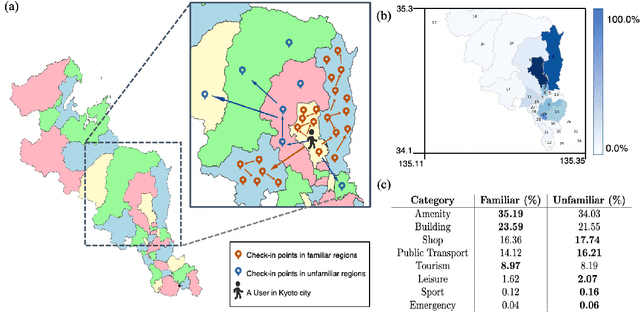
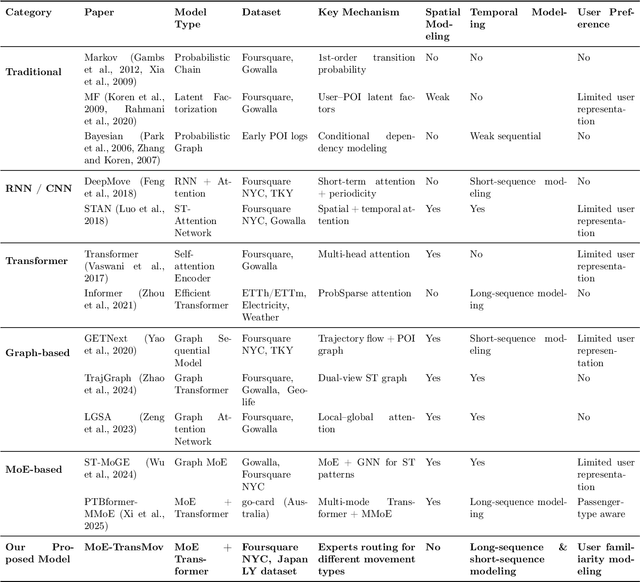
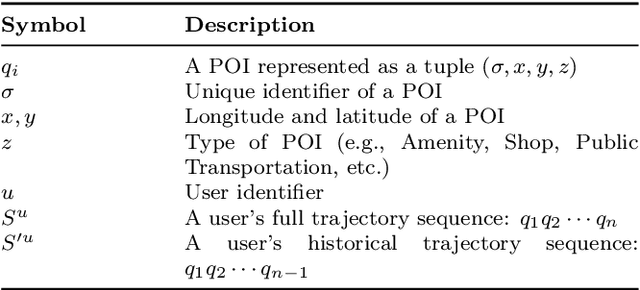
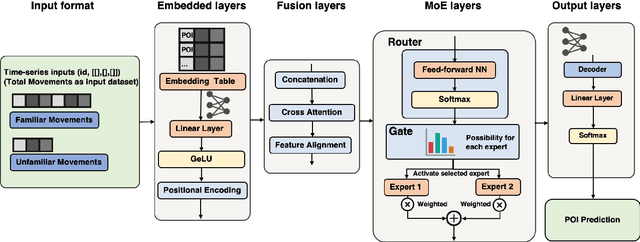
Accurate prediction of the next point of interest (POI) within human mobility trajectories is essential for location-based services, as it enables more timely and personalized recommendations. In particular, with the rise of these approaches, studies have shown that users exhibit different POI choices in their familiar and unfamiliar areas, highlighting the importance of incorporating user familiarity into predictive models. However, existing methods often fail to distinguish between the movements of users in familiar and unfamiliar regions. To address this, we propose MoE-TransMov, a Transformer-based model with a Transformer model with a Mixture-of-Experts (MoE) architecture designed to use one framework to capture distinct mobility patterns across different moving contexts without requiring separate training for certain data. Using user-check-in data, we classify movements into familiar and unfamiliar categories and develop a specialized expert network to improve prediction accuracy. Our approach integrates self-attention mechanisms and adaptive gating networks to dynamically select the most relevant expert models for different mobility contexts. Experiments on two real-world datasets, including the widely used but small open-source Foursquare NYC dataset and the large-scale Kyoto dataset collected with LY Corporation (Yahoo Japan Corporation), show that MoE-TransMov outperforms state-of-the-art baselines with notable improvements in Top-1, Top-5, Top-10 accuracy, and mean reciprocal rank (MRR). Given the results, we find that by using this approach, we can efficiently improve mobility predictions under different moving contexts, thereby enhancing the personalization of recommendation systems and advancing various urban applications.

Data Mining in Transportation Networks with Graph Neural Networks: A Review and Outlook
Jan 28, 2025


Data mining in transportation networks (DMTNs) refers to using diverse types of spatio-temporal data for various transportation tasks, including pattern analysis, traffic prediction, and traffic controls. Graph neural networks (GNNs) are essential in many DMTN problems due to their capability to represent spatial correlations between entities. Between 2016 and 2024, the notable applications of GNNs in DMTNs have extended to multiple fields such as traffic prediction and operation. However, existing reviews have primarily focused on traffic prediction tasks. To fill this gap, this study provides a timely and insightful summary of GNNs in DMTNs, highlighting new progress in prediction and operation from academic and industry perspectives since 2023. First, we present and analyze various DMTN problems, followed by classical and recent GNN models. Second, we delve into key works in three areas: (1) traffic prediction, (2) traffic operation, and (3) industry involvement, such as Google Maps, Amap, and Baidu Maps. Along these directions, we discuss new research opportunities based on the significance of transportation problems and data availability. Finally, we compile resources such as data, code, and other learning materials to foster interdisciplinary communication. This review, driven by recent trends in GNNs in DMTN studies since 2023, could democratize abundant datasets and efficient GNN methods for various transportation problems including prediction and operation.