 Add to Chrome
 Add to Firefox
 Add to Edge
MoE-TransMov: A Transformer-based Model for Next POI Prediction in Familiar & Unfamiliar Movements
Paper and Code
Dec 19, 2025
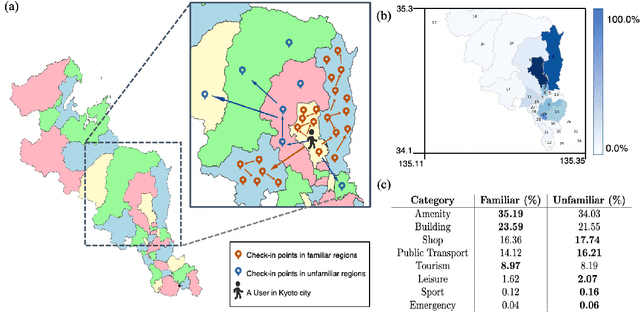
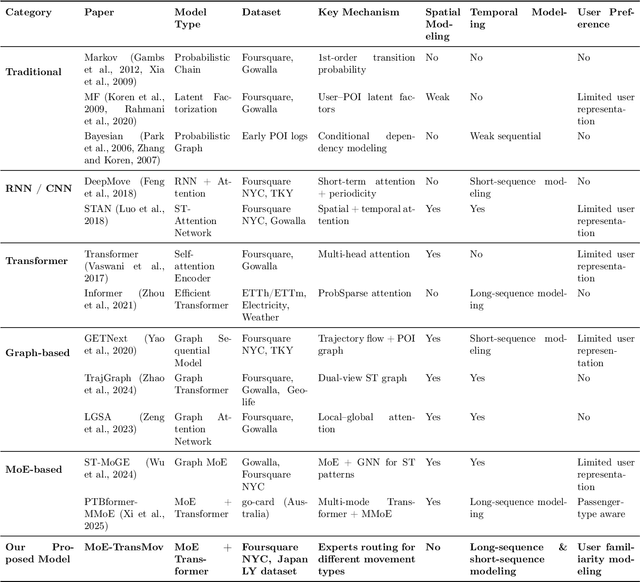
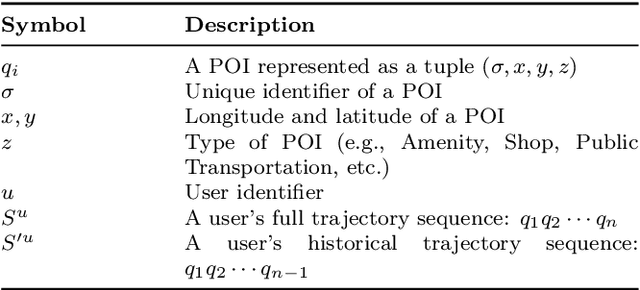
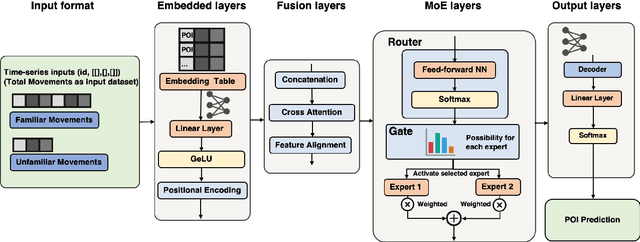
Accurate prediction of the next point of interest (POI) within human mobility trajectories is essential for location-based services, as it enables more timely and personalized recommendations. In particular, with the rise of these approaches, studies have shown that users exhibit different POI choices in their familiar and unfamiliar areas, highlighting the importance of incorporating user familiarity into predictive models. However, existing methods often fail to distinguish between the movements of users in familiar and unfamiliar regions. To address this, we propose MoE-TransMov, a Transformer-based model with a Transformer model with a Mixture-of-Experts (MoE) architecture designed to use one framework to capture distinct mobility patterns across different moving contexts without requiring separate training for certain data. Using user-check-in data, we classify movements into familiar and unfamiliar categories and develop a specialized expert network to improve prediction accuracy. Our approach integrates self-attention mechanisms and adaptive gating networks to dynamically select the most relevant expert models for different mobility contexts. Experiments on two real-world datasets, including the widely used but small open-source Foursquare NYC dataset and the large-scale Kyoto dataset collected with LY Corporation (Yahoo Japan Corporation), show that MoE-TransMov outperforms state-of-the-art baselines with notable improvements in Top-1, Top-5, Top-10 accuracy, and mean reciprocal rank (MRR). Given the results, we find that by using this approach, we can efficiently improve mobility predictions under different moving contexts, thereby enhancing the personalization of recommendation systems and advancing various urban applications.
