 Add to Chrome
 Add to Firefox
 Add to Edge
Allocating Recurrent Compute in Looped Language Models
Aug 18, 2026
Looped language models improve reasoning and knowledge manipulation by applying shared computation repeatedly. Existing systems usually repeat an entire layer stack, although a mixer and a dense feed-forward network (FFN) perform different operations and have different costs. We ask a narrower question: what should loop? We view recurrence as repeated composition of a state update and argue that an application is valuable when it exposes a new cross-position influence direction that remains observable at the task readout. Iterative Transport Rank (ITR) describes the cumulative influence trajectory; marginal ITR describes the nonredundant influence contributed by successive applications. This view motivates MixerLoop, which repeats each Gated DeltaNet mixer while applying its dense FFN once. We compare MixerLoop with no recurrence and full-block recurrence at 15M and 110M parameters under the same data, initialization, and architecture. A finite context-off intervention tests whether later mixer applications produce distinct, non-negligible, and beneficial changes at the final language-model readout. MixerLoop surpasses FullLoop on aggregate CORE at 15M and retains 41.5% of its CORE improvement at 110M while reducing recurrent-backbone projection FLOPs by 45.9%. These results show that the benefits of recurrent depth can be retained without repeatedly executing the dense FFN.

Reducing Data Bottlenecks in Distributed, Heterogeneous Neural Networks
Oct 12, 2024

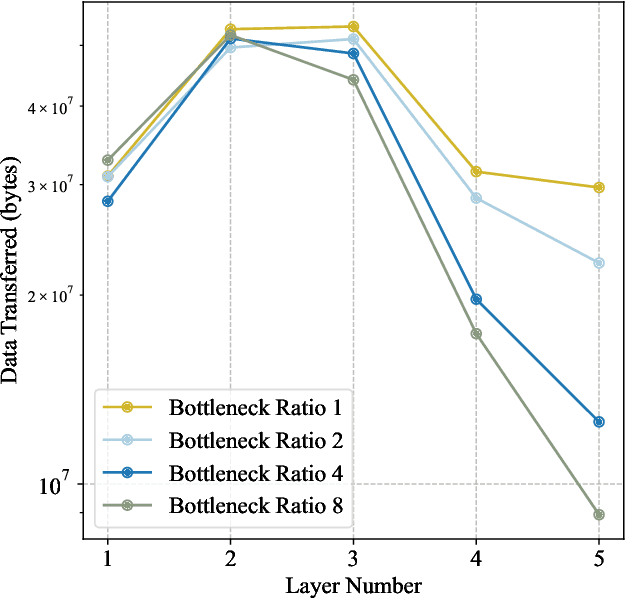
The rapid advancement of embedded multicore and many-core systems has revolutionized computing, enabling the development of high-performance, energy-efficient solutions for a wide range of applications. As models scale up in size, data movement is increasingly the bottleneck to performance. This movement of data can exist between processor and memory, or between cores and chips. This paper investigates the impact of bottleneck size, in terms of inter-chip data traffic, on the performance of deep learning models in embedded multicore and many-core systems. We conduct a systematic analysis of the relationship between bottleneck size, computational resource utilization, and model accuracy. We apply a hardware-software co-design methodology where data bottlenecks are replaced with extremely narrow layers to reduce the amount of data traffic. In effect, time-multiplexing of signals is replaced by learnable embeddings that reduce the demands on chip IOs. Our experiments on the CIFAR100 dataset demonstrate that the classification accuracy generally decreases as the bottleneck ratio increases, with shallower models experiencing a more significant drop compared to deeper models. Hardware-side evaluation reveals that higher bottleneck ratios lead to substantial reductions in data transfer volume across the layers of the neural network. Through this research, we can determine the trade-off between data transfer volume and model performance, enabling the identification of a balanced point that achieves good performance while minimizing data transfer volume. This characteristic allows for the development of efficient models that are well-suited for resource-constrained environments.