 Add to Chrome
 Add to Firefox
 Add to Edge
TCFormer: A 5M-Parameter Transformer with Density-Guided Aggregation for Weakly-Supervised Crowd Counting
Dec 21, 2025
Crowd counting typically relies on labor-intensive point-level annotations and computationally intensive backbones, restricting its scalability and deployment in resource-constrained environments. To address these challenges, this paper proposes the TCFormer, a tiny, ultra-lightweight, weakly-supervised transformer-based crowd counting framework with only 5 million parameters that achieves competitive performance. Firstly, a powerful yet efficient vision transformer is adopted as the feature extractor, the global context-aware capabilities of which provides semantic meaningful crowd features with a minimal memory footprint. Secondly, to compensate for the lack of spatial supervision, we design a feature aggregation mechanism termed the Learnable Density-Weighted Averaging module. This module dynamically re-weights local tokens according to predicted density scores, enabling the network to adaptively modulate regional features based on their specific density characteristics without the need for additional annotations. Furthermore, this paper introduces a density-level classification loss, which discretizes crowd density into distinct grades, thereby regularizing the training process and enhancing the model's classification power across varying levels of crowd density. Therefore, although TCformer is trained under a weakly-supervised paradigm utilizing only image-level global counts, the joint optimization of count and density-level losses enables the framework to achieve high estimation accuracy. Extensive experiments on four benchmarks including ShanghaiTech A/B, UCF-QNRF, and NWPU datasets demonstrate that our approach strikes a superior trade-off between parameter efficiency and counting accuracy and can be a good solution for crowd counting tasks in edge devices.

MCNet: A crowd denstity estimation network based on integrating multiscale attention module
Mar 29, 2024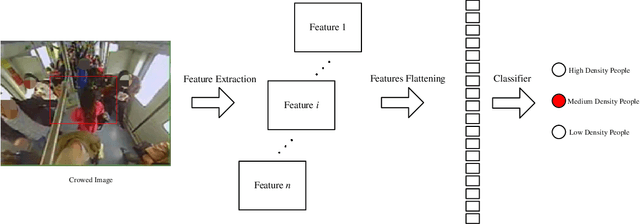

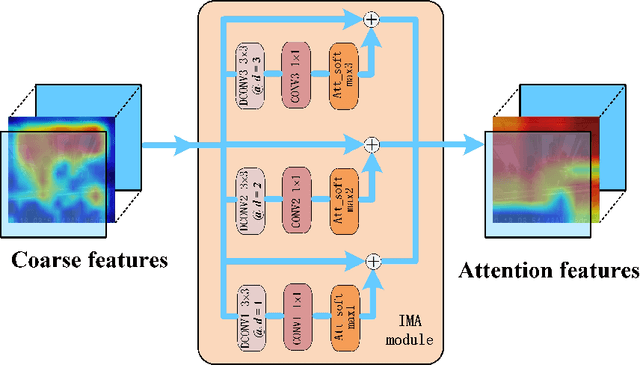
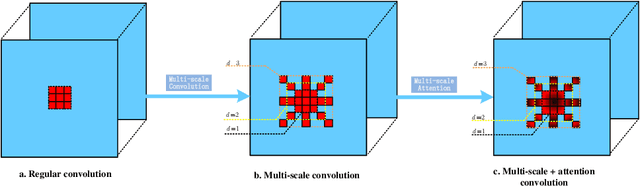
Aiming at the metro video surveillance system has not been able to effectively solve the metro crowd density estimation problem, a Metro Crowd density estimation Network (called MCNet) is proposed to automatically classify crowd density level of passengers. Firstly, an Integrating Multi-scale Attention (IMA) module is proposed to enhance the ability of the plain classifiers to extract semantic crowd texture features to accommodate to the characteristics of the crowd texture feature. The innovation of the IMA module is to fuse the dilation convolution, multiscale feature extraction and attention mechanism to obtain multi-scale crowd feature activation from a larger receptive field with lower computational cost, and to strengthen the crowds activation state of convolutional features in top layers. Secondly, a novel lightweight crowd texture feature extraction network is proposed, which can directly process video frames and automatically extract texture features for crowd density estimation, while its faster image processing speed and fewer network parameters make it flexible to be deployed on embedded platforms with limited hardware resources. Finally, this paper integrates IMA module and the lightweight crowd texture feature extraction network to construct the MCNet, and validate the feasibility of this network on image classification dataset: Cifar10 and four crowd density datasets: PETS2009, Mall, QUT and SH_METRO to validate the MCNet whether can be a suitable solution for crowd density estimation in metro video surveillance where there are image processing challenges such as high density, high occlusion, perspective distortion and limited hardware resources.