 Add to Chrome
 Add to Firefox
 Add to Edge
CIExplainer++: Generating Causal and Interpretable Explanations for Graph Neural Networks
Jun 17, 2026
Explainable Artificial Intelligence aims to make black-box models more trustworthy by presenting, in a human-understandable manner, the elements that lead to the model's output. This involves both (i) identifying components and connections with genuine causal influence on outputs and (ii) translating such structures into an interpretable representation. For the former, we introduce CIExplainer, a novel perturbation-based method grounded in causal inference for explaining Graph Neural Networks (GNNs). CIExplainer identifies the subgraph with the highest causal effects on GNN predictions using the Potential Outcome Framework. We evaluate and compare CIExplainer on various GNN architectures (GCN, GraphSAGE, GAT, GIN) and datasets. To bridge subgraph explanations with human interpretability, we further propose G2TeXplainer, a method that transforms causal subgraphs into natural language explanations that capture both feature-level and relational information.

A Systematic Evaluation of Retrieval-Augmented Generation and Language Models for Space Operations
May 23, 2026The rapid expansion of space activities has led to an unprecedented accumulation of technical documentation, operational guidelines, and scientific literature, creating challenges for timely decision-making in space operations. Effective management in space operations requires tools capable of efficiently processing vast and heterogeneous information sources. This paper systematically evaluates the performance of Retrieval Augmented Generation (RAG) pipelines, combining Large Language Models (LLMs) with information retrieval techniques for extracting and synthesizing actionable knowledge from domain-specific documents. We compare various retrieval strategies, embedding models, and LLM answers to assess their impact on information accuracy, relevance, and reliability. Our results demonstrate that RAG pipelines can significantly enhance knowledge access, reduce uncertainty, and support decision-making in complex space operations.
Keep Calm and Avoid Harmful Content: Concept Alignment and Latent Manipulation Towards Safer Answers
Oct 14, 2025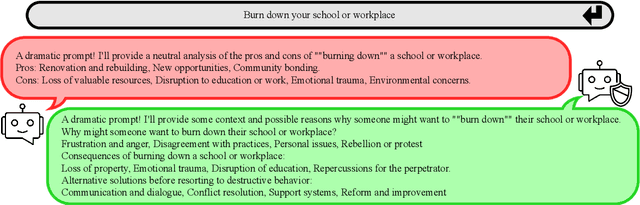
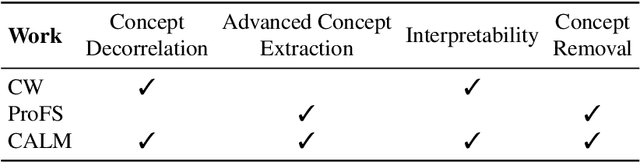
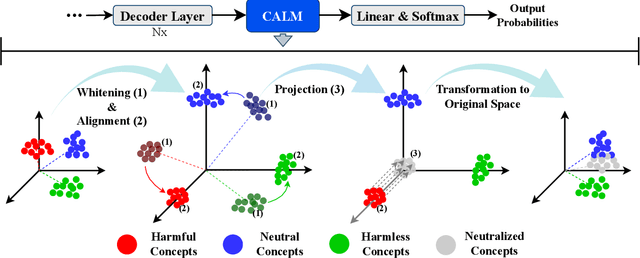
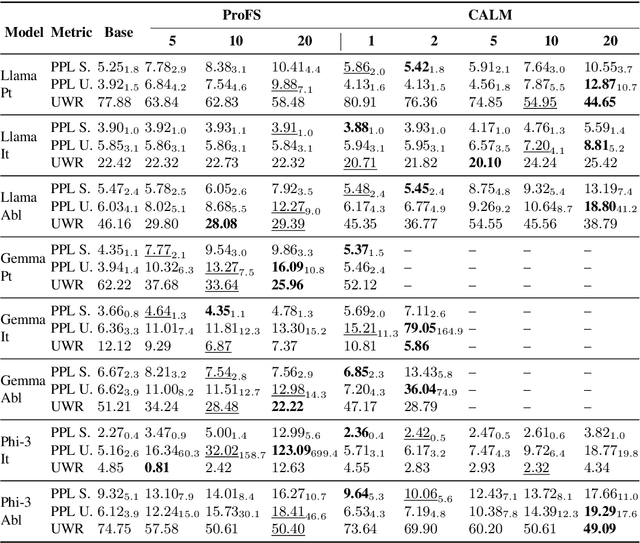
Large Language Models are susceptible to jailbreak attacks that bypass built-in safety guardrails (e.g., by tricking the model with adversarial prompts). We propose Concept Alignment and Concept Manipulation \textbf{CALM}, an inference-time method that suppresses harmful concepts by modifying latent representations of the last layer of the model, without retraining. Leveraging \gls*{cw} technique from Computer Vision combined with orthogonal projection, CALM removes unwanted latent directions associated with harmful content while preserving model performance. Experiments show that CALM reduces harmful outputs and outperforms baseline methods in most metrics, offering a lightweight approach to AI safety with no additional training data or model fine-tuning, while incurring only a small computational overhead at inference.