 Add to Chrome
 Add to Firefox
 Add to Edge
LAST: The Last Query Token Guides Visual Token Pruning for Edge-Cloud Collaborative MLLM Inference
Jul 30, 2026
Multimodal foundation models are reshaping edge-cloud visual intelligence from task-specific feature pipelines into token-based interfaces, where edge devices encode visual inputs into tokens for a general-purpose cloud MLLM. However, dense visual-token sequences increase cloud-side inference costs. Existing pruning methods mainly target centralized inference: vision-driven methods can operate before cloud execution but are typically query-agnostic, whereas query-guided methods often rely on internal states of the target MLLM and cannot determine token relevance before transmission. Compact guidance models offer an alternative, but existing designs may require costly attention aggregation or auxiliary generation. We propose LAST, a training-free framework for query-dependent visual token pruning in edge-cloud collaborative MLLM inference. LAST uses a compact edge-side VLM as a guidance proxy and derives a lightweight importance signal from the last query token's attention to visual tokens. Under causal attention, the last query token can attend to the full visual sequence and the entire query context, enabling query-aware pruning without cloud-model access, autoregressive generation, or costly aggregation over multiple query positions. LAST then retains a diverse set of query-relevant visual tokens under a fixed token budget. We evaluate LAST on 11 multimodal benchmarks under multiple token budgets against pruning methods with different guidance strategies. Experiments show that LAST consistently achieves the strongest performance, preserving 95.4% of the full-token accuracy while retaining only 12.5% of the visual tokens, with low edge-side selection overhead and reduced cloud-side computation.

LUMI: Tokenizer-Agnostic LLM-Based Lossless Image Compression
Jul 09, 2026Large language model (LLM)-based lossless image compression methods typically represent pixel data through the native text interface of a pretrained model, converting pixel values into token sequences that the LLM processes through its vocabulary head. This design shows that pretrained language models can provide probability estimates for image coding, but it also couples compression to tokenizer behavior, vocabulary-specific numeric tokens, and model-family-specific adaptation. In this paper, we present LUMI (LLM-based Unified Model-agnostic lossless Image compression), a tokenizer-agnostic framework for lossless RGB image compression with frozen LLM backbones. LUMI replaces pixel-as-text tokenization with a pixel embedding module that maps raw intensity and channel information into the continuous embedding space of the LLM. It further introduces intra-patch position encoding to retain two-dimensional spatial structure after flattening, and uses a 256-way prediction head to produce probabilities over the native pixel alphabet. Only the pixel embedding, position encoding, soft-prefix parameters, and prediction head are trained, while the LLM backbone remains fixed. Experiments on natural, medical, and remote-sensing image benchmarks with LLaMA, Qwen, and Gemma backbones show that LUMI provides a unified interface across tokenizer families, achieves competitive compression rates, and improves cross-domain robustness over tokenizer-based LLM compression baselines. These results formulate LLM-based lossless image compression as pixel-space adaptation of frozen foundation models rather than tokenizer-specific language-symbol modeling.
Boosting Neural Video Codec via Scale-Driven Online Flow Refinement
Jun 22, 2026Although state-of-the-art neural video codecs (NVCs) have achieved remarkable performance, they suffer from limited generalization when encountering complex motion patterns unseen during training. To bridge this domain gap without the expensive cost of online fine-tuning, we propose a Training-Free Scale-Driven Online Flow Refinement (SOFR) method. Serving as a plug-and-play module, SOFR integrates motion information from coarse and fine scales and dynamically fuses them according to warping accuracy, effectively rectifying motion estimation errors with negligible computational overhead. Furthermore, we design a rate-aware strategy that selects different dynamic fusion strategies according to bitrate modes, and employs a reliability check based on warping error to ensure robustness. Extensive experiments on the USTC-TD dataset verify the effectiveness and generalization of SOFR across various NVC frameworks, including DCVC-SDD, DCVC-FM, and EHVC. Notably, it brings an average of 2.84% and 4.05% bitrate savings in terms of PSNR and MS-SSIM, respectively, to DCVC-FM with negligible coding time increase. Our code is available at https://github.com/SunnyMass/SOFR.
Neural Video Compression with Domain Transfer
May 13, 2026Content-adaptive compression has always been a key direction in neural video coding (NVC), aiming to mitigate the domain gap between training and testing data. Such gaps often arise from distributional discrepancies between training and inference data, which may cause noticeable performance degradation when the testing content differs from the training distribution. To tackle this challenge, we propose DCVC-DT, a domain transfer enhanced neural video compression framework. Specifically, we design a lightweight online domain transfer (DT) mechanism that dynamically adapts the encoded latent representation during inference, effectively bridging the domain gap without modifying the encoder or decoder parameters. In addition, we develop a frame-level dynamic RD (Rate and Distortion) adjustment scheme that actively regulates the ratio of R and D in the loss function based on quality fluctuation, thereby improving rate-distortion performance. Extensive experiments demonstrate that DCVC-DT achieves up to 6.21% bitrate savings over the baseline DCVC-DC, while significantly enhancing generalization to unseen testing data and alleviating error propagation. Our code is available at https://github.com/SunnyMass/DCVC-DT.
Towards Modality Transferable Visual Information Representation with Optimal Model Compression
Aug 13, 2020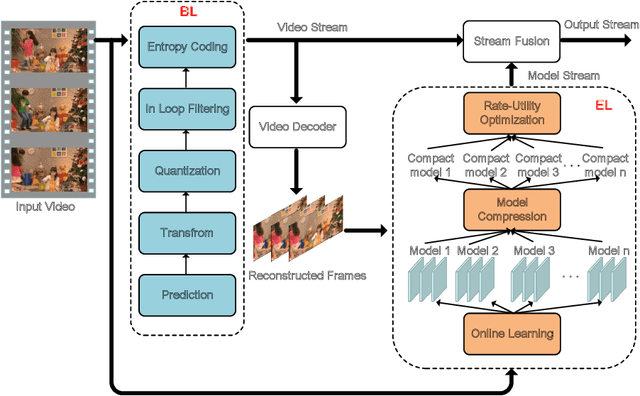
Compactly representing the visual signals is of fundamental importance in various image/video-centered applications. Although numerous approaches were developed for improving the image and video coding performance by removing the redundancies within visual signals, much less work has been dedicated to the transformation of the visual signals to another well-established modality for better representation capability. In this paper, we propose a new scheme for visual signal representation that leverages the philosophy of transferable modality. In particular, the deep learning model, which characterizes and absorbs the statistics of the input scene with online training, could be efficiently represented in the sense of rate-utility optimization to serve as the enhancement layer in the bitstream. As such, the overall performance can be further guaranteed by optimizing the new modality incorporated. The proposed framework is implemented on the state-of-the-art video coding standard (i.e., versatile video coding), and significantly better representation capability has been observed based on extensive evaluations.