 Add to Chrome
 Add to Firefox
 Add to Edge
OMUDA: Omni-level Masking for Unsupervised Domain Adaptation in Semantic Segmentation
Dec 13, 2025
Unsupervised domain adaptation (UDA) enables semantic segmentation models to generalize from a labeled source domain to an unlabeled target domain. However, existing UDA methods still struggle to bridge the domain gap due to cross-domain contextual ambiguity, inconsistent feature representations, and class-wise pseudo-label noise. To address these challenges, we propose Omni-level Masking for Unsupervised Domain Adaptation (OMUDA), a unified framework that introduces hierarchical masking strategies across distinct representation levels. Specifically, OMUDA comprises: 1) a Context-Aware Masking (CAM) strategy that adaptively distinguishes foreground from background to balance global context and local details; 2) a Feature Distillation Masking (FDM) strategy that enhances robust and consistent feature learning through knowledge transfer from pre-trained models; and 3) a Class Decoupling Masking (CDM) strategy that mitigates the impact of noisy pseudo-labels by explicitly modeling class-wise uncertainty. This hierarchical masking paradigm effectively reduces the domain shift at the contextual, representational, and categorical levels, providing a unified solution beyond existing approaches. Extensive experiments on multiple challenging cross-domain semantic segmentation benchmarks validate the effectiveness of OMUDA. Notably, on the SYNTHIA->Cityscapes and GTA5->Cityscapes tasks, OMUDA can be seamlessly integrated into existing UDA methods and consistently achieving state-of-the-art results with an average improvement of 7%.

Small Boxes Big Data: A Deep Learning Approach to Optimize Variable Sized Bin Packing
Feb 14, 2017
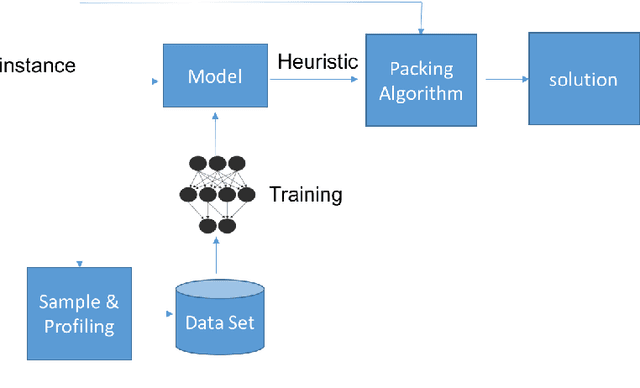
Bin Packing problems have been widely studied because of their broad applications in different domains. Known as a set of NP-hard problems, they have different vari- ations and many heuristics have been proposed for obtaining approximate solutions. Specifically, for the 1D variable sized bin packing problem, the two key sets of optimization heuristics are the bin assignment and the bin allocation. Usually the performance of a single static optimization heuristic can not beat that of a dynamic one which is tailored for each bin packing instance. Building such an adaptive system requires modeling the relationship between bin features and packing perform profiles. The primary drawbacks of traditional AI machine learnings for this task are the natural limitations of feature engineering, such as the curse of dimensionality and feature selection quality. We introduce a deep learning approach to overcome the drawbacks by applying a large training data set, auto feature selection and fast, accurate labeling. We show in this paper how to build such a system by both theoretical formulation and engineering practices. Our prediction system achieves up to 89% training accuracy and 72% validation accuracy to select the best heuristic that can generate a better quality bin packing solution.