 Add to Chrome
 Add to Firefox
 Add to Edge
LAMP: Latent Motion Prior-Guided Real-World Learning for Dexterous Hand Manipulation
Jul 07, 2026
Real-world learning for dexterous hands remains brittle because high-dimensional hand actions amplify imitation errors and make reinforcement-learning exploration prone to contact-breaking motion. While combining imitation learning (IL) with online reinforcement learning (RL) can reduce manual supervision, unconstrained exploration in raw hand-action spaces is sample-inefficient and risky for physical hardware. We introduce a latent motion prior module (\prior{}) that maps recent hand-action histories to a compact, history-conditioned latent prior and decodes continuous latent commands into executable high-dimensional hand targets. Built on this prior, \method{} is a three-stage real-world dexterous learning framework: it pretrains \prior{} from demonstrations, trains a visuomotor policy that predicts native arm commands and latent hand-action offsets, and improves the policy with online residual RL in the same latent hand-action space. This shared, decodable interface lets residual exploration make local corrections near demonstrated, contact-consistent hand motions rather than perturbing every finger joint independently. We evaluate \method{} on four real-robot dexterous manipulation tasks against raw, linear, and discrete hand-action interfaces. Starting from small task-specific demonstration sets, \method{} achieves a 56.25\% average IL success rate and raises it to 98.75\% after online RL, reaching 100\% final success on three tasks and 95\% on the remaining task.

OMUDA: Omni-level Masking for Unsupervised Domain Adaptation in Semantic Segmentation
Dec 13, 2025Unsupervised domain adaptation (UDA) enables semantic segmentation models to generalize from a labeled source domain to an unlabeled target domain. However, existing UDA methods still struggle to bridge the domain gap due to cross-domain contextual ambiguity, inconsistent feature representations, and class-wise pseudo-label noise. To address these challenges, we propose Omni-level Masking for Unsupervised Domain Adaptation (OMUDA), a unified framework that introduces hierarchical masking strategies across distinct representation levels. Specifically, OMUDA comprises: 1) a Context-Aware Masking (CAM) strategy that adaptively distinguishes foreground from background to balance global context and local details; 2) a Feature Distillation Masking (FDM) strategy that enhances robust and consistent feature learning through knowledge transfer from pre-trained models; and 3) a Class Decoupling Masking (CDM) strategy that mitigates the impact of noisy pseudo-labels by explicitly modeling class-wise uncertainty. This hierarchical masking paradigm effectively reduces the domain shift at the contextual, representational, and categorical levels, providing a unified solution beyond existing approaches. Extensive experiments on multiple challenging cross-domain semantic segmentation benchmarks validate the effectiveness of OMUDA. Notably, on the SYNTHIA->Cityscapes and GTA5->Cityscapes tasks, OMUDA can be seamlessly integrated into existing UDA methods and consistently achieving state-of-the-art results with an average improvement of 7%.
A Dataset for Analysing News Framing in Chinese Media
Mar 06, 2025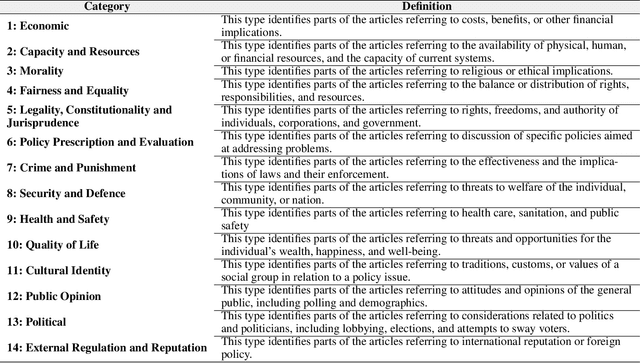
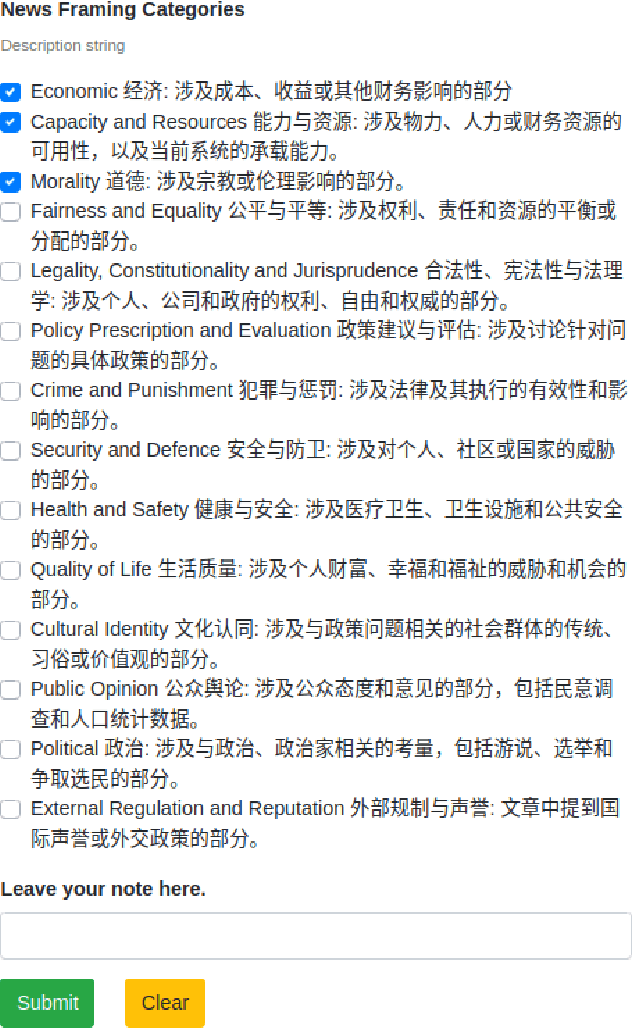
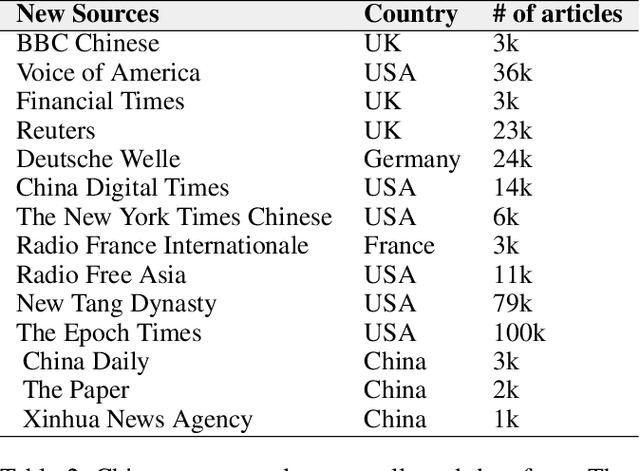

Framing is an essential device in news reporting, allowing the writer to influence public perceptions of current affairs. While there are existing automatic news framing detection datasets in various languages, none of them focus on news framing in the Chinese language which has complex character meanings and unique linguistic features. This study introduces the first Chinese News Framing dataset, to be used as either a stand-alone dataset or a supplementary resource to the SemEval-2023 task 3 dataset. We detail its creation and we run baseline experiments to highlight the need for such a dataset and create benchmarks for future research, providing results obtained through fine-tuning XLM-RoBERTa-Base and using GPT-4o in the zero-shot setting. We find that GPT-4o performs significantly worse than fine-tuned XLM-RoBERTa across all languages. For the Chinese language, we obtain an F1-micro (the performance metric for SemEval task 3, subtask 2) score of 0.719 using only samples from our Chinese News Framing dataset and a score of 0.753 when we augment the SemEval dataset with Chinese news framing samples. With positive news frame detection results, this dataset is a valuable resource for detecting news frames in the Chinese language and is a valuable supplement to the SemEval-2023 task 3 dataset.