 Add to Chrome
 Add to Firefox
 Add to Edge
The Information Shadow: Measuring Structural Limits on What Language Models Can Learn
Jul 17, 2026
Some limits on what language models know are not gaps in data coverage but structural properties of learning from text. We introduce the information shadow: the region of phenomena that a text-trained learner cannot acquire regardless of scale, comprising (I) structures language cannot express, (II) functions that are statistically non-identifiable from the training distribution, and (III) functions that are representable but unreachable by gradient-based training. We give each type a probe that is decisive because the premise of the shadow is, in that setting, provable. For Type I, Language Compression Residuals compare a text learner, which sees only a lossy text-like encoding of the signal, against a full-signal learner, which sees the underlying signal directly. The text learner sits at a computable expressibility ceiling while the full-signal learner pulls away by a gap that stays flat across 300x more data, so the deficit is a property of the channel, not of training. For Type II, the Counterfactual Distinction Test trains models on data exactly consistent with two incompatible rules. Across a provable string task and a language-like agreement task, behavior on counterfactuals is set by the model's inductive bias, while 5% disambiguating data steers the learned rule bidirectionally to either target (r = +/-1.0, p < 1e-10). For Type III, Basin Escape Mapping exhibits a function that is representable at 100% (by hand construction) yet reached 0% of the time by standard training and instantly from a nearby initialization, with width scaling providing no help (p = 1.6 x 10^-14). Each effect is isolated by a control that rules out a capacity or modality artifact. We release the probe suite and discuss implications for benchmark design, capability auditing, and shadow-aware uncertainty.

FairMed-XGB: A Bayesian-Optimised Multi-Metric Framework with Explainability for Demographic Equity in Critical Healthcare Data
Mar 16, 2026Machine learning models deployed in critical care settings exhibit demographic biases, particularly gender disparities, that undermine clinical trust and equitable treatment. This paper introduces FairMed-XGB, a novel framework that systematically detects and mitigates gender-based prediction bias while preserving model performance and transparency. The framework integrates a fairness-aware loss function combining Statistical Parity Difference, Theil Index, and Wasserstein Distance, jointly optimised via Bayesian Search into an XGBoost classifier. Post-mitigation evaluation on seven clinically distinct cohorts derived from the MIMIC-IV-ED and eICU databases demonstrates substantial bias reduction: Statistical Parity Difference decreases by 40 to 51 percent on MIMIC-IV-ED and 10 to 19 percent on eICU; Theil Index collapses by four to five orders of magnitude to near-zero values; Wasserstein Distance is reduced by 20 to 72 percent. These gains are achieved with negligible degradation in predictive accuracy (AUC-ROC drop <0.02). SHAP-based explainability reveals that the framework diminishes reliance on gender-proxy features, providing clinicians with actionable insights into how and where bias is corrected. FairMed-XGB offers a robust, interpretable, and ethically aligned solution for equitable clinical decision-making, paving the way for trustworthy deployment of AI in high-stakes healthcare environments.
Enhancing Machine Learning Model Efficiency through Quantization and Bit Depth Optimization: A Performance Analysis on Healthcare Data
Nov 16, 2025This research aims to optimize intricate learning models by implementing quantization and bit-depth optimization techniques. The objective is to significantly cut time complexity while preserving model efficiency, thus addressing the challenge of extended execution times in intricate models. Two medical datasets were utilized as case studies to apply a Logistic Regression (LR) machine learning model. Using efficient quantization and bit depth optimization strategies the input data is downscaled from float64 to float32 and int32. The results demonstrated a significant reduction in time complexity, with only a minimal decrease in model accuracy post-optimization, showcasing the state-of-the-art optimization approach. This comprehensive study concludes that the impact of these optimization techniques varies depending on a set of parameters.
* Published as Chapter 2 in Intelligent and Smart Computing: Applications to Engineering Problems, Cambridge Scholars Publishing (2025). ISBN: 978-1-0364-5886-7
MiVID: Multi-Strategic Self-Supervision for Video Frame Interpolation using Diffusion Model
Nov 08, 2025Video Frame Interpolation (VFI) remains a cornerstone in video enhancement, enabling temporal upscaling for tasks like slow-motion rendering, frame rate conversion, and video restoration. While classical methods rely on optical flow and learning-based models assume access to dense ground-truth, both struggle with occlusions, domain shifts, and ambiguous motion. This article introduces MiVID, a lightweight, self-supervised, diffusion-based framework for video interpolation. Our model eliminates the need for explicit motion estimation by combining a 3D U-Net backbone with transformer-style temporal attention, trained under a hybrid masking regime that simulates occlusions and motion uncertainty. The use of cosine-based progressive masking and adaptive loss scheduling allows our network to learn robust spatiotemporal representations without any high-frame-rate supervision. Our framework is evaluated on UCF101-7 and DAVIS-7 datasets. MiVID is trained entirely on CPU using the datasets and 9-frame video segments, making it a low-resource yet highly effective pipeline. Despite these constraints, our model achieves optimal results at just 50 epochs, competitive with several supervised baselines.This work demonstrates the power of self-supervised diffusion priors for temporally coherent frame synthesis and provides a scalable path toward accessible and generalizable VFI systems.
Adversarial-Ensemble Kolmogorov Arnold Networks for Enhancing Indoor Wi-Fi Positioning: A Defensive Approach Against Spoofing and Signal Manipulation Attacks
Jan 16, 2025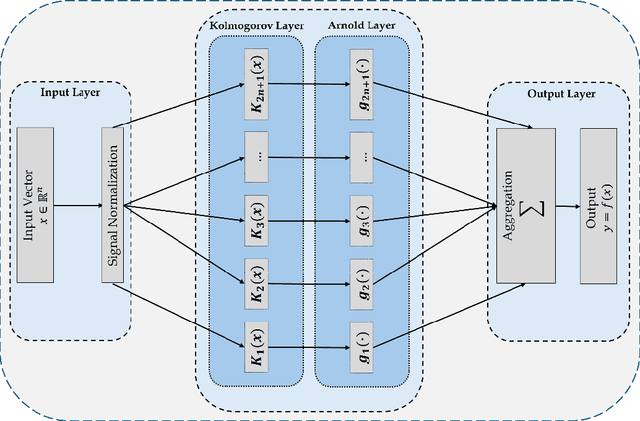
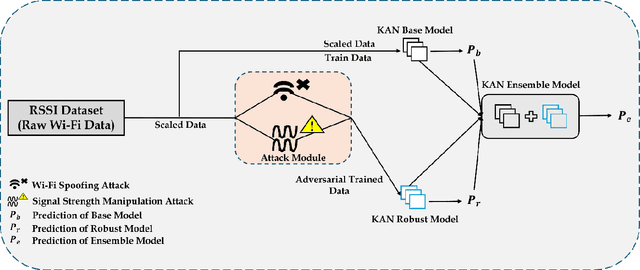
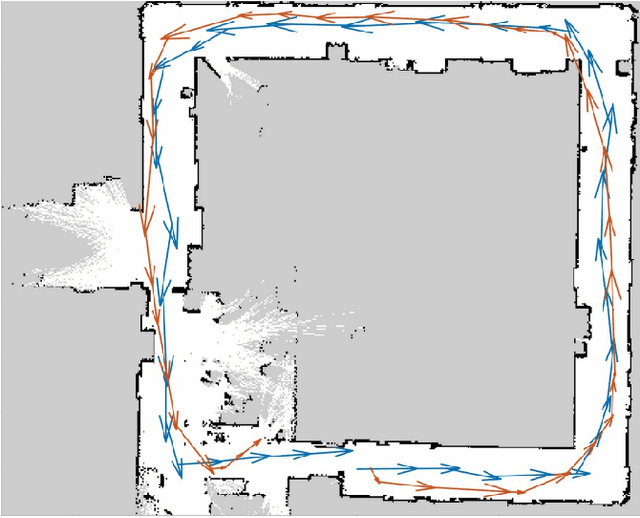
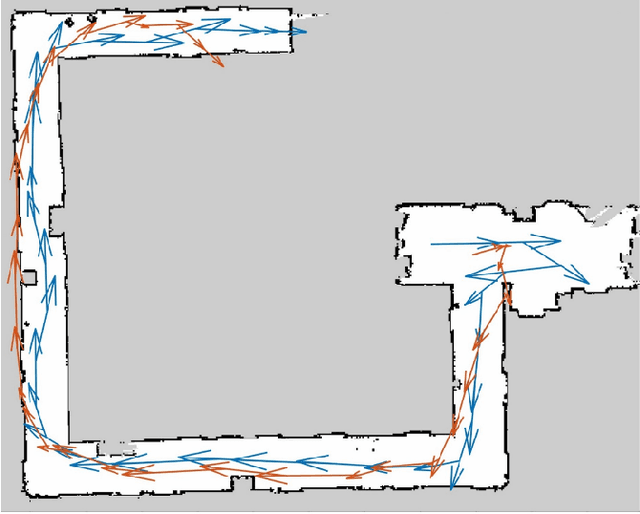
The research presents a study on enhancing the robustness of Wi-Fi-based indoor positioning systems against adversarial attacks. The goal is to improve the positioning accuracy and resilience of these systems under two attack scenarios: Wi-Fi Spoofing and Signal Strength Manipulation. Three models are developed and evaluated: a baseline model (M_Base), an adversarially trained robust model (M_Rob), and an ensemble model (M_Ens). All models utilize a Kolmogorov-Arnold Network (KAN) architecture. The robust model is trained with adversarially perturbed data, while the ensemble model combines predictions from both the base and robust models. Experimental results show that the robust model reduces positioning error by approximately 10% compared to the baseline, achieving 2.03 meters error under Wi-Fi spoofing and 2.00 meters under signal strength manipulation. The ensemble model further outperforms with errors of 2.01 meters and 1.975 meters for the respective attack types. This analysis highlights the effectiveness of adversarial training techniques in mitigating attack impacts. The findings underscore the importance of considering adversarial scenarios in developing indoor positioning systems, as improved resilience can significantly enhance the accuracy and reliability of such systems in mission-critical environments.
A Unified Framework for Continual Learning and Machine Unlearning
Aug 21, 2024Continual learning and machine unlearning are crucial challenges in machine learning, typically addressed separately. Continual learning focuses on adapting to new knowledge while preserving past information, whereas unlearning involves selectively forgetting specific subsets of data. In this paper, we introduce a novel framework that jointly tackles both tasks by leveraging controlled knowledge distillation. Our approach enables efficient learning with minimal forgetting and effective targeted unlearning. By incorporating a fixed memory buffer, the system supports learning new concepts while retaining prior knowledge. The distillation process is carefully managed to ensure a balance between acquiring new information and forgetting specific data as needed. Experimental results on benchmark datasets show that our method matches or exceeds the performance of existing approaches in both continual learning and machine unlearning. This unified framework is the first to address both challenges simultaneously, paving the way for adaptable models capable of dynamic learning and forgetting while maintaining strong overall performance.