 Add to Chrome
 Add to Firefox
 Add to Edge
Ghost-FWL: A Large-Scale Full-Waveform LiDAR Dataset for Ghost Detection and Removal
Mar 30, 2026
LiDAR has become an essential sensing modality in autonomous driving, robotics, and smart-city applications. However, ghost points (or ghosts), which are false reflections caused by multi-path laser returns from glass and reflective surfaces, severely degrade 3D mapping and localization accuracy. Prior ghost removal relies on geometric consistency in dense point clouds, failing on mobile LiDAR's sparse, dynamic data. We address this by exploiting full-waveform LiDAR (FWL), which captures complete temporal intensity profiles rather than just peak distances, providing crucial cues for distinguishing ghosts from genuine reflections in mobile scenarios. As this is a new task, we present Ghost-FWL, the first and largest annotated mobile FWL dataset for ghost detection and removal. Ghost-FWL comprises 24K frames across 10 diverse scenes with 7.5 billion peak-level annotations, which is 100x larger than existing annotated FWL datasets. Benefiting from this large-scale dataset, we establish a FWL-based baseline model for ghost detection and propose FWL-MAE, a masked autoencoder for efficient self-supervised representation learning on FWL data. Experiments show that our baseline outperforms existing methods in ghost removal accuracy, and our ghost removal further enhances downstream tasks such as LiDAR-based SLAM (66% trajectory error reduction) and 3D object detection (50x false positive reduction). The dataset and code is publicly available and can be accessed via the project page: https://keio-csg.github.io/Ghost-FWL

D-SLAMSpoof: An Environment-Agnostic LiDAR Spoofing Attack using Dynamic Point Cloud Injection
Mar 11, 2026In this work, we introduce Dynamic SLAMSpoof (D-SLAMSpoof), a novel attack that compromises LiDAR SLAM even in feature-rich environments. The attack leverages LiDAR spoofing, which injects spurious measurements into LiDAR scans through external laser interference. By designing both spatial injection shapes and temporally coordinated dynamic injection patterns guided by scan-matching principles, D-SLAMSpoof significantly improves attack success rates in real-world, feature-rich environments such as urban areas and indoor spaces, where conventional LiDAR spoofing methods often fail. Furthermore, we propose a practical defense method, ISD-SLAM, that relies solely on inertial dead reckoning signals commonly available in autonomous systems. We demonstrate that ISD-SLAM accurately detects LiDAR spoofing attacks, including D-SLAMSpoof, and effectively mitigates the resulting position drift. Our findings expose inherent vulnerabilities in LiDAR-based SLAM and introduce the first practical defense against LiDAR-based SLAM spoofing using only standard onboard sensors, providing critical insights for improving the security and reliability of autonomous systems.
MirrorDrift: Actuated Mirror-Based Attacks on LiDAR SLAM
Mar 11, 2026LiDAR SLAM provides high-accuracy localization but is fragile to point-cloud corruption because scan matching assumes geometric consistency. Prior physical attacks on LiDAR SLAM largely rely on LiDAR spoofing via external signal injection, which requires sensor-specific timing knowledge and is increasingly mitigated by modern defense mechanisms such as timing obfuscation and injection rejection. In this work, we show that specular reflection offers an injection-free alternative and demonstrate an attack, MirrorDrift, that uses an actuated planar mirror to cause ghost points in LiDAR scans and systematically bias scan-matching correspondences. MirrorDrift optimizes mirror placement, alignment, and actuation. In simulation, it increases the average pose error (APE) by 6.1x over random placement, degrading three SLAM systems to 2.29-3.31 m mean APE. In real-world experiments on a modern LiDAR with state-of-the-art interference mitigation, it induces localization errors of up to 6.03 m. To the best of our knowledge, this is the first successful SLAM-targeted attack against production-grade secure LiDARs.
SLAMSpoof: Practical LiDAR Spoofing Attacks on Localization Systems Guided by Scan Matching Vulnerability Analysis
Feb 19, 2025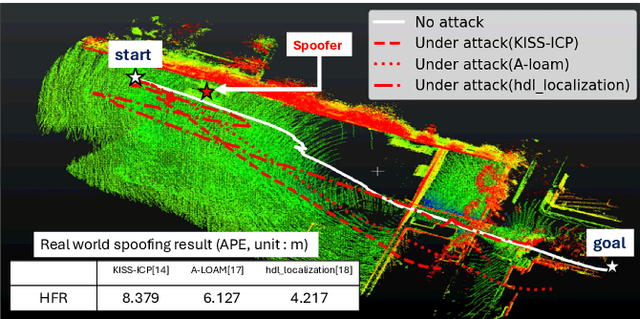

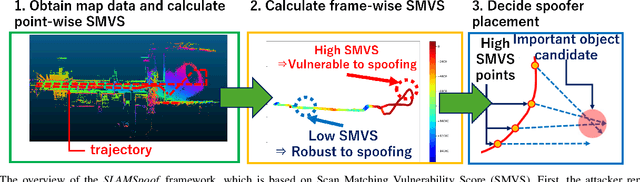
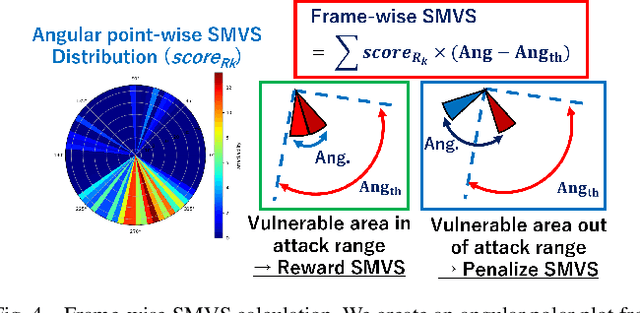
Accurate localization is essential for enabling modern full self-driving services. These services heavily rely on map-based traffic information to reduce uncertainties in recognizing lane shapes, traffic light locations, and traffic signs. Achieving this level of reliance on map information requires centimeter-level localization accuracy, which is currently only achievable with LiDAR sensors. However, LiDAR is known to be vulnerable to spoofing attacks that emit malicious lasers against LiDAR to overwrite its measurements. Once localization is compromised, the attack could lead the victim off roads or make them ignore traffic lights. Motivated by these serious safety implications, we design SLAMSpoof, the first practical LiDAR spoofing attack on localization systems for self-driving to assess the actual attack significance on autonomous vehicles. SLAMSpoof can effectively find the effective attack location based on our scan matching vulnerability score (SMVS), a point-wise metric representing the potential vulnerability to spoofing attacks. To evaluate the effectiveness of the attack, we conduct real-world experiments on ground vehicles and confirm its high capability in real-world scenarios, inducing position errors of $\geq$4.2 meters (more than typical lane width) for all 3 popular LiDAR-based localization algorithms. We finally discuss the potential countermeasures of this attack. Code is available at https://github.com/Keio-CSG/slamspoof