 Add to Chrome
 Add to Firefox
 Add to Edge
Improving Driver Satisfaction with a Driving Function Learning from Implicit Human Feedback -- a Test Group Study
Feb 14, 2026
During the use of advanced driver assistance systems, drivers frequently intervene into the active driving function and adjust the system's behavior to their personal wishes. These active driver-initiated takeovers contain feedback about deviations in the driving function's behavior from the drivers' personal preferences. This feedback should be utilized to optimize and personalize the driving function's behavior. In this work, the adjustment of the speed profile of a Predictive Longitudinal Driving Function (PLDF) on a pre-defined route is highlighted. An algorithm is introduced which iteratively adjusts the PLDF's speed profile by taking into account both the original speed profile of the PLDF and the driver demonstration. This approach allows for personalization in a traded control scenario during active use of the PLDF. The applicability of the proposed algorithm is tested in a driving simulator-based test group study with 43 participants. The study finds a significant increase in driver satisfaction and a significant reduction in the intervention frequency when using the proposed adaptive PLDF. Additionally, feedback by the participants was gathered to identify further optimization potentials of the proposed system.

An Analysis of Driver-Initiated Takeovers during Assisted Driving and their Effect on Driver Satisfaction
Apr 19, 2024During the use of Advanced Driver Assistance Systems (ADAS), drivers can intervene in the active function and take back control due to various reasons. However, the specific reasons for driver-initiated takeovers in naturalistic driving are still not well understood. In order to get more information on the reasons behind these takeovers, a test group study was conducted. There, 17 participants used a predictive longitudinal driving function for their daily commutes and annotated the reasons for their takeovers during active function use. In this paper, the recorded takeovers are analyzed and the different reasons for them are highlighted. The results show that the reasons can be divided into three main categories. The most common category consists of takeovers which aim to adjust the behavior of the ADAS within its Operational Design Domain (ODD) in order to better match the drivers' personal preferences. Other reasons include takeovers due to leaving the ADAS's ODD and corrections of incorrect sensing state information. Using the questionnaire results of the test group study, it was found that the number and frequency of takeovers especially within the ADAS's ODD have a significant negative impact on driver satisfaction. Therefore, the driver satisfaction with the ADAS could be increased by adapting its behavior to the drivers' wishes and thereby lowering the number of takeovers within the ODD. The information contained in the takeover behavior of the drivers could be used as feedback for the ADAS. Finally, it is shown that there are considerable differences in the takeover behavior of different drivers, which shows a need for ADAS individualization.
Combining Visual Saliency Methods and Sparse Keypoint Annotations to Providently Detect Vehicles at Night
Apr 25, 2022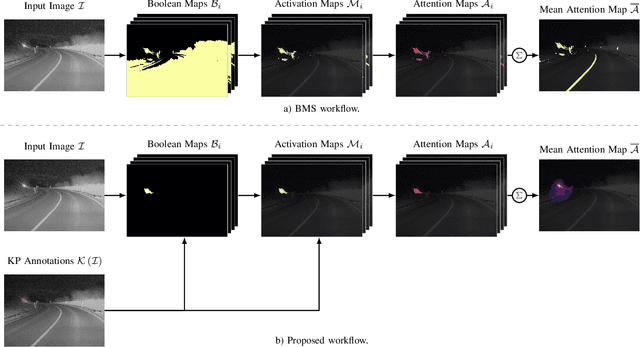

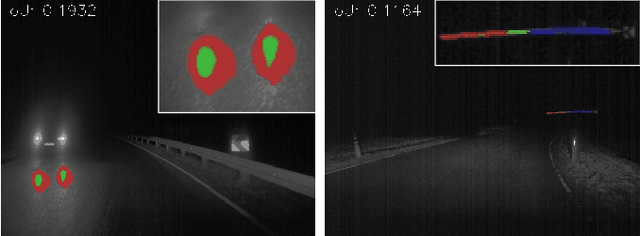
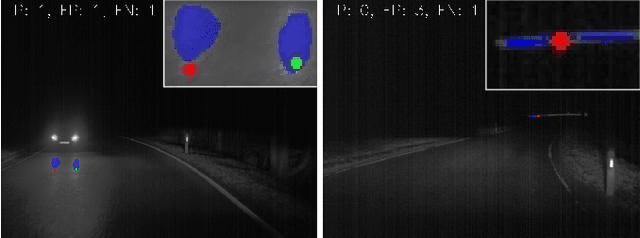
Provident detection of other road users at night has the potential for increasing road safety. For this purpose, humans intuitively use visual cues, such as light cones and light reflections emitted by other road users to be able to react to oncoming traffic at an early stage. This behavior can be imitated by computer vision methods by predicting the appearance of vehicles based on emitted light reflections caused by the vehicle's headlights. Since current object detection algorithms are mainly based on detecting directly visible objects annotated via bounding boxes, the detection and annotation of light reflections without sharp boundaries is challenging. For this reason, the extensive open-source dataset PVDN (Provident Vehicle Detection at Night) was published, which includes traffic scenarios at night with light reflections annotated via keypoints. In this paper, we explore the potential of saliency-based approaches to create different object representations based on the visual saliency and sparse keypoint annotations of the PVDN dataset. For that, we extend the general idea of Boolean map saliency towards a context-aware approach by taking into consideration sparse keypoint annotations by humans. We show that this approach allows for an automated derivation of different object representations, such as binary maps or bounding boxes so that detection models can be trained on different annotation variants and the problem of providently detecting vehicles at night can be tackled from different perspectives. With that, we provide further powerful tools and methods to study the problem of detecting vehicles at night before they are actually visible.