 Add to Chrome
 Add to Firefox
 Add to Edge
Machine learning prediction of obstructive coronary artery disease using opportunistic coronary calcium and epicardial fat assessments from CT calcium scoring scans
May 20, 2026
Non-contrast computed tomography calcium scoring (CTCS) is a cost-effective imaging modality widely used to detect coronary artery calcifications. This study aimed to develop an advanced machine learning framework that utilizes quantitative analyses of coronary calcium and epicardial fat from CTCS images to predict obstructive coronary artery disease (CAD). The study population consisted of 1,324 patients from the SCOT-HEART clinical trial who underwent both CTCS and coronary CT angiography. We extracted and analyzed a broad range of features, including 24 clinical variables, 189 calcium-omics, and 211 epicardial fat-omics features from the CTCS images. Feature selection was conducted using the CatBoost algorithm combined with SHapley Additive exPlanation (SHAP) values. Predictive modeling utilized the CatBoost gradient boosting method, focusing on the most informative features. From an initial set of 424 candidate features, 14 were identified as most predictive through the CatBoost-SHAP method. The top two predictive features originated from fat-omics, with the remaining 12 features derived from calcium-omics. The optimized model achieved robust predictive capabilities, demonstrating a sensitivity of 83.1+/-4.6%, specificity of 93.8+/-1.7%, accuracy of 85.3+/-2.0%, and an F1 score of 73.9+/-3.3%. Inclusion of calcium-omics and fat-omics data significantly improved predictive performance. Notably, the model also showed reliable predictive accuracy in patients with diverse coronary calcium scores, including cases with obstructive CAD despite a zero-calcium score. This innovative approach holds promise for improving clinical decision-making and potentially reducing dependence on contrast-enhanced or invasive diagnostic procedures, particularly within low-to intermediate-risk patient groups.

Quantitative coronary calcification analysis for prediction of myocardial ischemia using non-contrast CT calcium scoring
May 20, 2026Non-contrast computed tomography calcium scoring (CTCS) is widely recognized as an effective tool for cardiovascular risk stratification. This study aimed to develop a novel machine learning framework for predicting myocardial ischemia from routine non-contrast CTCS scans using quantitative coronary calcium assessment. This study analyzed 1,375 patients who underwent both non-contrast CTCS and regadenoson stress cardiac positron emission tomography myocardial perfusion imaging within one year at University Hospitals Cleveland Medical Center. A total of 74 variables, including clinical variables, Agatston score, and calcium-omics features, were evaluated. Relevant features were identified using XGBoost with Shapley Additive exPlanations (SHAP). Predictive models were trained and evaluated using 5-fold cross-validation. Among 987 patients, 89 (9%) were positive for myocardial ischemia. The final model incorporated the Agatston score, eight calcium-omics features, and age. The proposed model achieved a precision of 98.9+/-3.0%, sensitivity of 79.2+/-8.4, and F1 score of 87.7+/-5.3%. The addition of calcium-omics features significantly improved predictive performance compared with models using clinical variables alone or clinical variables with the Agatston score (p<0.05). Interestingly, the number of calcified arteries, despite being the lowest-ranked feature based on SHAP analysis, showed the strongest association with myocardial ischemia in logistic regression analysis (odds ratio: 3.63, 95% confidence interval: 2.80-4.77, p<0.00001). We developed a machine learning approach for predicting myocardial ischemia using routinely acquired non-contrast CTCS scans. Calcium-omics features provided incremental predictive value beyond conventional risk factors and Agatston scoring and may support more accessible cardiovascular risk stratification.
Enhancing cardiovascular risk prediction through AI-enabled calcium-omics
Aug 23, 2023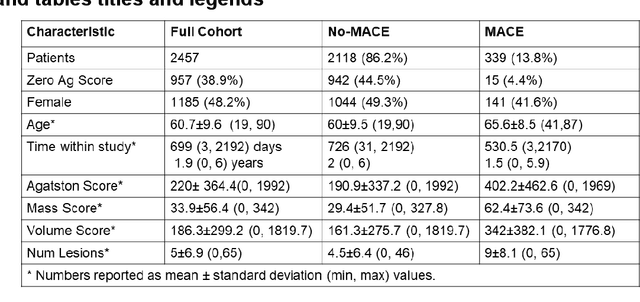
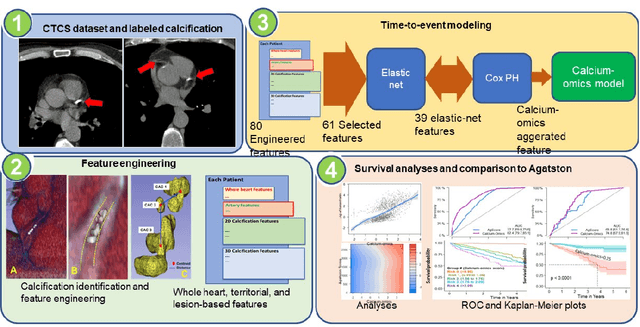
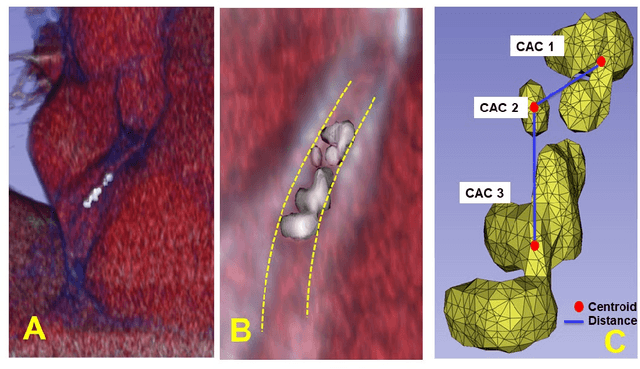

Background. Coronary artery calcium (CAC) is a powerful predictor of major adverse cardiovascular events (MACE). Traditional Agatston score simply sums the calcium, albeit in a non-linear way, leaving room for improved calcification assessments that will more fully capture the extent of disease. Objective. To determine if AI methods using detailed calcification features (i.e., calcium-omics) can improve MACE prediction. Methods. We investigated additional features of calcification including assessment of mass, volume, density, spatial distribution, territory, etc. We used a Cox model with elastic-net regularization on 2457 CT calcium score (CTCS) enriched for MACE events obtained from a large no-cost CLARIFY program (ClinicalTri-als.gov Identifier: NCT04075162). We employed sampling techniques to enhance model training. We also investigated Cox models with selected features to identify explainable high-risk characteristics. Results. Our proposed calcium-omics model with modified synthetic down sampling and up sampling gave C-index (80.5%/71.6%) and two-year AUC (82.4%/74.8%) for (80:20, training/testing), respectively (sampling was applied to the training set only). Results compared favorably to Agatston which gave C-index (71.3%/70.3%) and AUC (71.8%/68.8%), respectively. Among calcium-omics features, numbers of calcifications, LAD mass, and diffusivity (a measure of spatial distribution) were important determinants of increased risk, with dense calcification (>1000HU) associated with lower risk. The calcium-omics model reclassified 63% of MACE patients to the high risk group in a held-out test. The categorical net-reclassification index was NRI=0.153. Conclusions. AI analysis of coronary calcification can lead to improved results as compared to Agatston scoring. Our findings suggest the utility of calcium-omics in improved prediction of risk.