 Add to Chrome
 Add to Firefox
 Add to Edge
DeepCORO-CLIP: A Multi-View Foundation Model for Comprehensive Coronary Angiography Video-Text Analysis and External Validation
Mar 18, 2026
Coronary angiography is the reference standard for evaluating coronary artery disease, yet visual interpretation remains variable between readers. Existing artificial intelligence methods typically analyze single frames or projections and focus mainly on stenosis, limiting comprehensive coronary assessment. We present DeepCORO-CLIP, a multi-view foundation model trained with video-text contrastive learning on 203,808 angiography videos from 28,117 patients across 32,473 studies at the Montreal Heart Institute and externally validated on 4,249 studies from the University of California, San Francisco. DeepCORO-CLIP integrates multiple projections with attention-based pooling for study-level assessment across diagnostic, prognostic, and disease progression tasks. For significant stenosis detection, the model achieved an AUROC of 0.888 internally and 0.89 on external validation. Mean absolute error against core laboratory quantitative coronary angiography was 13.6%, lower than clinical reports at 19.0%. The model also performed strongly for chronic total occlusion, intracoronary thrombus, and coronary calcification detection. Transfer learning enabled prediction of one-year major adverse cardiovascular events with AUROC 0.79 and estimation of left ventricular ejection fraction with mean absolute error 7.3%. Embeddings also captured disease progression across serial examinations. With a mean inference time of 4.2 seconds in hospital deployment, DeepCORO-CLIP provides a foundation for automated coronary angiography interpretation at the point of care. Code, sample data, model weights, and deployment infrastructure are publicly released.

CathAI: Fully Automated Interpretation of Coronary Angiograms Using Neural Networks
Jun 14, 2021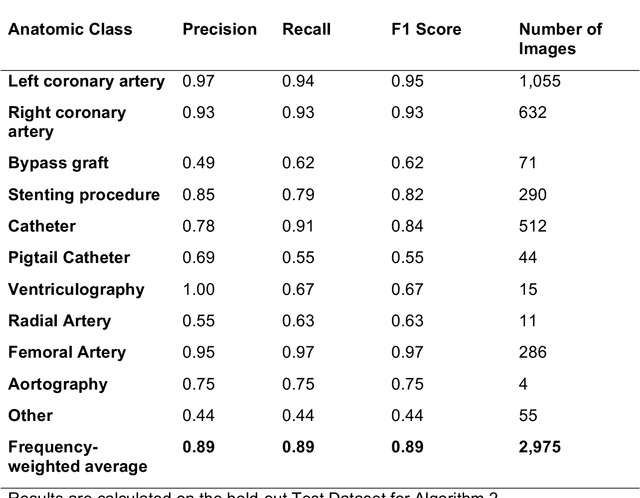
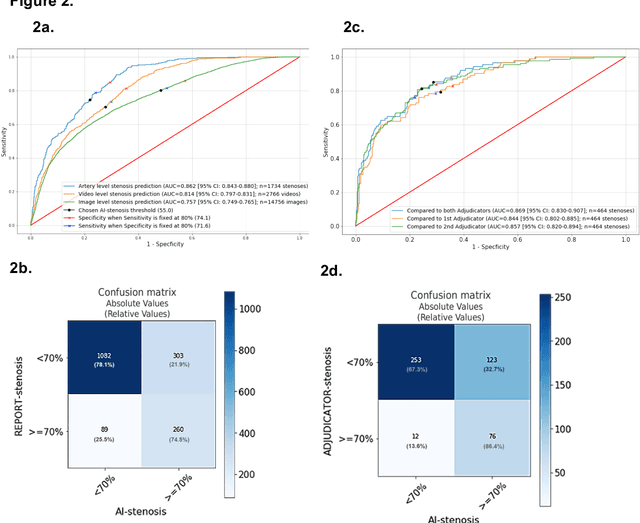
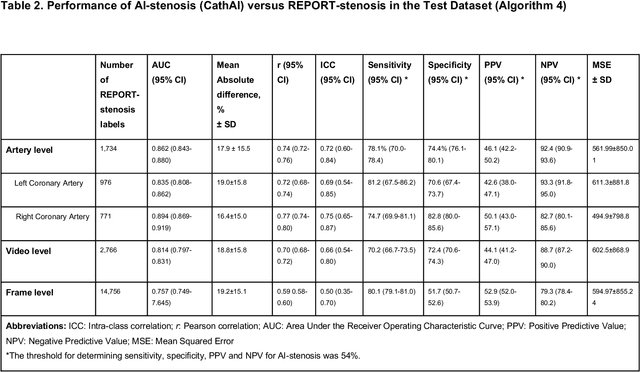
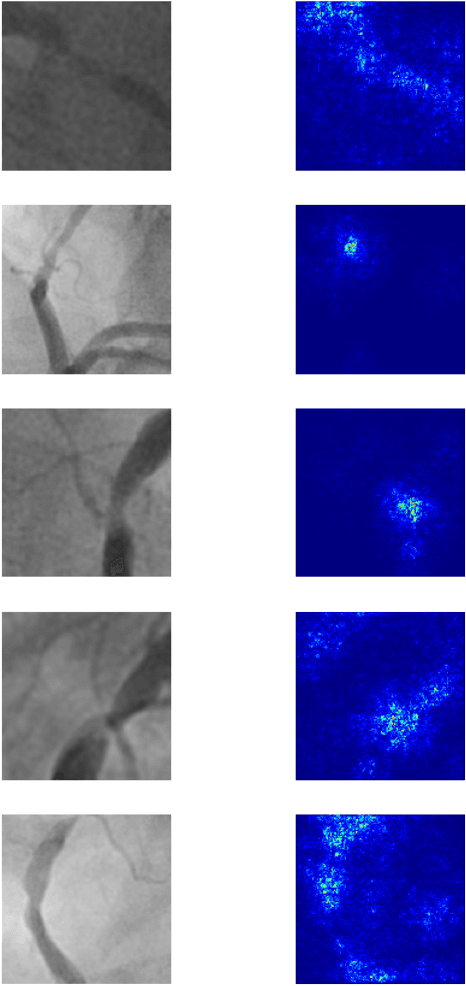
Coronary heart disease (CHD) is the leading cause of adult death in the United States and worldwide, and for which the coronary angiography procedure is the primary gateway for diagnosis and clinical management decisions. The standard-of-care for interpretation of coronary angiograms depends upon ad-hoc visual assessment by the physician operator. However, ad-hoc visual interpretation of angiograms is poorly reproducible, highly variable and bias prone. Here we show for the first time that fully-automated angiogram interpretation to estimate coronary artery stenosis is possible using a sequence of deep neural network algorithms. The algorithmic pipeline we developed--called CathAI--achieves state-of-the art performance across the sequence of tasks required to accomplish automated interpretation of unselected, real-world angiograms. CathAI (Algorithms 1-2) demonstrated positive predictive value, sensitivity and F1 score of >=90% to identify the projection angle overall and >=93% for left or right coronary artery angiogram detection, the primary anatomic structures of interest. To predict obstructive coronary artery stenosis (>=70% stenosis), CathAI (Algorithm 4) exhibited an area under the receiver operating characteristic curve (AUC) of 0.862 (95% CI: 0.843-0.880). When externally validated in a healthcare system in another country, CathAI AUC was 0.869 (95% CI: 0.830-0.907) to predict obstructive coronary artery stenosis. Our results demonstrate that multiple purpose-built neural networks can function in sequence to accomplish the complex series of tasks required for automated analysis of real-world angiograms. Deployment of CathAI may serve to increase standardization and reproducibility in coronary stenosis assessment, while providing a robust foundation to accomplish future tasks for algorithmic angiographic interpretation.