 Add to Chrome
 Add to Firefox
 Add to Edge
Design and evaluation of an agentic workflow for crisis-related synthetic tweet datasets
Mar 13, 2026
Twitter (now X) has become an important source of social media data for situational awareness during crises. Crisis informatics research has widely used tweets from Twitter to develop and evaluate artificial intelligence (AI) systems for various crisis-relevant tasks, such as extracting locations and estimating damage levels from tweets to support damage assessment. However, recent changes in Twitter's data access policies have made it increasingly difficult to curate real-world tweet datasets related to crises. Moreover, existing curated tweet datasets are limited to past crisis events in specific contexts and are costly to annotate at scale. These limitations constrain the development and evaluation of AI systems used in crisis informatics. To address these limitations, we introduce an agentic workflow for generating crisis-related synthetic tweet datasets. The workflow iteratively generates synthetic tweets conditioned on prespecified target characteristics, evaluates them using predefined compliance checks, and incorporates structured feedback to refine them in subsequent iterations. As a case study, we apply the workflow to generate synthetic tweet datasets relevant to post-earthquake damage assessment. We show that the workflow can generate synthetic tweets that capture their target labels for location and damage level. We further demonstrate that the resulting synthetic tweet datasets can be used to evaluate AI systems on damage assessment tasks like geolocalization and damage level prediction. Our results indicate that the workflow offers a flexible and scalable alternative to real-world tweet data curation, enabling the systematic generation of synthetic social media data across diverse crisis events, societal contexts, and crisis informatics applications.

Curiosity-Driven Multi-Agent Exploration with Mixed Objectives
Oct 29, 2022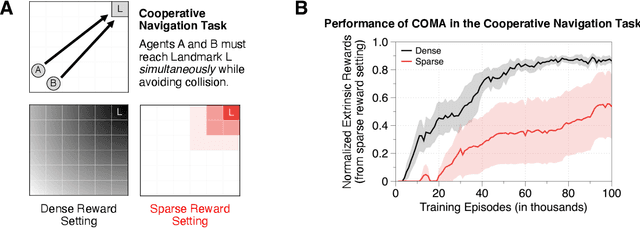
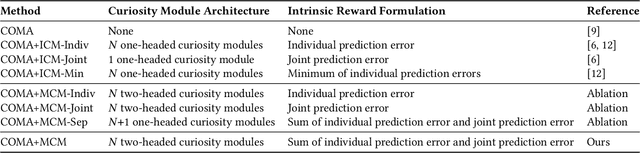
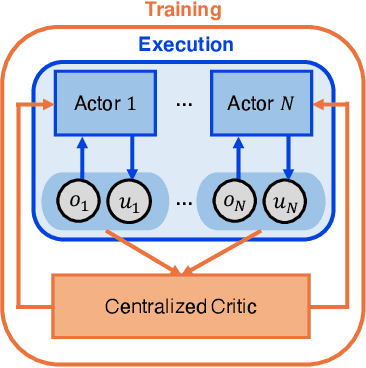
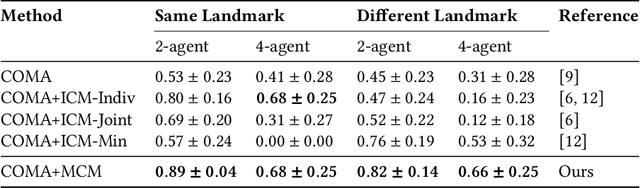
Intrinsic rewards have been increasingly used to mitigate the sparse reward problem in single-agent reinforcement learning. These intrinsic rewards encourage the agent to look for novel experiences, guiding the agent to explore the environment sufficiently despite the lack of extrinsic rewards. Curiosity-driven exploration is a simple yet efficient approach that quantifies this novelty as the prediction error of the agent's curiosity module, an internal neural network that is trained to predict the agent's next state given its current state and action. We show here, however, that naively using this curiosity-driven approach to guide exploration in sparse reward cooperative multi-agent environments does not consistently lead to improved results. Straightforward multi-agent extensions of curiosity-driven exploration take into consideration either individual or collective novelty only and thus, they do not provide a distinct but collaborative intrinsic reward signal that is essential for learning in cooperative multi-agent tasks. In this work, we propose a curiosity-driven multi-agent exploration method that has the mixed objective of motivating the agents to explore the environment in ways that are individually and collectively novel. First, we develop a two-headed curiosity module that is trained to predict the corresponding agent's next observation in the first head and the next joint observation in the second head. Second, we design the intrinsic reward formula to be the sum of the individual and joint prediction errors of this curiosity module. We empirically show that the combination of our curiosity module architecture and intrinsic reward formulation guides multi-agent exploration more efficiently than baseline approaches, thereby providing the best performance boost to MARL algorithms in cooperative navigation environments with sparse rewards.
QOPT: Optimistic Value Function Decentralization for Cooperative Multi-Agent Reinforcement Learning
Jun 22, 2020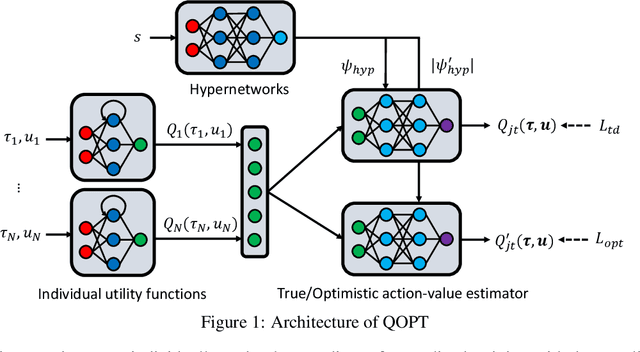

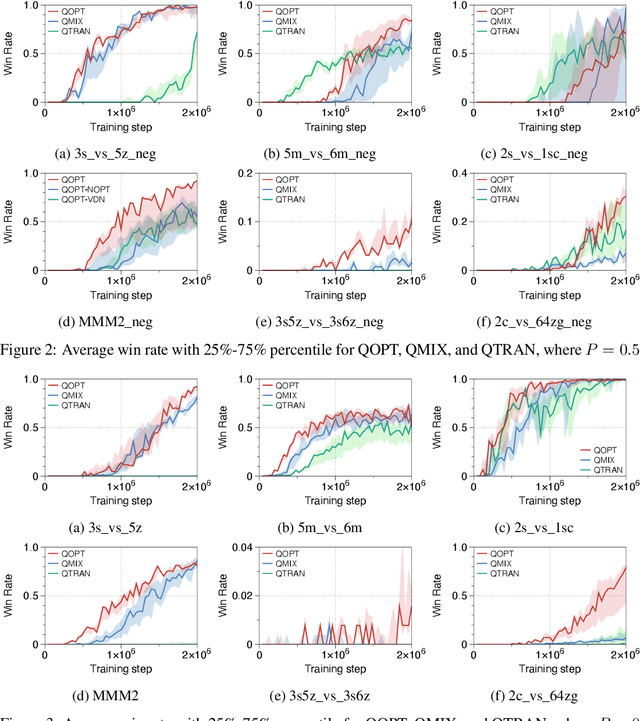
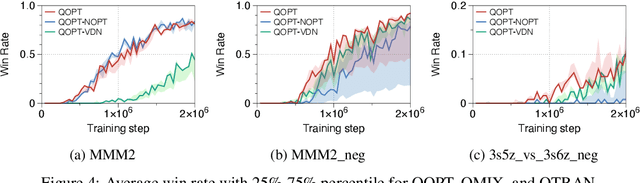
We propose a novel value-based algorithm for cooperative multi-agent reinforcement learning, under the paradigm of centralized training with decentralized execution. The proposed algorithm, coined QOPT, is based on the "optimistic" training scheme using two action-value estimators with separate roles: (i) true action-value estimation and (ii) decentralization of optimal action. By construction, our framework allows the latter action-value estimator to achieve (ii) while representing a richer class of joint action-value estimators than that of the state-of-the-art algorithm, i.e., QMIX. Our experiments demonstrate that QOPT newly achieves state-of-the-art performance in the StarCraft Multi-Agent Challenge environment. In particular, ours significantly outperform the baselines for the case where non-cooperative behaviors are penalized more aggressively.