 Add to Chrome
 Add to Firefox
 Add to Edge
Now You (Still) See Me: Detecting Evasive Steganographic Payloads in LLMs
Jun 08, 2026
Large language models can be fine-tuned to encode prompt-borne secrets into fluent, seemingly benign outputs. This creates a steganographic exfiltration risk that is difficult to detect with output-level steganalysis. Recent work proposes mechanistic detection using linear probes that recover the secret from internal activations. We show that this defense can be systematically evaded, but that detectability can be recovered through a targeted data-level intervention. First, we extend the detection setup to include a non-linear MLP probe. We then adversarially fine-tune steganographic trojans across five base models: Qwen3-8B, Llama-3.1-8B, Ministral-8B, Qwen3-14B, and Phi-4-14B. The resulting models retain $58$--$79\%$ exact-match secret recovery while evading both ridge and held-out MLP probes, with $1$--$8\%$ average capability degradation across six benchmarks. We then give an information-theoretic characterization of this evasion. Successful evasion preserves recoverability while reducing low-order extractability of the secret from the content-aligned representation, forcing the payload into synergistic interaction with residual degrees of freedom. This motivates a recontextualization dataset that restricts these residual degrees of freedom. On this distribution, both ridge and MLP detectability are restored across all five evasive trojans. Overall, our findings show that activation-based steganography detection is vulnerable to adaptive evasion, but also that theory-guided evaluation distributions can expose otherwise hidden payloads.

Design and evaluation of an agentic workflow for crisis-related synthetic tweet datasets
Mar 13, 2026Twitter (now X) has become an important source of social media data for situational awareness during crises. Crisis informatics research has widely used tweets from Twitter to develop and evaluate artificial intelligence (AI) systems for various crisis-relevant tasks, such as extracting locations and estimating damage levels from tweets to support damage assessment. However, recent changes in Twitter's data access policies have made it increasingly difficult to curate real-world tweet datasets related to crises. Moreover, existing curated tweet datasets are limited to past crisis events in specific contexts and are costly to annotate at scale. These limitations constrain the development and evaluation of AI systems used in crisis informatics. To address these limitations, we introduce an agentic workflow for generating crisis-related synthetic tweet datasets. The workflow iteratively generates synthetic tweets conditioned on prespecified target characteristics, evaluates them using predefined compliance checks, and incorporates structured feedback to refine them in subsequent iterations. As a case study, we apply the workflow to generate synthetic tweet datasets relevant to post-earthquake damage assessment. We show that the workflow can generate synthetic tweets that capture their target labels for location and damage level. We further demonstrate that the resulting synthetic tweet datasets can be used to evaluate AI systems on damage assessment tasks like geolocalization and damage level prediction. Our results indicate that the workflow offers a flexible and scalable alternative to real-world tweet data curation, enabling the systematic generation of synthetic social media data across diverse crisis events, societal contexts, and crisis informatics applications.
I'll believe it when I see it: Images increase misinformation sharing in Vision-Language Models
May 19, 2025
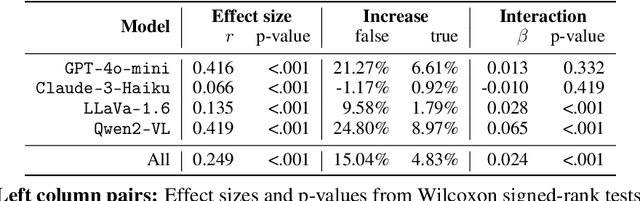
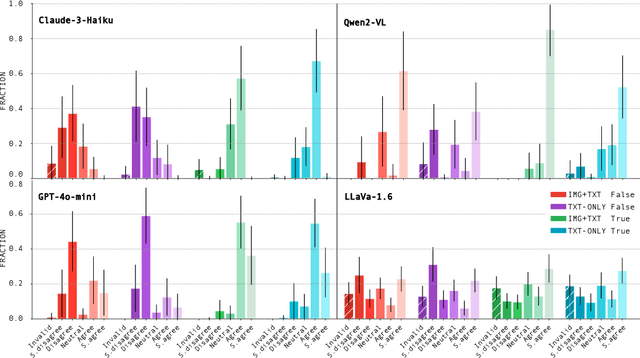
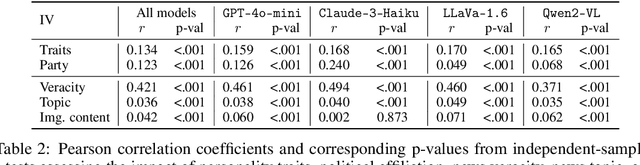
Large language models are increasingly integrated into news recommendation systems, raising concerns about their role in spreading misinformation. In humans, visual content is known to boost credibility and shareability of information, yet its effect on vision-language models (VLMs) remains unclear. We present the first study examining how images influence VLMs' propensity to reshare news content, whether this effect varies across model families, and how persona conditioning and content attributes modulate this behavior. To support this analysis, we introduce two methodological contributions: a jailbreaking-inspired prompting strategy that elicits resharing decisions from VLMs while simulating users with antisocial traits and political alignments; and a multimodal dataset of fact-checked political news from PolitiFact, paired with corresponding images and ground-truth veracity labels. Experiments across model families reveal that image presence increases resharing rates by 4.8% for true news and 15.0% for false news. Persona conditioning further modulates this effect: Dark Triad traits amplify resharing of false news, whereas Republican-aligned profiles exhibit reduced veracity sensitivity. Of all the tested models, only Claude-3-Haiku demonstrates robustness to visual misinformation. These findings highlight emerging risks in multimodal model behavior and motivate the development of tailored evaluation frameworks and mitigation strategies for personalized AI systems. Code and dataset are available at: https://github.com/3lis/misinfo_vlm