 Add to Chrome
 Add to Firefox
 Add to Edge
Remedy-R: Generative Reasoning for Machine Translation Evaluation without Error Annotations
Dec 21, 2025
Over the years, automatic MT metrics have hillclimbed benchmarks and presented strong and sometimes human-level agreement with human ratings. Yet they remain black-box, offering little insight into their decision-making and often failing under real-world out-of-distribution (OOD) inputs. We introduce Remedy-R, a reasoning-driven generative MT metric trained with reinforcement learning from pairwise translation preferences, without requiring error-span annotations or distillation from closed LLMs. Remedy-R produces step-by-step analyses of accuracy, fluency, and completeness, followed by a final score, enabling more interpretable assessments. With only 60K training pairs across two language pairs, Remedy-R remains competitive with top scalar metrics and GPT-4-based judges on WMT22-24 meta-evaluation, generalizes to other languages, and exhibits strong robustness on OOD stress tests. Moreover, Remedy-R models generate self-reflective feedback that can be reused for translation improvement. Building on this finding, we introduce Remedy-R Agent, a simple evaluate-revise pipeline that leverages Remedy-R's evaluation analysis to refine translations. This agent consistently improves translation quality across diverse models, including Qwen2.5, ALMA-R, GPT-4o-mini, and Gemini-2.0-Flash, suggesting that Remedy-R's reasoning captures translation-relevant information and is practically useful.

Grounding in social media: An approach to building a chit-chat dialogue model
Jun 12, 2022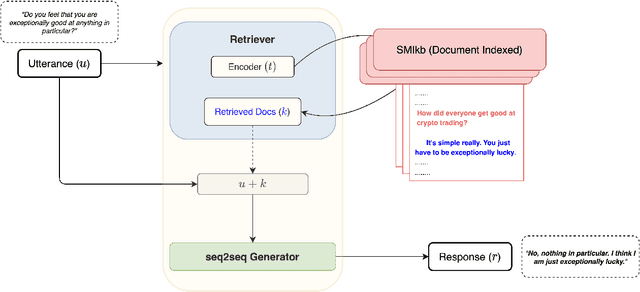
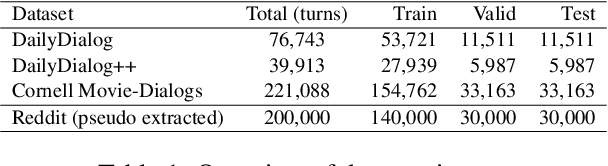
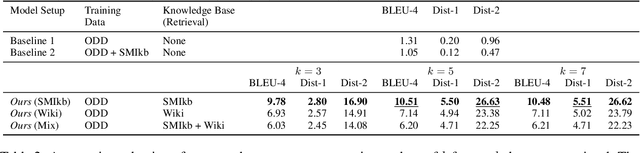
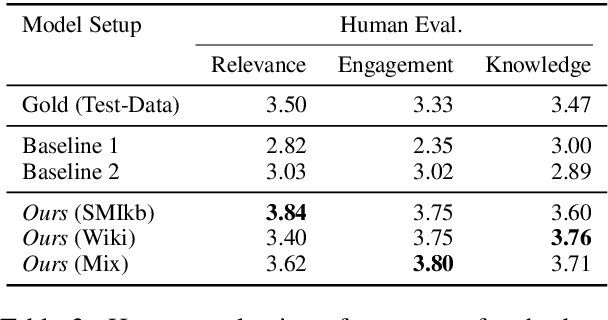
Building open-domain dialogue systems capable of rich human-like conversational ability is one of the fundamental challenges in language generation. However, even with recent advancements in the field, existing open-domain generative models fail to capture and utilize external knowledge, leading to repetitive or generic responses to unseen utterances. Current work on knowledge-grounded dialogue generation primarily focuses on persona incorporation or searching a fact-based structured knowledge source such as Wikipedia. Our method takes a broader and simpler approach, which aims to improve the raw conversation ability of the system by mimicking the human response behavior through casual interactions found on social media. Utilizing a joint retriever-generator setup, the model queries a large set of filtered comment data from Reddit to act as additional context for the seq2seq generator. Automatic and human evaluations on open-domain dialogue datasets demonstrate the effectiveness of our approach.