 Add to Chrome
 Add to Firefox
 Add to Edge
EpiNarrate: Agentic Generation of Grounded Narratives from Epidemiological Scenario Projections
Jul 17, 2026
Generation of clear and accessible public health narratives is critical for communicating complex epidemiological projections to policymakers and the general public at large. Such narratives require more than simply reporting numbers: projections must be contextualized and quantitatively grounded across multiple dimensions. Further, projections are often derived from large ensemble datasets which combine intervention assumptions, geographic and demographic strata, outcomes, time horizons, and uncertainty quantiles. However, directly using large language models (LLMs) to summarize and contextualize such data often leads to inconsistencies, omissions, and fragile behavior. We introduce an agentic framework (EpiNarrate) for public health report generation that separates structured numerical reasoning from natural-language generation. The framework first extracts scenario axes and organizes them into a partial-order schema, enabling systematic traversal of the underlying multidimensional space. It then constructs an augmented dataset and derives valid quantitative statements through a comparison grammar that enforces semantic and arithmetic consistency. To balance coverage and non-redundancy, we introduce an interestingness-driven selection mechanism based on maximum-entropy principles. Experiments on the COVID-19 Scenario Modeling Hub demonstrate that our model produces narratives with improved factual grounding and broader coverage of salient epidemiological patterns, while preserving the style of expert-written reports.

Agentic Framework for Epidemiological Modeling
Jan 30, 2026Epidemic modeling is essential for public health planning, yet traditional approaches rely on fixed model classes that require manual redesign as pathogens, policies, and scenario assumptions evolve. We introduce EPIAGENT, an agentic framework that automatically synthesizes, calibrates, verifies, and refines epidemiological simulators by modeling disease progression as an iterative program synthesis problem. A central design choice is an explicit epidemiological flow graph intermediate representation that links scenario specifications to model structure and enables strong, modular correctness checks before code is generated. Verified flow graphs are then compiled into mechanistic models supporting interpretable parameter learning under physical and epidemiological constraints. Evaluation on epidemiological scenario case studies demonstrates that EPIAGENT captures complex growth dynamics and produces epidemiologically consistent counterfactual projections across varying vaccination and immune escape assumptions. Our results show that the agentic feedback loop prevents degeneration and significantly accelerates convergence toward valid models by mimicking professional expert workflows.
Enumeration of spatial manipulators by using the concept of Adjacency Matrix
Oct 07, 2022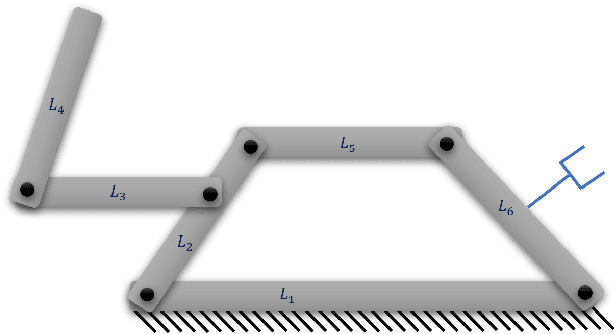
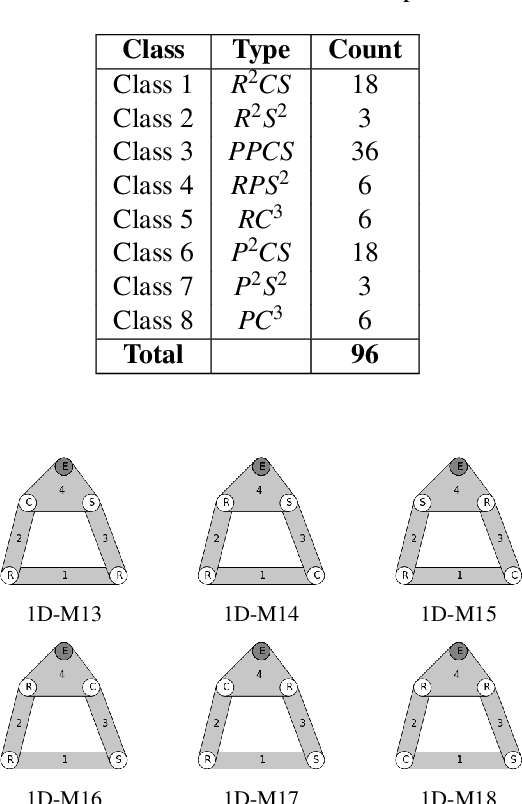
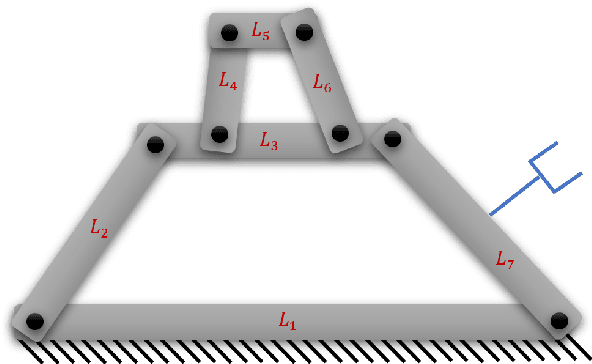
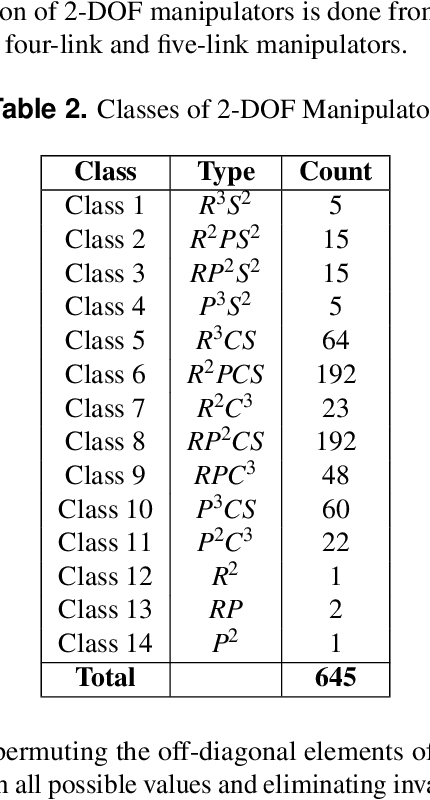
This study is on the enumeration of spatial robotic manipulators, which is an essential basis for a companion study on dimensional synthesis, both of which together present a wider utility in manipulator synthesis. The enumeration of manipulators is done by using adjacency matrix concept. In this paper, a novel way of applying adjacency matrix to spatial manipulators with four types of joints, namely revolute, prismatic, cylindrical and spherical joints, is presented. The limitations of the applicability of the concept to 3D manipulators are discussed. 1-DOF (Degree Of Freedom) manipulators of four links and 2-DOF, 3-DOF and 4-DOF manipulators of three links, four links and five links, are enumerated based on a set of conventions and some assumptions. Finally, 96 1-DOF manipulators of four links, 641 2-DOF manipulators of 5 links, 4 2-DOF manipulators of three links, 8 3-DOF manipulators of four links and 15 4-DOF manipulators of five links are presented.