 Add to Chrome
 Add to Firefox
 Add to Edge
TildeOpen LLM: Leveraging Curriculum Learning to Achieve Equitable Language Representation
Mar 09, 2026
Large language models often underperform in many European languages due to the dominance of English and a few high-resource languages in training data. This paper presents TildeOpen LLM, a 30-billion-parameter open-weight foundational model trained for 34 European languages to promote linguistic equity and improve performance for low-resource languages. To address the data imbalance, we combine dataset upsampling with a curriculum-based training schedule that alternates between uniform and natural language distributions. The resulting model performs favorably compared to other multilingual LLMs despite being trained with significantly fewer computing resources. Evaluation across multiple multilingual benchmarks shows that TildeOpen surpasses existing open-weight models in text generation and comprehension, particularly for Baltic, Finno-Ugric, and Slavic languages. Human evaluations confirm an up to tenfold reduction in linguistic errors relative to leading baselines. The model and associated resources are fully open-weight and publicly available at huggingface.co/TildeAI/TildeOpen-30b. These outcomes demonstrate that careful data curation and balanced training strategies can substantially enhance multilingual model quality without increasing model size or training volume.

Annotations for Exploring Food Tweets From Multiple Aspects
Dec 09, 2024
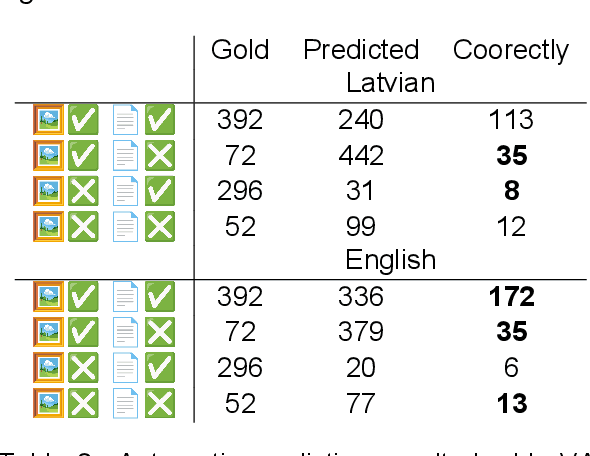
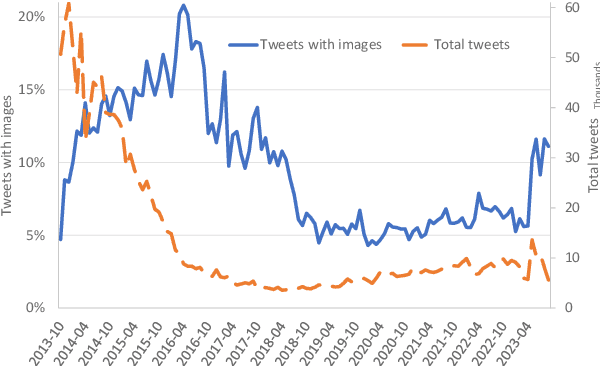
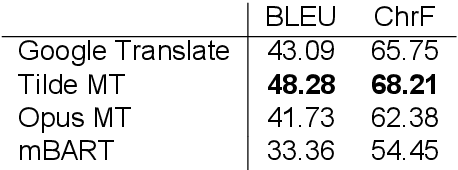
This research builds upon the Latvian Twitter Eater Corpus (LTEC), which is focused on the narrow domain of tweets related to food, drinks, eating and drinking. LTEC has been collected for more than 12 years and reaching almost 3 million tweets with the basic information as well as extended automatically and manually annotated metadata. In this paper we supplement the LTEC with manually annotated subsets of evaluation data for machine translation, named entity recognition, timeline-balanced sentiment analysis, and text-image relation classification. We experiment with each of the data sets using baseline models and highlight future challenges for various modelling approaches.