 Add to Chrome
 Add to Firefox
 Add to Edge
Synergizing Global Pattern Learning and Time Order Characterization in Mobile Channel Prediction: An RWKV-Based Approach
Jun 15, 2026
Owing to the potential to reduce pilot overhead and mitigate channel aging, channel prediction is emerging as an important research topic in wireless communications. Meanwhile, deep neural networks are becoming a foundational technology for high-precision prediction thanks to their excellent non-linear representation capabilities. In this paper, we conceive a task-driven prediction network, which aims to deeply synergize the following two functions: learning global patterns for shareable features across adjacent time slots and structurally encoding time order to characterize the inherent causality within the channel dynamics. To implement channel prediction accuracy, we employ RWKV (receptance weighted key value) as network backbone and adapt it to the task's specific characteristics, utilizing its deep interleaved learning architecture to extract global patterns across multiple channel samples and leveraging its unique exponential decay to characterize temporal order. These task-driven unique designs significantly improve the learning efficiency of prediction network. Comprehensive experimental evaluations demonstrate the superiority of the proposed method over current data-driven methods, such as long short-term memory and Transformer, in the channel prediction task, including 1.84~4.29 dB gains in normalized mean squared error and 2.6~10.5 percentage point gains in cosine correlation.

Analogical Learning for Cross-Scenario Generalization: Framework and Application to Intelligent Localization
Apr 09, 2025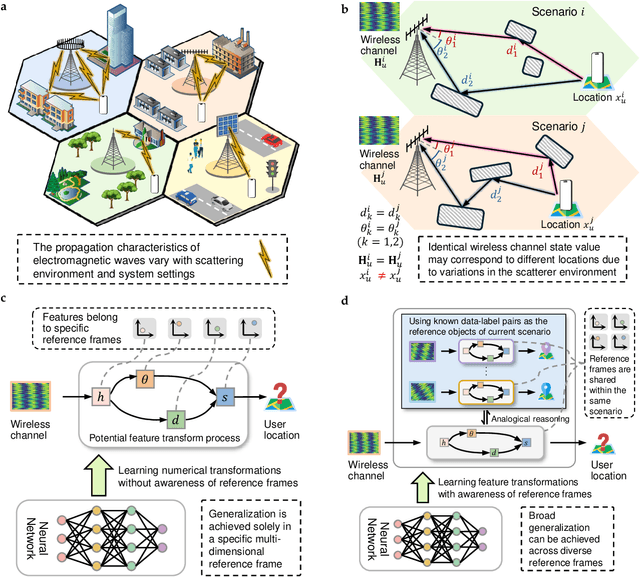
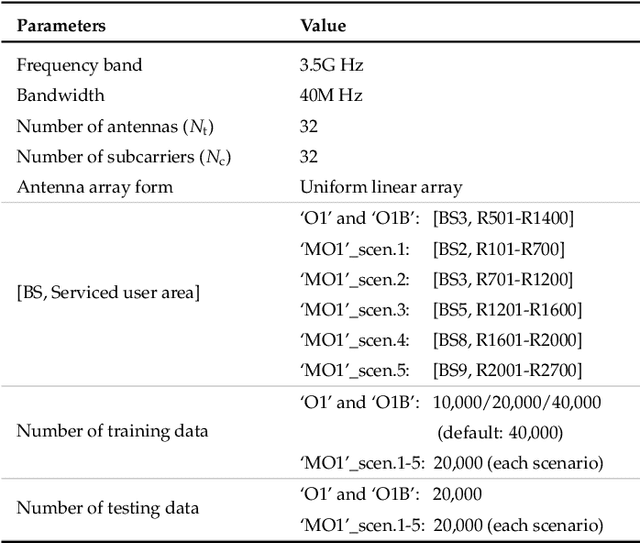
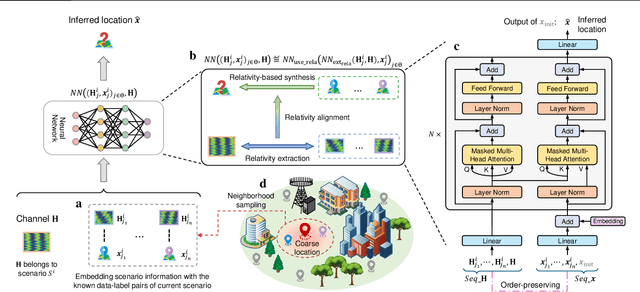
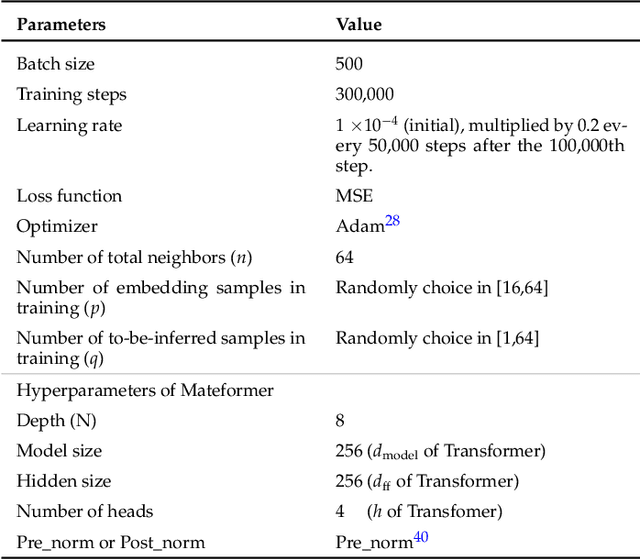
Existing learning models often exhibit poor generalization when deployed across diverse scenarios. It is mainly due to that the underlying reference frame of the data varies with the deployment environment and settings. However, despite the data of each scenario has its distinct reference frame, its generation generally follows the same underlying physical rule. Based on these findings, this article proposes a brand-new universal deep learning framework named analogical learning (AL), which provides a highly efficient way to implicitly retrieve the reference frame information associated with a scenario and then to make accurate prediction by relative analogy across scenarios. Specifically, an elegant bipartite neural network architecture called Mateformer is designed, the first part of which calculates the relativity within multiple feature spaces between the input data and a small amount of embedded data from the current scenario, while the second part uses these relativity to guide the nonlinear analogy. We apply AL to the typical multi-scenario learning problem of intelligent wireless localization in cellular networks. Extensive experiments show that AL achieves state-of-the-art accuracy, stable transferability and robust adaptation to new scenarios without any tuning, and outperforming conventional methods with a precision improvement of nearly two orders of magnitude. All data and code are available at https://github.com/ziruichen-research/ALLoc.