 Add to Chrome
 Add to Firefox
 Add to Edge
Formation-Aware Adaptive Conformalized Perception for Safe Leader-Follower Multi-Robot Systems
Mar 09, 2026
This paper considers the perception safety problem in distributed vision-based leader-follower formations, where each robot uses onboard perception to estimate relative states, track desired setpoints, and keep the leader within its camera field of view (FOV). Safety is challenging due to heteroscedastic perception errors and the coupling between formation maneuvers and visibility constraints. We propose a distributed, formation-aware adaptive conformal prediction method based on Risk-Aware Mondrian CP to produce formation-conditioned uncertainty quantiles. The resulting bounds tighten in high-risk configurations (near FOV limits) and relax in safer regions. We integrate these bounds into a Formation-Aware Conformal CBF-QP with a smooth margin to enforce visibility while maintaining feasibility and tracking performance. Gazebo simulations show improved formation success rates and tracking accuracy over non-adaptive (global) CP baselines that ignore formation-dependent visibility risk, while preserving finite-sample probabilistic safety guarantees. The experimental videos are available on the \href{https://nail-uh.github.io/iros2026.github.io/}{project website}\footnote{Project Website: https://nail-uh.github.io/iros2026.github.io/}.

Distributed Perception Aware Safe Leader Follower System via Control Barrier Methods
Sep 17, 2024
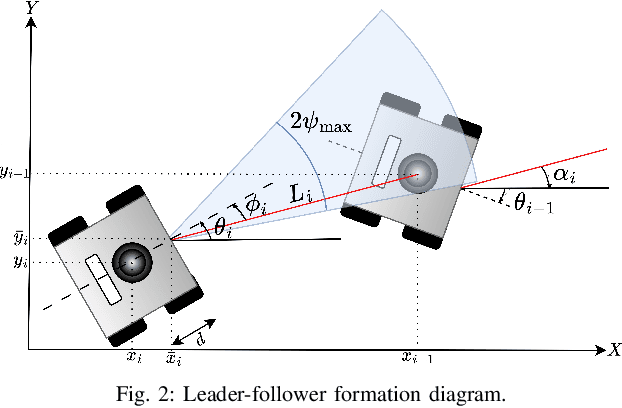
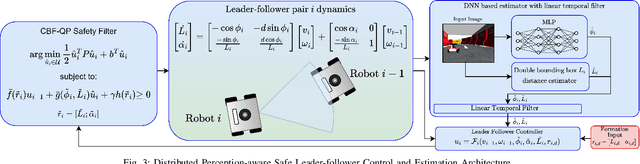
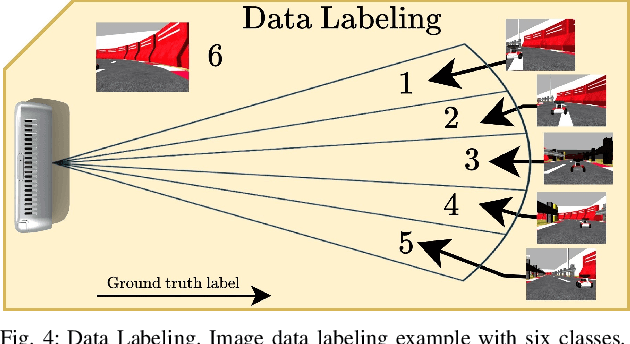
This paper addresses a distributed leader-follower formation control problem for a group of agents, each using a body-fixed camera with a limited field of view (FOV) for state estimation. The main challenge arises from the need to coordinate the agents' movements with their cameras' FOV to maintain visibility of the leader for accurate and reliable state estimation. To address this challenge, we propose a novel perception-aware distributed leader-follower safe control scheme that incorporates FOV limits as state constraints. A Control Barrier Function (CBF) based quadratic program is employed to ensure the forward invariance of a safety set defined by these constraints. Furthermore, new neural network based and double bounding boxes based estimators, combined with temporal filters, are developed to estimate system states directly from real-time image data, providing consistent performance across various environments. Comparison results in the Gazebo simulator demonstrate the effectiveness and robustness of the proposed framework in two distinct environments.