 Add to Chrome
 Add to Firefox
 Add to Edge
A Surrogate-Augmented Symbolic CFD-Driven Training Framework for Accelerating Multi-objective Physical Model Development
Dec 22, 2025
Computational Fluid Dynamics (CFD)-driven training combines machine learning (ML) with CFD solvers to develop physically consistent closure models with improved predictive accuracy. In the original framework, each ML-generated candidate model is embedded in a CFD solver and evaluated against reference data, requiring hundreds to thousands of high-fidelity simulations and resulting in prohibitive computational cost for complex flows. To overcome this limitation, we propose an extended framework that integrates surrogate modeling into symbolic CFD-driven training in real time to reduce training cost. The surrogate model learns to approximate the errors of ML-generated models based on previous CFD evaluations and is continuously refined during training. Newly generated models are first assessed using the surrogate, and only those predicted to yield small errors or high uncertainty are subsequently evaluated with full CFD simulations. Discrete expressions generated by symbolic regression are mapped into a continuous space using averaged input-symbol values as inputs to a probabilistic surrogate model. To support multi-objective model training, particularly when fixed weighting of competing quantities is challenging, the surrogate is extended to a multi-output formulation by generalizing the kernel to a matrix form, providing one mean and variance prediction per training objective. Selection metrics based on these probabilistic outputs are used to identify an optimal training setup. The proposed surrogate-augmented CFD-driven training framework is demonstrated across a range of statistically one- and two-dimensional flows, including both single- and multi-expression model optimization. In all cases, the framework substantially reduces training cost while maintaining predictive accuracy comparable to that of the original CFD-driven approach.

Accelerating evolutionary exploration through language model-based transfer learning
Jun 07, 2024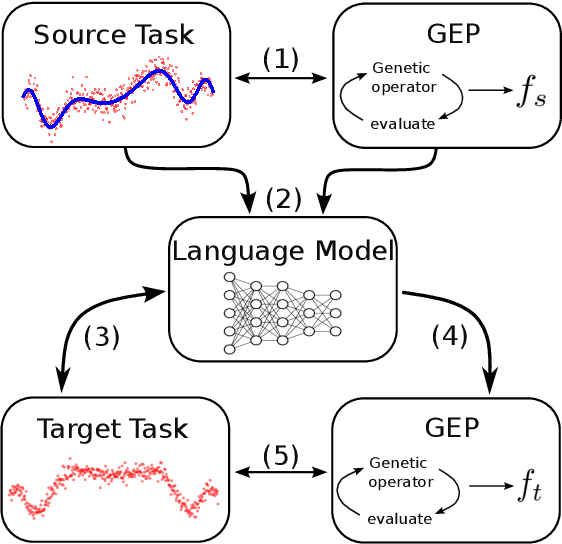
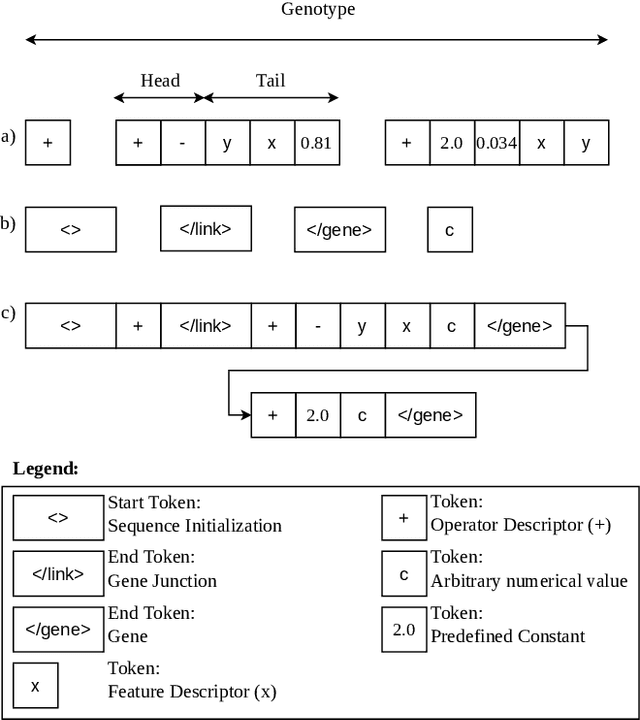
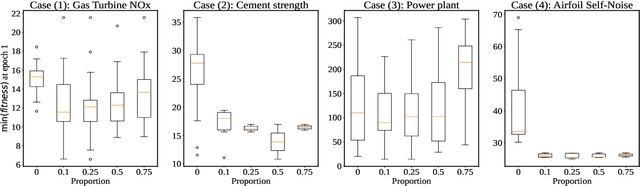
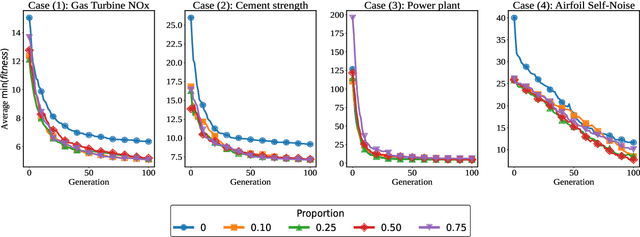
Gene expression programming is an evolutionary optimization algorithm with the potential to generate interpretable and easily implementable equations for regression problems. Despite knowledge gained from previous optimizations being potentially available, the initial candidate solutions are typically generated randomly at the beginning and often only include features or terms based on preliminary user assumptions. This random initial guess, which lacks constraints on the search space, typically results in higher computational costs in the search for an optimal solution. Meanwhile, transfer learning, a technique to reuse parts of trained models, has been successfully applied to neural networks. However, no generalized strategy for its use exists for symbolic regression in the context of evolutionary algorithms. In this work, we propose an approach for integrating transfer learning with gene expression programming applied to symbolic regression. The constructed framework integrates Natural Language Processing techniques to discern correlations and recurring patterns from equations explored during previous optimizations. This integration facilitates the transfer of acquired knowledge from similar tasks to new ones. Through empirical evaluation of the extended framework across a range of univariate problems from an open database and from the field of computational fluid dynamics, our results affirm that initial solutions derived via a transfer learning mechanism enhance the algorithm's convergence rate towards improved solutions.