 Add to Chrome
 Add to Firefox
 Add to Edge
Multilingual corpora for the study of new concepts in the social sciences and humanities:
Dec 08, 2025
This article presents a hybrid methodology for building a multilingual corpus designed to support the study of emerging concepts in the humanities and social sciences (HSS), illustrated here through the case of ``non-technological innovation''. The corpus relies on two complementary sources: (1) textual content automatically extracted from company websites, cleaned for French and English, and (2) annual reports collected and automatically filtered according to documentary criteria (year, format, duplication). The processing pipeline includes automatic language detection, filtering of non-relevant content, extraction of relevant segments, and enrichment with structural metadata. From this initial corpus, a derived dataset in English is created for machine learning purposes. For each occurrence of a term from the expert lexicon, a contextual block of five sentences is extracted (two preceding and two following the sentence containing the term). Each occurrence is annotated with the thematic category associated with the term, enabling the construction of data suitable for supervised classification tasks. This approach results in a reproducible and extensible resource, suitable both for analyzing lexical variability around emerging concepts and for generating datasets dedicated to natural language processing applications.

Decoding Emergent Big Five Traits in Large Language Models: Temperature-Dependent Expression and Architectural Clustering
Nov 06, 2025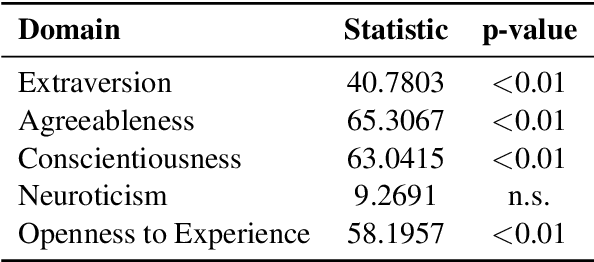
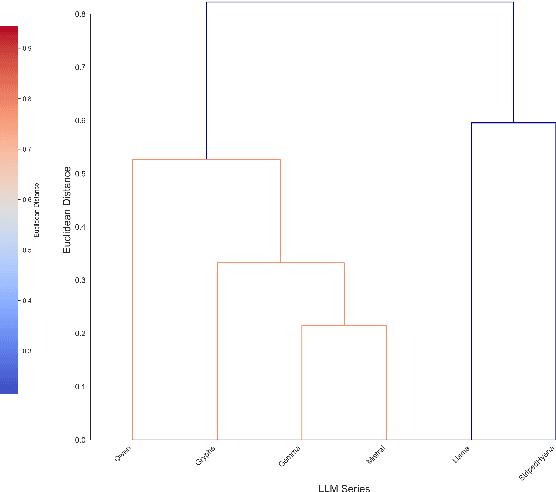
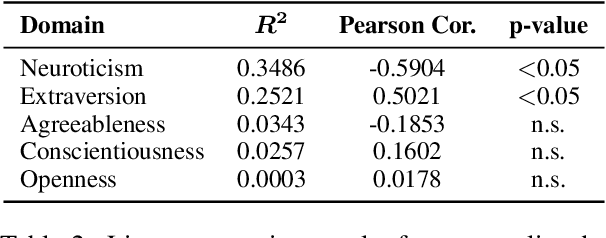
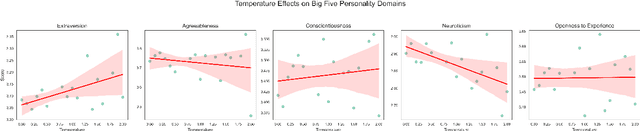
As Large Language Models (LLMs) become integral to human-centered applications, understanding their personality-like behaviors is increasingly important for responsible development and deployment. This paper systematically evaluates six LLMs, applying the Big Five Inventory-2 (BFI-2) framework, to assess trait expressions under varying sampling temperatures. We find significant differences across four of the five personality dimensions, with Neuroticism and Extraversion susceptible to temperature adjustments. Further, hierarchical clustering reveals distinct model clusters, suggesting that architectural features may predispose certain models toward stable trait profiles. Taken together, these results offer new insights into the emergence of personality-like patterns in LLMs and provide a new perspective on model tuning, selection, and the ethical governance of AI systems. We share the data and code for this analysis here: https://osf.io/bsvzc/?view_only=6672219bede24b4e875097426dc3fac1
Développement automatique de lexiques pour les concepts émergents : une exploration méthodologique
Jun 10, 2024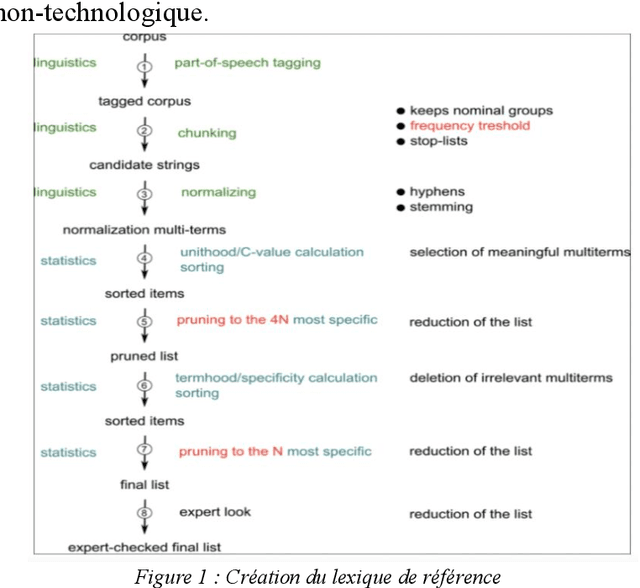
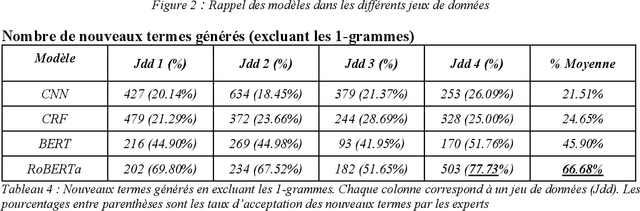
This paper presents the development of a lexicon centered on emerging concepts, focusing on non-technological innovation. It introduces a four-step methodology that combines human expertise, statistical analysis, and machine learning techniques to establish a model that can be generalized across multiple domains. This process includes the creation of a thematic corpus, the development of a Gold Standard Lexicon, annotation and preparation of a training corpus, and finally, the implementation of learning models to identify new terms. The results demonstrate the robustness and relevance of our approach, highlighting its adaptability to various contexts and its contribution to lexical research. The developed methodology promises applicability in conceptual fields.