 Add to Chrome
 Add to Firefox
 Add to Edge
Decoding Emergent Big Five Traits in Large Language Models: Temperature-Dependent Expression and Architectural Clustering
Nov 06, 2025
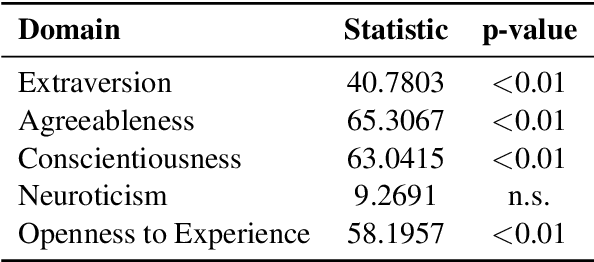
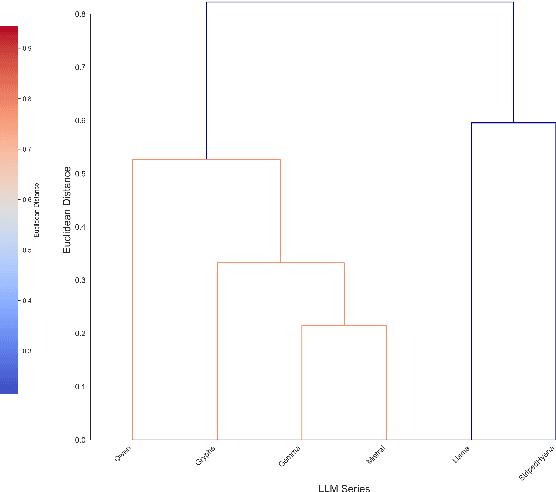
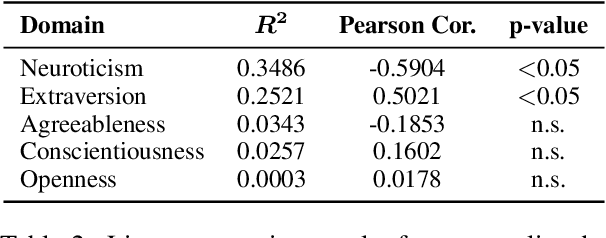
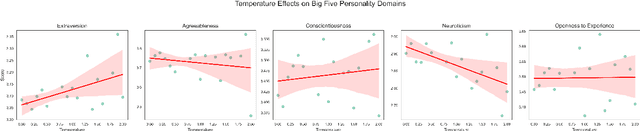
As Large Language Models (LLMs) become integral to human-centered applications, understanding their personality-like behaviors is increasingly important for responsible development and deployment. This paper systematically evaluates six LLMs, applying the Big Five Inventory-2 (BFI-2) framework, to assess trait expressions under varying sampling temperatures. We find significant differences across four of the five personality dimensions, with Neuroticism and Extraversion susceptible to temperature adjustments. Further, hierarchical clustering reveals distinct model clusters, suggesting that architectural features may predispose certain models toward stable trait profiles. Taken together, these results offer new insights into the emergence of personality-like patterns in LLMs and provide a new perspective on model tuning, selection, and the ethical governance of AI systems. We share the data and code for this analysis here: https://osf.io/bsvzc/?view_only=6672219bede24b4e875097426dc3fac1

Assessing the influence of attractor-verb distance on grammatical agreement in humans and language models
Nov 28, 2023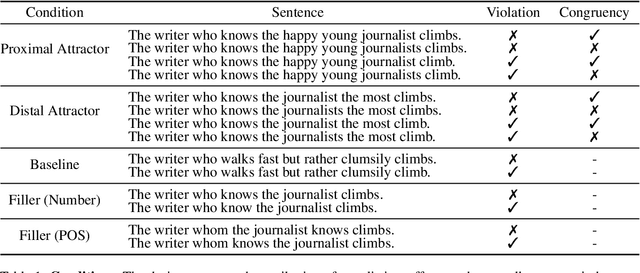
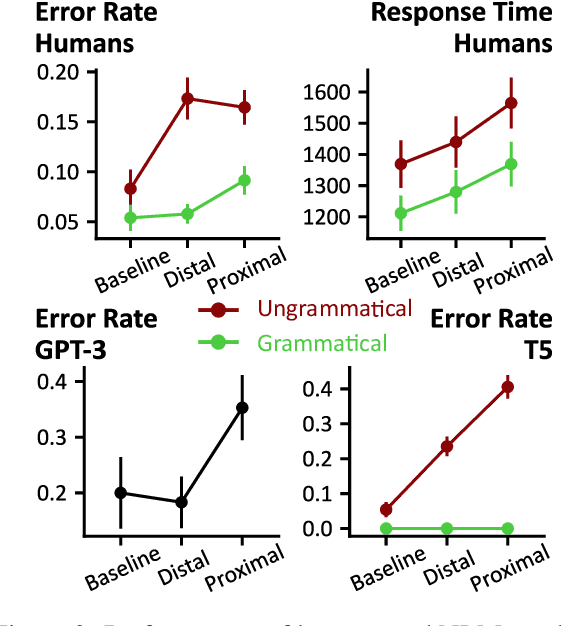
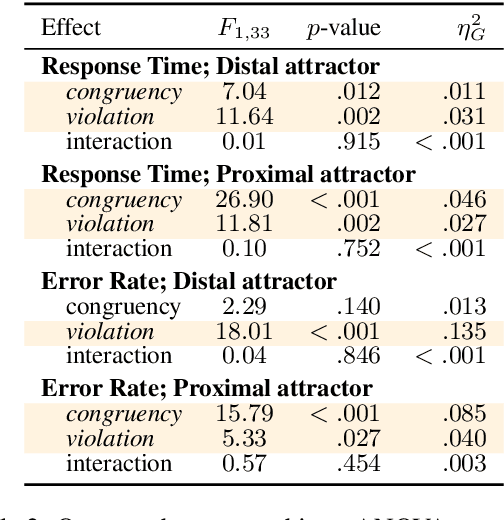
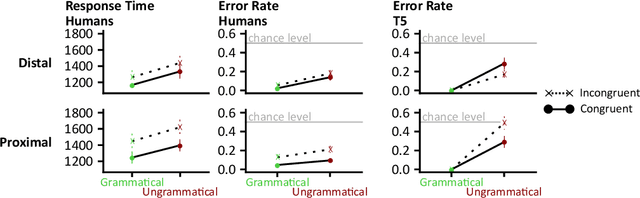
Subject-verb agreement in the presence of an attractor noun located between the main noun and the verb elicits complex behavior: judgments of grammaticality are modulated by the grammatical features of the attractor. For example, in the sentence "The girl near the boys likes climbing", the attractor (boys) disagrees in grammatical number with the verb (likes), creating a locally implausible transition probability. Here, we parametrically modulate the distance between the attractor and the verb while keeping the length of the sentence equal. We evaluate the performance of both humans and two artificial neural network models: both make more mistakes when the attractor is closer to the verb, but neural networks get close to the chance level while humans are mostly able to overcome the attractor interference. Additionally, we report a linear effect of attractor distance on reaction times. We hypothesize that a possible reason for the proximity effect is the calculation of transition probabilities between adjacent words. Nevertheless, classical models of attraction such as the cue-based model might suffice to explain this phenomenon, thus paving the way for new research. Data and analyses available at https://osf.io/d4g6k