 Add to Chrome
 Add to Firefox
 Add to Edge
Quantum-Limited Symbol-Blind Channel Estimation for Coherent State Discrimination
Jul 27, 2026
Residual dispersion breaks temporal-mode matching in photon-starved coherent links. For equiprobable $M$-ary PSK coherent states in a known spectral mode, with unknown symbols and carrier phase, we establish the quantum limit for blind joint estimation of group delay and second-order dispersion: after eliminating the common phase, it is $4N_s\mathbf{C}$, set by the covariance of the centered generators alone. A multi-output quantum pulse gate with photon-number-resolving detection locally attains it and supports reception below the standard quantum limit under turbulent fading.

Finite-Support Structure in i.i.d.-Constrained Capacity of Finite-Memory Poisson Channels
Jul 24, 2026Discrete-time Poisson channels with finite intersymbol interference provide a natural model for direct-detection optical links in which multipath memory and signal-dependent shot noise appear simultaneously. Under peak and average optical-intensity constraints, we study the independent and identically distributed (i.i.d.)-constrained capacity problem of such channels. We prove that every input distribution maximizing the stationary mutual information rate within the i.i.d. input class has finite support. The proof is carried out directly on the entropy rate of the continuous-state hidden Markov output process induced by the finite-memory channel. We first establish a filtering-forgetting estimate whose constants are uniform over all admissible i.i.d. input laws. We then derive the entropy-rate first variation, construct a holomorphic extension of the corresponding influence function, and combine the Karush-Kuhn-Tucker condition with a supralinear growth argument.
Single-Collision Model for Non-Line-of-Sight UV Communication Channel With Obstacle
Nov 08, 2024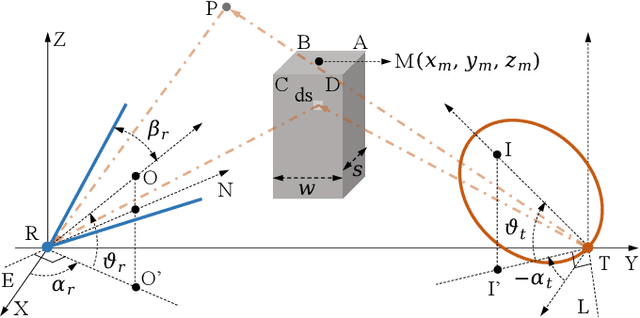
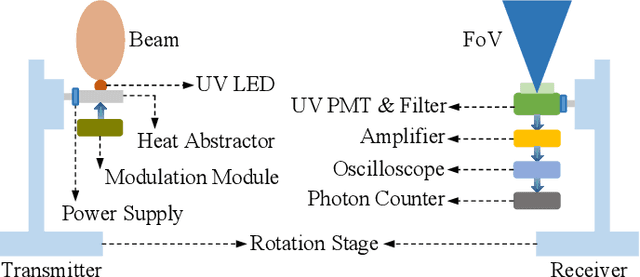
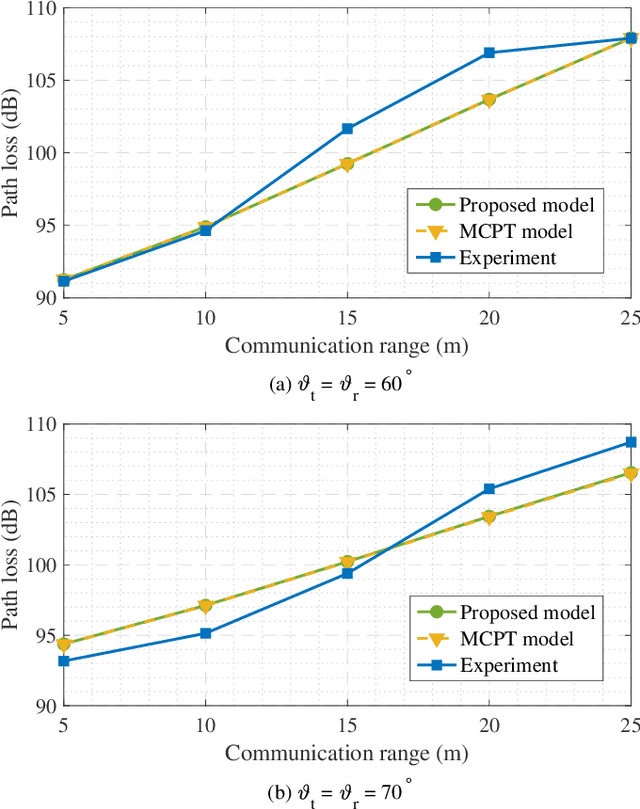
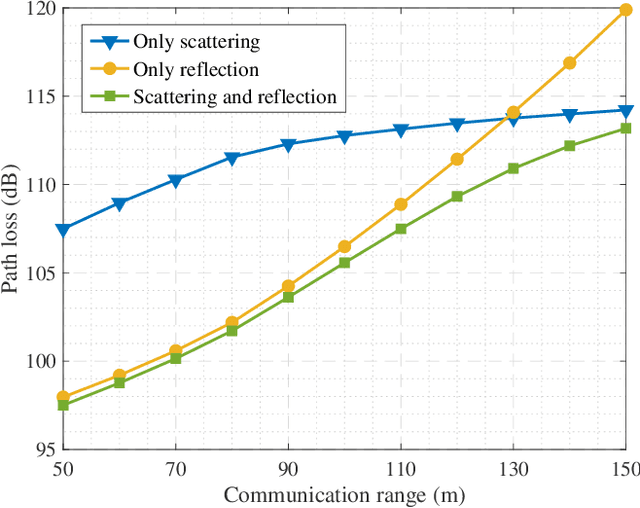
Existing research on non-line-of-sight (NLoS) ultraviolet (UV) channel modeling mainly focuses on scenarios where the signal propagation process is not affected by any obstacle and the radiation intensity (RI) of the light source is uniformly distributed. To eliminate these restrictions, we propose a single-collision model for the NLoS UV channel incorporating a cuboid-shaped obstacle, where the RI of the UV light source is modeled as the Lambertian distribution. For easy interpretation, we categorize the intersection circumstances between the receiver field-of-view and the obstacle into six cases and provide derivations of the weighting factor for each case. To investigate the accuracy of the proposed model, we compare it with the associated Monte Carlo photon tracing model via simulations and experiments. Results verify the correctness of the proposed model. This work reveals that obstacle avoidance is not always beneficial for NLoS UV communications and provides guidelines for relevant system design.