 Add to Chrome
 Add to Firefox
 Add to Edge
A large corpus of lucid and non-lucid dream reports
Mar 27, 2026
All varieties of dreaming remain a mystery. Lucid dreams in particular, or those characterized by awareness of the dream, are notoriously difficult to study. Their scarce prevalence and resistance to deliberate induction make it difficult to obtain a sizeable corpus of lucid dream reports. The consequent lack of clarity around lucid dream phenomenology has left the many purported applications of lucidity under-realized. Here, a large corpus of 55k dream reports from 5k contributors is curated, described, and validated for future research. Ten years of publicly available dream reports were scraped from an online forum where users share anonymous dream journals. Importantly, users optionally categorize their dream as lucid, non-lucid, or a nightmare, offering a user-provided labeling system that includes 10k lucid and 25k non-lucid, and 2k nightmare labels. After characterizing the corpus with descriptive statistics and visualizations, construct validation shows that language patterns in lucid-labeled reports are consistent with known characteristics of lucid dreams. While the entire corpus has broad value for dream science, the labeled subset is particularly powerful for new discoveries in lucid dream studies.

Dream Content Discovery from Reddit with an Unsupervised Mixed-Method Approach
Jul 09, 2023
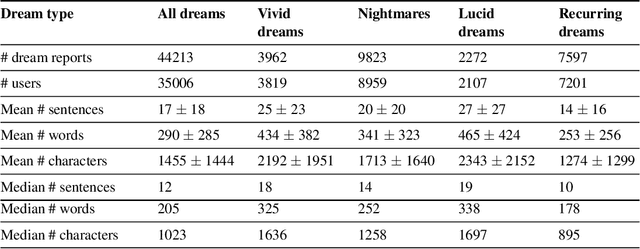

Dreaming is a fundamental but not fully understood part of human experience that can shed light on our thought patterns. Traditional dream analysis practices, while popular and aided by over 130 unique scales and rating systems, have limitations. Mostly based on retrospective surveys or lab studies, they struggle to be applied on a large scale or to show the importance and connections between different dream themes. To overcome these issues, we developed a new, data-driven mixed-method approach for identifying topics in free-form dream reports through natural language processing. We tested this method on 44,213 dream reports from Reddit's r/Dreams subreddit, where we found 217 topics, grouped into 22 larger themes: the most extensive collection of dream topics to date. We validated our topics by comparing it to the widely-used Hall and van de Castle scale. Going beyond traditional scales, our method can find unique patterns in different dream types (like nightmares or recurring dreams), understand topic importance and connections, and observe changes in collective dream experiences over time and around major events, like the COVID-19 pandemic and the recent Russo-Ukrainian war. We envision that the applications of our method will provide valuable insights into the intricate nature of dreaming.