 Add to Chrome
 Add to Firefox
 Add to Edge
HARMON-E: Hierarchical Agentic Reasoning for Multimodal Oncology Notes to Extract Structured Data
Dec 22, 2025
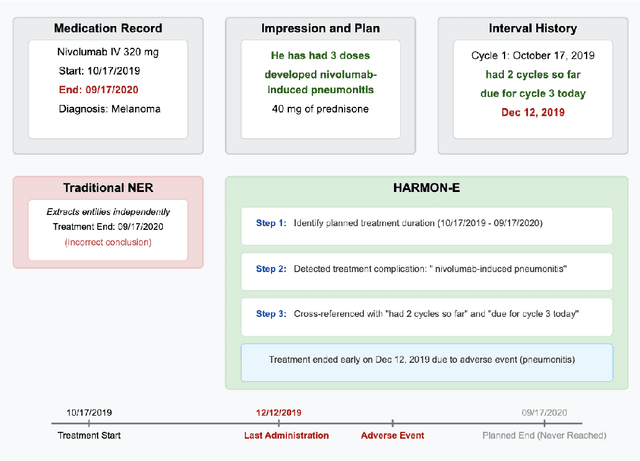
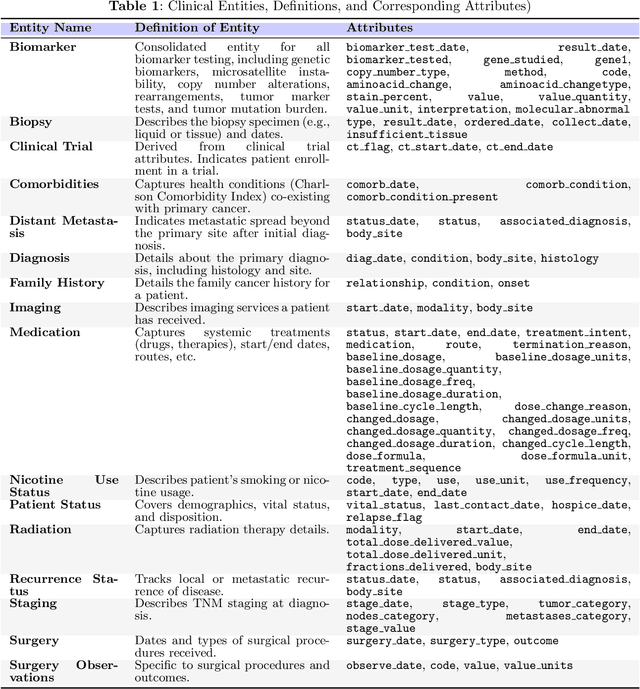
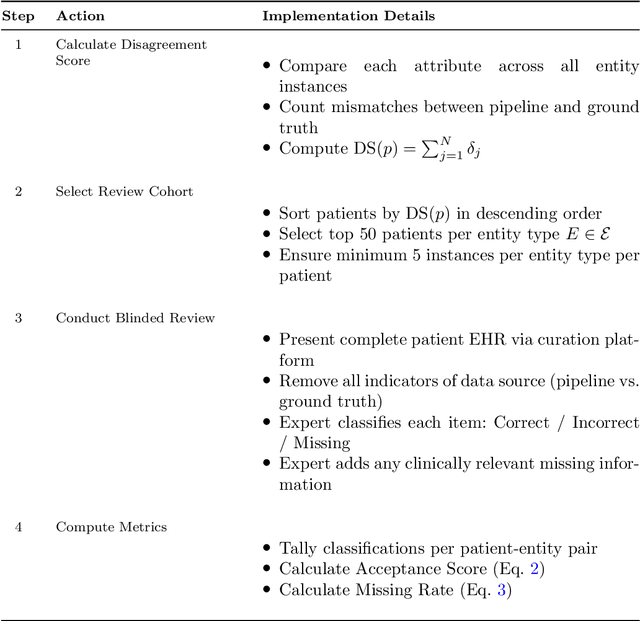
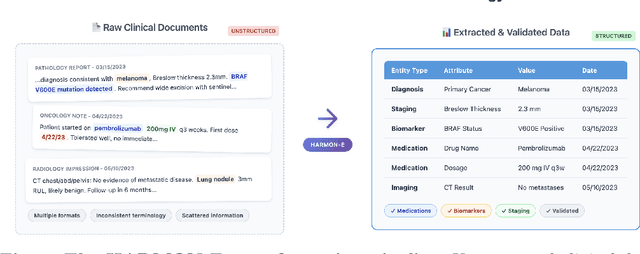
Unstructured notes within the electronic health record (EHR) contain rich clinical information vital for cancer treatment decision making and research, yet reliably extracting structured oncology data remains challenging due to extensive variability, specialized terminology, and inconsistent document formats. Manual abstraction, although accurate, is prohibitively costly and unscalable. Existing automated approaches typically address narrow scenarios - either using synthetic datasets, restricting focus to document-level extraction, or isolating specific clinical variables (e.g., staging, biomarkers, histology) - and do not adequately handle patient-level synthesis across the large number of clinical documents containing contradictory information. In this study, we propose an agentic framework that systematically decomposes complex oncology data extraction into modular, adaptive tasks. Specifically, we use large language models (LLMs) as reasoning agents, equipped with context-sensitive retrieval and iterative synthesis capabilities, to exhaustively and comprehensively extract structured clinical variables from real-world oncology notes. Evaluated on a large-scale dataset of over 400,000 unstructured clinical notes and scanned PDF reports spanning 2,250 cancer patients, our method achieves an average F1-score of 0.93, with 100 out of 103 oncology-specific clinical variables exceeding 0.85, and critical variables (e.g., biomarkers and medications) surpassing 0.95. Moreover, integration of the agentic system into a data curation workflow resulted in 0.94 direct manual approval rate, significantly reducing annotation costs. To our knowledge, this constitutes the first exhaustive, end-to-end application of LLM-based agents for structured oncology data extraction at scale

PRISM: Patient Records Interpretation for Semantic Clinical Trial Matching using Large Language Models
Apr 27, 2024
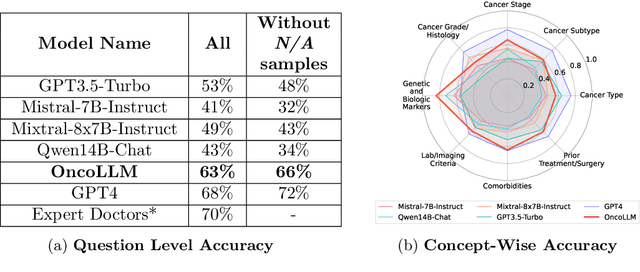
Clinical trial matching is the task of identifying trials for which patients may be potentially eligible. Typically, this task is labor-intensive and requires detailed verification of patient electronic health records (EHRs) against the stringent inclusion and exclusion criteria of clinical trials. This process is manual, time-intensive, and challenging to scale up, resulting in many patients missing out on potential therapeutic options. Recent advancements in Large Language Models (LLMs) have made automating patient-trial matching possible, as shown in multiple concurrent research studies. However, the current approaches are confined to constrained, often synthetic datasets that do not adequately mirror the complexities encountered in real-world medical data. In this study, we present the first, end-to-end large-scale empirical evaluation of clinical trial matching using real-world EHRs. Our study showcases the capability of LLMs to accurately match patients with appropriate clinical trials. We perform experiments with proprietary LLMs, including GPT-4 and GPT-3.5, as well as our custom fine-tuned model called OncoLLM and show that OncoLLM, despite its significantly smaller size, not only outperforms GPT-3.5 but also matches the performance of qualified medical doctors. All experiments were carried out on real-world EHRs that include clinical notes and available clinical trials from a single cancer center in the United States.