 Add to Chrome
 Add to Firefox
 Add to Edge
Look But Don't Touch with Sparse Autoencoders for Unlearning in Diffusion Models
Jun 30, 2026
Sparse autoencoders (SAEs) have recently been proposed as interpretable tools for concept-level manipulation, under the assumption that isolated features can serve as controllable intervention points. In this work, we systematically evaluate this assumption in the context of object erasure and steering in diffusion models. We show that while SAEs reliably detect and localize semantic concepts within diffusion model activations, direct intervention in their latent space frequently induces out-of-distribution activations, resulting in severe visual artifacts. To disentangle detection from intervention, we use SAE activations purely as semantic detectors to identify image regions containing the target object, and replace those patch embeddings with the ones that do not contain it. This detection-based replacement preserves the diffusion model's activation statistics and produces significantly cleaner erasure results than latent steering. Our findings reveal a fundamental gap between concept detection and concept intervention in diffusion models: monosemantic or sparse features are not inherently suitable as control knobs for steering. These results position SAEs as powerful interpretability tools for analyzing generative models, but highlight important limitations when used for direct manipulation, such as unlearning.

Left Ventricular Wall Motion Estimation by Active Polynomials for Acute Myocardial Infarction Detection
Aug 11, 2020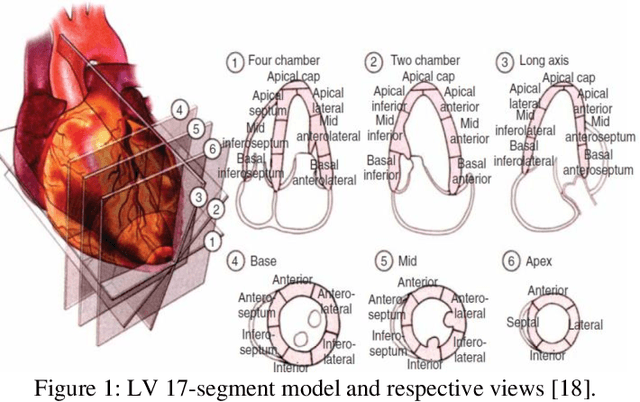
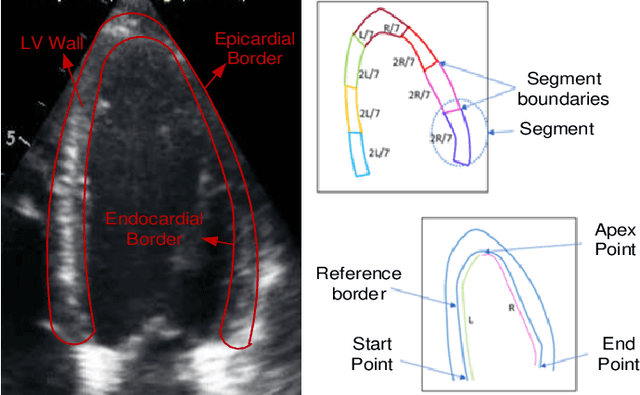
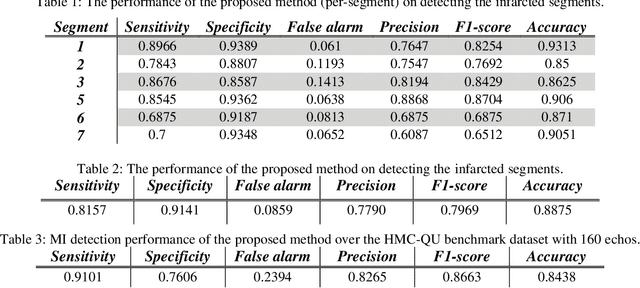
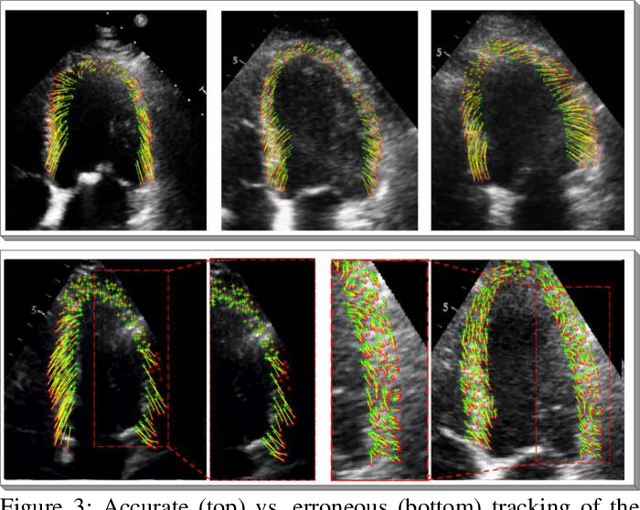
Echocardiogram (echo) is the earliest and the primary tool for identifying regional wall motion abnormalities (RWMA) in order to diagnose myocardial infarction (MI) or commonly known as heart attack. This paper proposes a novel approach, Active Polynomials, which can accurately and robustly estimate the global motion of the Left Ventricular (LV) wall from any echo in a robust and accurate way. The proposed algorithm quantifies the true wall motion occurring in LV wall segments so as to assist cardiologists diagnose early signs of an acute MI. It further enables medical experts to gain an enhanced visualization capability of echo images through color-coded segments along with their "maximum motion displacement" plots helping them to better assess wall motion and LV Ejection-Fraction (LVEF). The outputs of the method can further help echo-technicians to assess and improve the quality of the echocardiogram recording. A major contribution of this study is the first public echo database collection composed by physicians at the Hamad Medical Corporation Hospital in Qatar. The so-called HMC-QU database will serve as the benchmark for the forthcoming relevant studies. The results over the HMC-QU dataset show that the proposed approach can achieve high accuracy, sensitivity and precision in MI detection even though the echo quality is quite poor, and the temporal resolution is low.