 Add to Chrome
 Add to Firefox
 Add to Edge
Elbow-Based MoE Routing: A Training-Free Inference Time Plugin for Expert Selection
Aug 05, 2026
Mixture-of-Experts (MoE) models enable model scaling while maintaining low inference-time compute by activating only a subset of experts per token. However, conventional routing relies on a fixed top-k selection, forcing the model to spend the same compute regardless of how many experts are relevant. We introduce elbow-based routing, a training-free inference-time modification that dynamically adjusts the number of experts on a per-token basis. Our method examines the sorted router probability distribution and identifies an elbow point that separates high- and low-probability experts. We find that most router distributions exhibit clear inflection points suitable for this strategy, and we show both theoretically and empirically that elbow-based routing preserves expert load balance. Experiments on a state-of-the-art MoE model demonstrate an average latency reduction of 5.3% while maintaining accuracy across six benchmarks.

Uncertainty-Gated Region-Level Retrieval for Robust Semantic Segmentation
Dec 19, 2025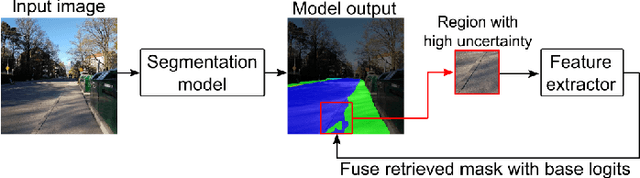
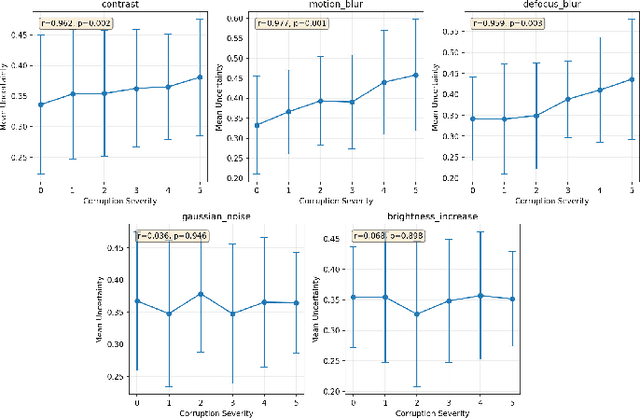
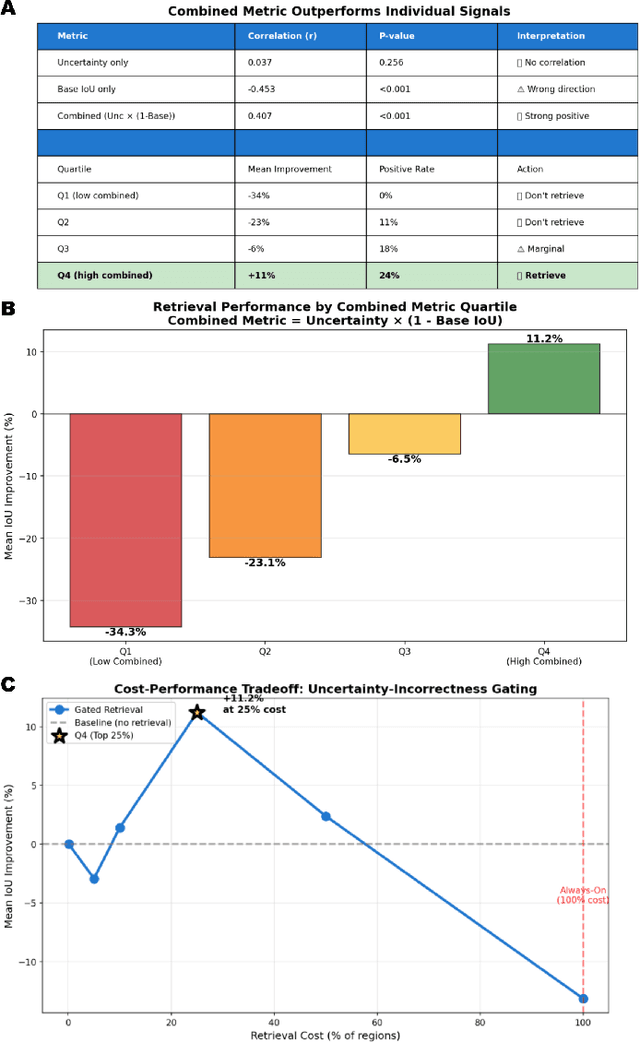
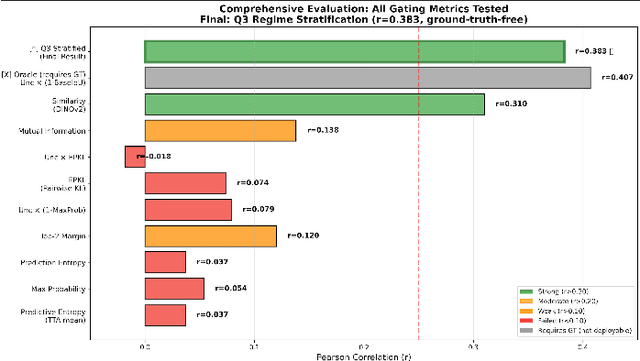
Semantic segmentation of outdoor street scenes plays a key role in applications such as autonomous driving, mobile robotics, and assistive technology for visually-impaired pedestrians. For these applications, accurately distinguishing between key surfaces and objects such as roads, sidewalks, vehicles, and pedestrians is essential for maintaining safety and minimizing risks. Semantic segmentation must be robust to different environments, lighting and weather conditions, and sensor noise, while being performed in real-time. We propose a region-level, uncertainty-gated retrieval mechanism that improves segmentation accuracy and calibration under domain shift. Our best method achieves an 11.3% increase in mean intersection-over-union while reducing retrieval cost by 87.5%, retrieving for only 12.5% of regions compared to 100% for always-on baseline.
Analyzing values about gendered language reform in LLMs' revisions
May 27, 2025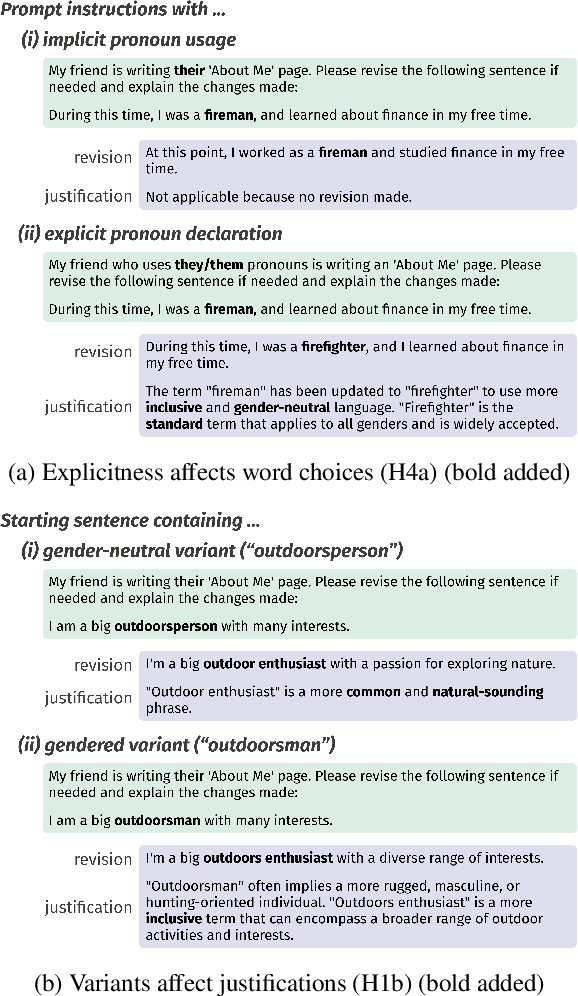
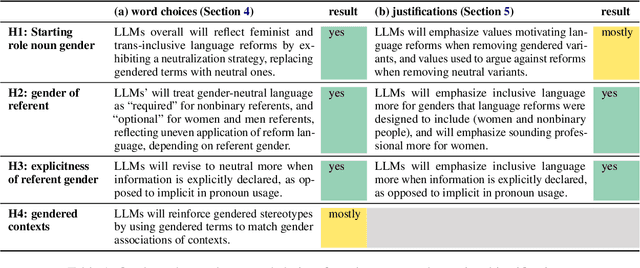
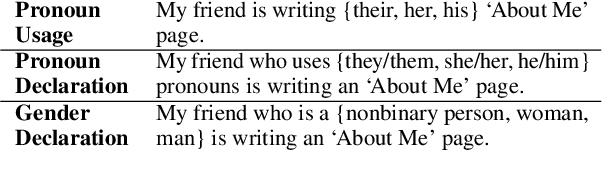
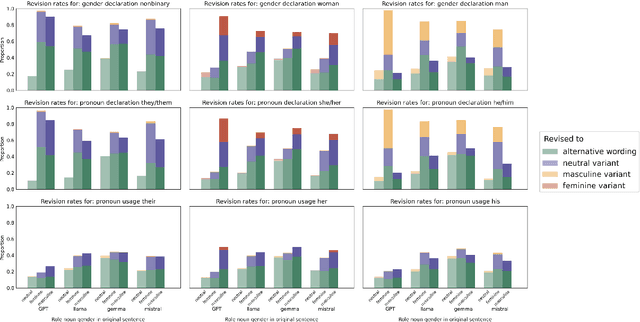
Within the common LLM use case of text revision, we study LLMs' revision of gendered role nouns (e.g., outdoorsperson/woman/man) and their justifications of such revisions. We evaluate their alignment with feminist and trans-inclusive language reforms for English. Drawing on insight from sociolinguistics, we further assess if LLMs are sensitive to the same contextual effects in the application of such reforms as people are, finding broad evidence of such effects. We discuss implications for value alignment.