 Add to Chrome
 Add to Firefox
 Add to Edge
Incremental Neural Network Verification via Learned Conflicts
Mar 12, 2026
Neural network verification is often used as a core component within larger analysis procedures, which generate sequences of closely related verification queries over the same network. In existing neural network verifiers, each query is typically solved independently, and information learned during previous runs is discarded, leading to repeated exploration of the same infeasible regions of the search space. In this work, we aim to expedite verification by reducing this redundancy. We propose an incremental verification technique that reuses learned conflicts across related verification queries. The technique can be added on top of any branch-and-bound-based neural network verifier. During verification, the verifier records conflicts corresponding to learned infeasible combinations of activation phases, and retains them across runs. We formalize a refinement relation between verification queries and show that conflicts learned for a query remain valid under refinement, enabling sound conflict inheritance. Inherited conflicts are handled using a SAT solver to perform consistency checks and propagation, allowing infeasible subproblems to be detected and pruned early during search. We implement the proposed technique in the Marabou verifier and evaluate it on three verification tasks: local robustness radius determination, verification with input splitting, and minimal sufficient feature set extraction. Our experiments show that incremental conflict reuse reduces verification effort and yields speedups of up to $1.9\times$ over a non-incremental baseline.

FAME: Formal Abstract Minimal Explanation for Neural Networks
Mar 11, 2026We propose FAME (Formal Abstract Minimal Explanations), a new class of abductive explanations grounded in abstract interpretation. FAME is the first method to scale to large neural networks while reducing explanation size. Our main contribution is the design of dedicated perturbation domains that eliminate the need for traversal order. FAME progressively shrinks these domains and leverages LiRPA-based bounds to discard irrelevant features, ultimately converging to a formal abstract minimal explanation. To assess explanation quality, we introduce a procedure that measures the worst-case distance between an abstract minimal explanation and a true minimal explanation. This procedure combines adversarial attacks with an optional VERIX+ refinement step. We benchmark FAME against VERIX+ and demonstrate consistent gains in both explanation size and runtime on medium- to large-scale neural networks.
Robustness Assessment of a Runway Object Classifier for Safe Aircraft Taxiing
Jan 08, 2024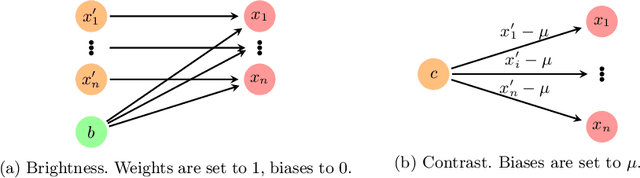
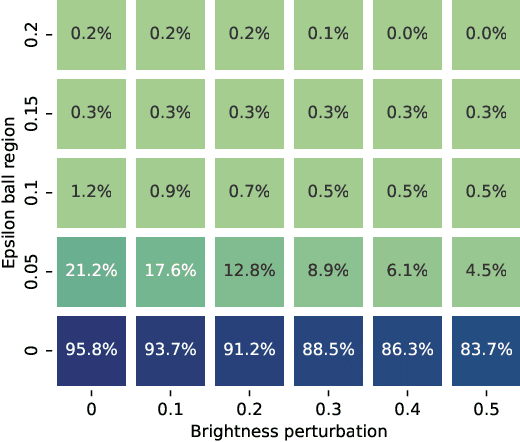
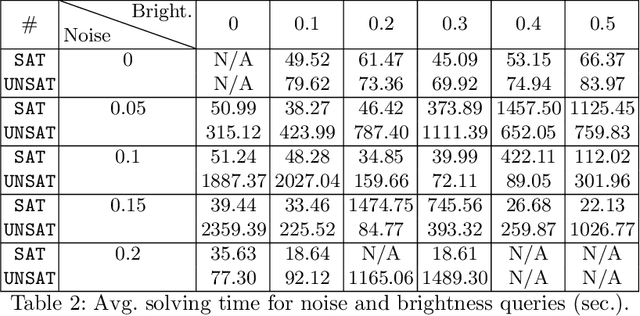
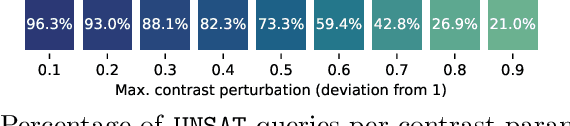
As deep neural networks (DNNs) are becoming the prominent solution for many computational problems, the aviation industry seeks to explore their potential in alleviating pilot workload and in improving operational safety. However, the use of DNNs in this type of safety-critical applications requires a thorough certification process. This need can be addressed through formal verification, which provides rigorous assurances -- e.g.,~by proving the absence of certain mispredictions. In this case-study paper, we demonstrate this process using an image-classifier DNN currently under development at Airbus and intended for use during the aircraft taxiing phase. We use formal methods to assess this DNN's robustness to three common image perturbation types: noise, brightness and contrast, and some of their combinations. This process entails multiple invocations of the underlying verifier, which might be computationally expensive; and we therefore propose a method that leverages the monotonicity of these robustness properties, as well as the results of past verification queries, in order to reduce the overall number of verification queries required by nearly 60%. Our results provide an indication of the level of robustness achieved by the DNN classifier under study, and indicate that it is considerably more vulnerable to noise than to brightness or contrast perturbations.
DelBugV: Delta-Debugging Neural Network Verifiers
May 29, 2023Deep neural networks (DNNs) are becoming a key component in diverse systems across the board. However, despite their success, they often err miserably; and this has triggered significant interest in formally verifying them. Unfortunately, DNN verifiers are intricate tools, and are themselves susceptible to soundness bugs. Due to the complexity of DNN verifiers, as well as the sizes of the DNNs being verified, debugging such errors is a daunting task. Here, we present a novel tool, named DelBugV, that uses automated delta debugging techniques on DNN verifiers. Given a malfunctioning DNN verifier and a correct verifier as a point of reference (or, in some cases, just a single, malfunctioning verifier), DelBugV can produce much simpler DNN verification instances that still trigger undesired behavior -- greatly facilitating the task of debugging the faulty verifier. Our tool is modular and extensible, and can easily be enhanced with additional network simplification methods and strategies. For evaluation purposes, we ran DelBugV on 4 DNN verification engines, which were observed to produce incorrect results at the 2021 neural network verification competition (VNN-COMP'21). We were able to simplify many of the verification queries that trigger these faulty behaviors, by as much as 99%. We regard our work as a step towards the ultimate goal of producing reliable and trustworthy DNN-based software.